 how-to
Honda Civic Air Filter Replacement 2026: Step-by-Step
Table of Contents
- Honda Civic Air Filter Replacement Tools and What You'll Need
- 2026 Honda Civic Engine Air Filter Replacement
- 2026 Honda Civic Cabin Air Filter Replacement
- Honda Civic Air Filter Replacement Interval: When to Change Both Filters
- 2026 Civic Fitment by Trim, Engine, and Hybrid Status
- OEM-Style vs Aftermarket Filters: Part Numbers and What Fits
- Common Mistakes and Post-Installation Checks
- Frequently Asked Questions
Last Updated: October 8, 2026
Honda Civic Air Filter Replacement Tools and What You'll Need
Replacing the Honda Civic air filter on a 2026 model is one of the easiest maintenance jobs you can do yourself, and it needs no special equipment.
Speedy Roo Motorsports has serviced Japanese vehicles since 2002, and the 2026 Civic is one of the friendliest cars to work on.
Here's what most guides get wrong: they treat the engine and cabin filters as separate jobs. Do them together.
Engine Air Filter Tools
The engine side is the simpler job. You need:
- A Phillips-head screwdriver (some trims use clips instead)
- A clean rag
- The replacement engine air filter
No sockets, no ramps, no lifting. The housing sits right on top of the engine.
Cabin Air Filter Tools
The cabin filter job needs even less:
- Your hands (most 2026 Civics need no tools at all)
- A flashlight for tight spaces
- The replacement cabin air filter
Some glovebox designs use a small tab you press by hand. Check your owner's manual if the door feels stuck.
2026 Honda Civic Engine Air Filter Replacement
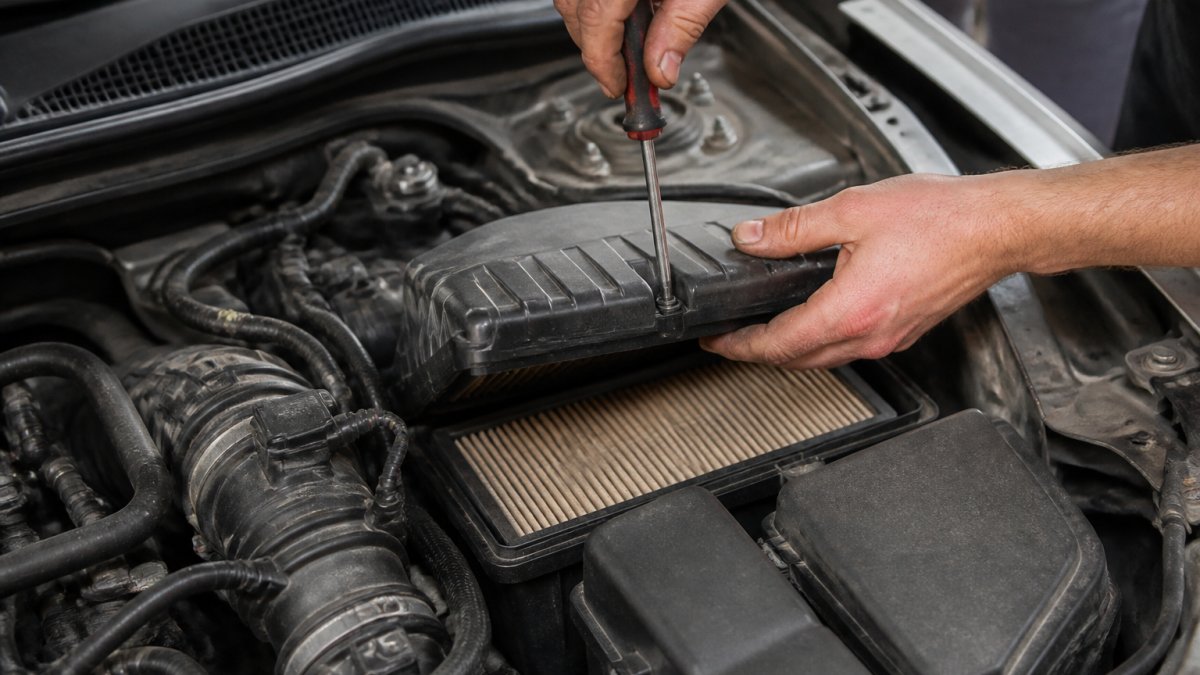
The 2026 Honda Civic engine air filter replacement takes about five minutes and requires only a screwdriver. The filter feeds clean air to your engine intake, and a clogged one robs power and fuel economy. Here are the steps.
Step 1: Locate the Air-Filter Housing
Open the hood and look for a large black plastic box connected to a wide rubber tube. That's the air-filter housing. On the 2.0L engine and the 1.5L turbo, it sits near the front of the engine bay. The filter cover is held by four to six Phillips screws or metal clips.
Step 2: Open the Housing and Remove the Old Filter
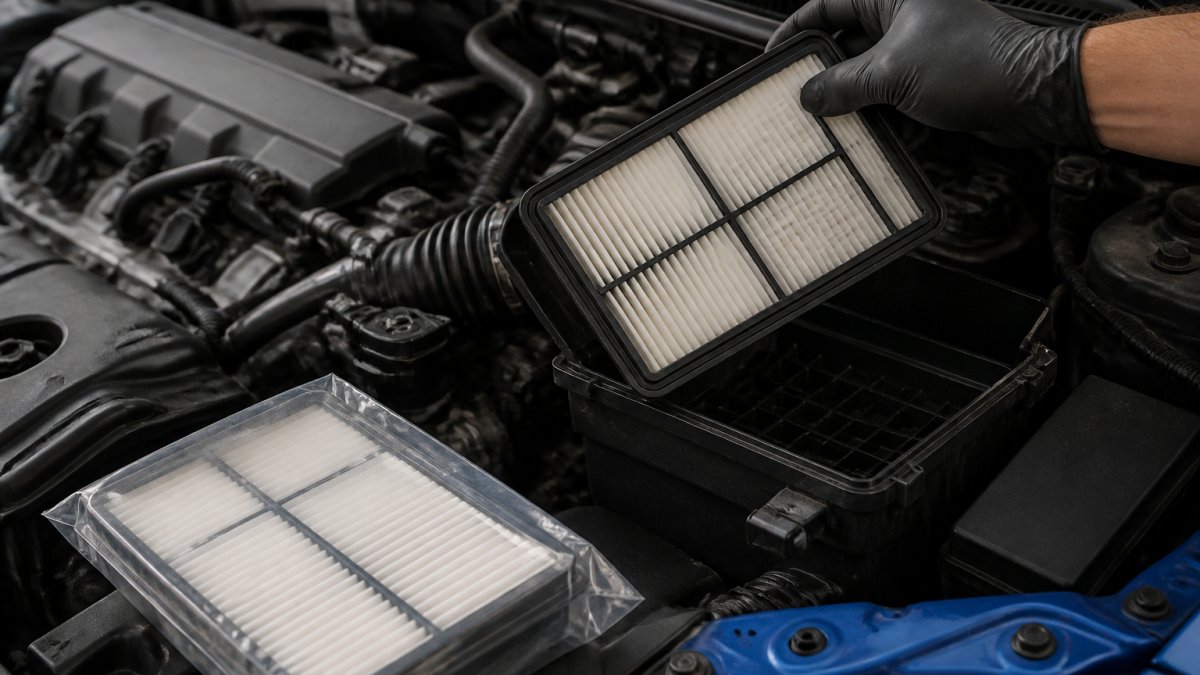
Loosen the screws or unclip the cover. Lift the lid and set it aside. Pull the old filter straight out and note which way it faced. Hold it up to the light. If you can't see through it, it's done.
Step 3: Install the Replacement Filter and Secure the Cover
Drop the new filter in with the rubber seal facing the same direction as the old one. Seat it flat. Replace the cover, then tighten the screws or snap the clips. Give the cover a light tug to confirm it's secure.
2026 Honda Civic Cabin Air Filter Replacement
The 2026 Honda Civic cabin air filter replacement cleans the air coming through your vents. It traps dust, pollen, and debris before they reach your cabin. Most owners can finish this in under five minutes with no tools.
Step 1: Access the Cabin Filter Behind the Glovebox
Open the glovebox and squeeze the sides inward so it drops past the stops. Behind it, you'll see a rectangular cover with a small tab. Press the tab and pull the cover off.
Step 2: Remove the Old Cabin Filter and Note Orientation
Slide the old filter out and check the arrows printed on its edge. Those arrows show airflow direction. Snap a photo with your phone before you toss it. Getting orientation backwards is the number one mistake here.
Step 3: Install the New Cabin Filter and Reassemble
Slide the new filter in with the arrows pointing the same way as the old one. Push the cover back until it clicks. Lift the glovebox back into place.
Honda Civic Air Filter Replacement Interval: When to Change Both Filters
The Honda Civic air filter replacement interval is typically every 15,000 to 30,000 miles for the engine filter and every 15,000 to 25,000 miles for the cabin filter. Honda's own maintenance schedule lists the engine filter around the 30,000-mile mark under normal driving, but real-world conditions often call for earlier swaps.
Many owners in dusty or high-traffic areas find they need a change closer to every 15,000 miles. Check both filters at every oil change. It costs you nothing but a minute.
Severe-Use Conditions That Shorten the Interval
Certain driving habits push you toward the shorter end of that range:
- Stop-and-go commuting in heavy traffic
- Driving on dirt or gravel roads
- Living in areas with high pollen or wildfire smoke
If any of these describe your routine, inspect both filters every 10,000 to 15,000 miles.
2026 Civic Fitment by Trim, Engine, and Hybrid Status
Fitment is where most buyers get tripped up, so check your trim before ordering. The 2026 Civic ships in three engine configurations, and the engine air filter is not shared across all of them.
| Trim | Engine | Engine Code Family | Engine Filter Shape | Cabin Filter Shape |
|---|---|---|---|---|
| LX Sedan | 2.0L naturally aspirated | K20C2 | Rectangular panel | Standard panel |
| Sport Sedan / Hatchback | 2.0L naturally aspirated | K20C2 | Rectangular panel | Standard panel |
| EX / EX-L | 1.5L turbo | L15B7 family | Rectangular panel | Standard panel |
| Touring | 1.5L turbo | L15B7 family | Rectangular panel | Standard panel |
| Hybrid Sport / Hybrid Sport Touring | 2.0L hybrid (Atkinson cycle) | LFC-H4 family | Rectangular panel (verify by VIN) | Standard panel |
The cabin filter is the easy one, the same panel fits every 2026 Civic trim, hybrid included. The engine filter is where the confusion lives.
How to Verify Fitment in Under Two Minutes
You do not need to trust a cross-reference chart or a marketplace compatibility filter. Use the VIN.
- Find the 17-character VIN on the driver-side dashboard, visible through the windshield, or on the door jamb sticker.
- Write down characters 4 through 8. Those five characters encode the model, body style, engine, and restraint system.
- Take that string to any Honda parts counter or enter it into a Honda parts catalog online. The catalog returns the exact engine air filter part number for your build.
A second method works if you already have the car apart: pull the old engine filter and read the part number stamped or printed on the rubber seal edge. That number is the ground truth.
Hybrid-Specific Notes
The 2026 Civic Hybrid uses the same cabin filter as every other trim, so that job is identical. The engine air filter is the one to double-check. Hybrid intake housings are shaped to fit around the battery cooling ductwork, and a filter that physically drops in may still not seal if the pleat depth is wrong.
OEM-Style vs Aftermarket Filters: Part Numbers and What Fits
OEM-style filters match the factory part exactly. Aftermarket filters are built to the same dimensions by a third party and often add extra filtration layers. Both work. The difference comes down to airflow, filtration media, and price, and the honest answer is that for a daily-driven 2026 Civic, the gap is smaller than the marketing suggests.
Reading the Part Number on Your Old Filter
Every Honda engine air filter carries an identifier on the rubber seal edge or the pleated media frame. It is usually a string like 17220-XXXX-XXX. The first five digits identify the filter family; the middle block identifies the engine application; the last block is a revision code.
If the chart only lists '2026 Civic,' treat that as a yellow flag. It means the seller has not verified the hybrid and non-hybrid split.
What Actually Differs
- Filtration media. OEM-style filters typically use cellulose or a cellulose-synthetic blend. Many aftermarket filters add a layer of synthetic media or a pre-filter wrap. More media can trap finer particles, but it also restricts airflow slightly as it loads up.
- Pleat count and depth. This is the spec that determines whether the filter seals. A filter with the right outer dimensions but the wrong pleat depth can leave a gap at the housing lip.
- Frame rigidity. OEM-style frames are molded to hold their shape through heat cycles. Cheaper aftermarket frames can warp, which is how you get the whistle or hiss that owners sometimes report after a swap.
The Decision Framework
| Priority | Best Pick | Why |
|---|---|---|
| Guaranteed fit, zero guesswork | OEM-style | Matches the factory part number exactly |
| Lowest cost per change | Aftermarket standard | Usually a few dollars less, same dimensions |
| Best filtration in dusty or smoky air | Aftermarket with synthetic layer | Traps finer particles, but inspect more often |
| Performance or tuned build | High-flow reusable | More airflow, but lets more dust through, not for stock daily drivers |
DIY Cost and Time vs a Shop
For a 2026 Civic, both filters together are a genuine 15-minute job for a first-timer. Parts cost is modest, a pair of standard filters typically runs well under what a single shop visit charges in labor. A shop will bill both replacements as separate line items, and the labor rate is the same whether the job takes them ten minutes or thirty.
A Note on 'High-Flow' Claims
High-flow filters are marketed on horsepower gains. On a stock 2026 Civic, the factory intake is not the bottleneck, so the gain is negligible. What you do get is a filter that passes more particulate. For a daily driver in a dusty climate, that is a downgrade, not an upgrade. Save the high-flow option for a build that has actually changed the intake and tuning.
Honda owner's manuals and maintenance schedules by model year
Common Mistakes and Post-Installation Checks
Even an easy job has a few traps. Watch for these:
- Installing the filter backwards (check the arrows)
- Forgetting to reseat the housing cover fully, which causes a whistle
- Over-tightening screws and cracking the plastic lid
After you finish, start the engine and listen for a whistle or hiss. That usually means the cover isn't sealed. For the cabin filter, run the fan on high and check that airflow feels normal.
If either job feels off, or you'd rather not crawl around the glovebox, we handle both in minutes. Our team works on Honda and Acura daily.
Frequently Asked Questions
How often should I replace the engine air filter in a 2026 Honda Civic?
Honda's maintenance schedule typically calls for a new engine air filter around every 25,000 miles under normal driving. If you often drive on dirt roads, in heavy traffic, or through dusty Colorado conditions, inspect it sooner and replace it as early as 15,000 miles. A clogged filter reduces airflow to the engine intake, which can hurt fuel economy and acceleration.
What tools do I need to replace a 2026 Honda Civic air filter?
For the engine air filter, you usually need a Phillips-head screwdriver to loosen the housing cover, though some trims use clips that require no tools. The cabin air filter behind the glovebox typically needs no tools at all. A clean rag and a small vacuum help remove dust and debris from the housing before you install the replacement filter.
How can I tell if my Honda Civic air filter needs replacing?
Hold the old filter up to a light source. If you cannot see light passing through the pleats, it is clogged and needs replacement. Other signs include reduced acceleration, lower fuel economy, a musty smell from the vents (cabin filter), or visible dust and debris caked into the filter element. Inspecting both filters at every oil change makes the decision easy.
Can I replace both the engine and cabin air filters myself in under 30 minutes?
Yes. The engine air filter replacement usually takes under five minutes once you open the housing and swap the element. The cabin air filter behind the glovebox takes about 10 to 15 minutes. Together, a DIY replacement on a 2026 Civic is a straightforward job that saves labor costs compared to a dealership visit.
A clogged filter quietly costs you fuel, cabin comfort, and airflow. If you'd rather have it done right the first time, Speedy Roo Motorsports has serviced Japanese vehicles since 2002, with honest diagnostics, quality work under the hood, and friendly service. We'll swap both filters, check the housing seals, and confirm everything's seated properly. Get started with Speedy Roo Motorsports and keep your Civic breathing clean.