 how-to
Signs of a Bad Toyota Thermostat: 7 Symptoms to Know
Table of Contents
- 7 Signs of a Bad Toyota Thermostat
- Thermostat Stuck Open vs. Stuck Closed: Key Differences
- How to Test a Car Thermostat Without Removing It
- Toyota Overheating Causes: Thermostat or Something Else?
- Toyota-Specific Symptoms by Model and Engine
- Toyota Thermostat Replacement Cost and What to Expect
- Conclusion
- Frequently Asked Questions
Last Updated: October 21, 2026
7 Signs of a Bad Toyota Thermostat
A stuck thermostat is one of the most common cooling system failures on Toyota cars, and it rarely announces itself with drama. According to Consumer Reports' auto reliability coverage, cooling system faults remain among the most frequent repair categories for older vehicles.
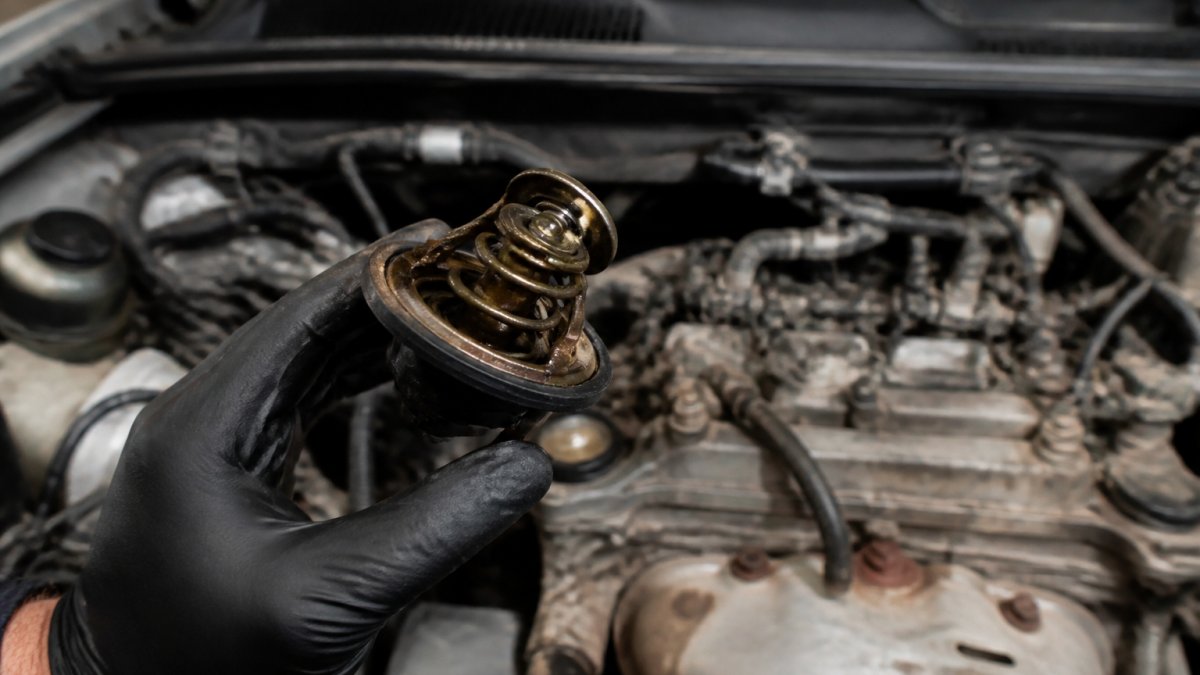
The thermostat is a temperature-controlled valve that stays closed on a cold start so the engine warms up fast, then opens to let coolant circulate through the radiator. When it fails, it usually fails stuck open or stuck closed.
Below are the seven signs we look for in the shop, how to tell a thermostat apart from other cooling faults, and what replacement involves.
1. Engine Overheating or Running Too Cold
Overheating is the loudest symptom. A thermostat stuck closed blocks coolant flow, so heat builds with nowhere to go, the gauge climbs, and in bad cases steam pours from under the hood.
Running too cold is the quieter twin. A thermostat stuck open lets coolant circulate constantly, so the engine never reaches operating temperature, with slow warm-up on cold mornings and weak cabin heat.
Both extremes shorten engine life. Overheating risks a head gasket. Overcooling wastes fuel and accelerates wear.
2. Erratic Temperature Gauge Readings
A healthy temperature gauge rises steadily, then holds near the middle. Erratic readings that jump or drift between hot and cold point to a thermostat valve opening and closing unpredictably.
Watch for these patterns:
- Gauge swings during highway driving
- Temperature drops when you accelerate
- Readings that never settle in one spot
A faulty temperature sensor can mimic this, so a proper diagnosis matters before you buy parts.
3. Heater Blowing Cold or Weak Air
Cold air from the vents with the engine warm is a classic sign of a bad Toyota thermostat: if it is stuck open, the engine runs cool and the heater core never gets hot coolant.
Check coolant level and heater settings first. If both are fine and the air stays cold, the thermostat is a prime suspect.
4. Coolant Leaks and Low Coolant Level
Thermostats live inside a housing sealed by a gasket. When that gasket fails, coolant seeps out, often as crusty residue around the housing. Low coolant from any cause also triggers overheating.
Look for:
- Green, pink, or orange crust near the thermostat housing
- Sweet-smelling fluid under the car
- A coolant level that keeps dropping
A leak will not fix itself. Pressure builds in the cooling system, and small seeps become big ones.
5. Poor Fuel Efficiency
An engine running below operating temperature burns more fuel as the computer adds fuel to compensate for the cold. If your mileage has slipped and nothing else explains it, an overcooling thermostat deserves a look.
6. Check Engine Light or Temperature Warning Light
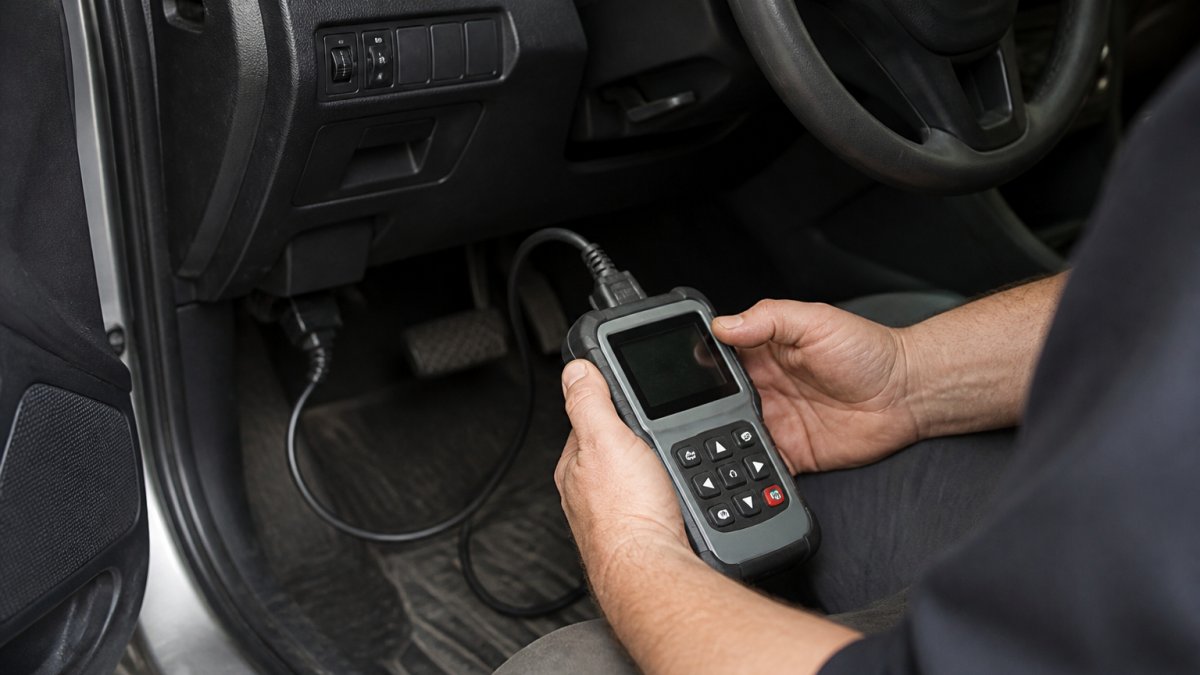
A bad thermostat can set a diagnostic trouble code, usually P0128 for coolant temperature below regulating threshold, which a scan tool reads in minutes.
The temperature warning light is more urgent. If it comes on, pull over safely and let the engine cool. Driving on an overheated engine can warp the head or blow the head gasket.
7. Unusual Noises or Steam
Steam from the hood means coolant is boiling or escaping. You may also hear gurgling from the heater core or a rushing sound as coolant forces past a failing valve. Shut the engine off and let it cool before opening anything.
Thermostat Stuck Open vs. Stuck Closed: Key Differences
The two failure modes behave in opposite ways, and that difference is your best diagnostic clue.
| Failure Mode | Main Symptom | Engine Temperature | Heater | Risk |
|---|---|---|---|---|
| Stuck closed | Overheating, steam | Runs hot | Weak or cold | Head gasket damage |
| Stuck open | Slow warm-up, poor mileage | Runs cold | Cold air | Wear, poor fuel economy |
A stuck-closed thermostat is the emergency. A stuck-open thermostat is the slow burn. Neither should wait.
How to Test a Car Thermostat Without Removing It
You can check a thermostat in your driveway with basic tools and no disassembly:
- Start with a cold engine. Let the car sit overnight so coolant is at ambient temperature.
- Check the coolant level. Top off if low, and note any leaks.
- Start the engine and watch the gauge. It should climb steadily toward the middle within a few minutes.
- Feel the upper radiator hose. It should stay cool at first, then get hot once the thermostat opens.
- Use an infrared thermometer. Aim it at the thermostat housing and upper hose. A sudden temperature jump signals the valve opening.
- Watch for stability. The gauge should hold steady, not swing.
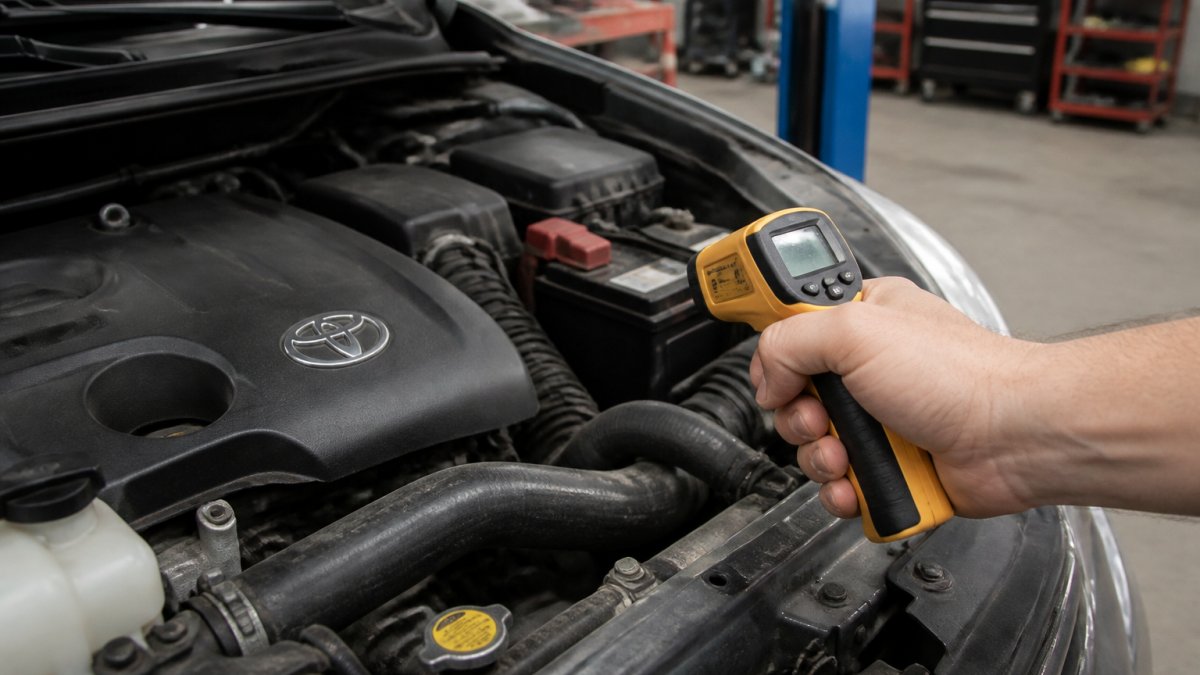
If the hose never gets hot, the thermostat is likely stuck closed. If it heats up immediately from a cold start, it is likely stuck open.
Toyota Overheating Causes: Thermostat or Something Else?
A thermostat is the most common single cause of Toyota overheating, but far from the only one. Replacing it when the real problem is a water pump or clogged radiator wastes money and leaves the overheating unresolved, so tell the faults apart before you buy parts.
The main suspects and how they behave
- Stuck-closed thermostat: Overheats within minutes of a normal cold start. The upper radiator hose stays cool while the gauge climbs, and cabin heat may be weak or cold because coolant is not circulating through the heater core.
- Low coolant from a leak: Overheats gradually and may run hot at idle. The level drops, with residue at hose connections, the water pump weep hole, or the radiator. A pressure test finds leaks a visual inspection misses.
- Failing water pump: Overheats under load or at speed, with a whine, grind, or rattle from the front of the engine and a weeping seal or crusty residue near the pump. Unlike a stuck-closed thermostat, the upper hose usually gets hot because coolant still circulates, just poorly.
How to narrow it down without guessing
A few checks separate the faults quickly:
- Watch the upper radiator hose from a cold start. Cool at first, then hot once the thermostat opens, is normal. Never hot means the thermostat is likely stuck closed. Hot almost immediately means it is likely stuck open.
- Compare idle and highway behavior. Overheating at idle points to airflow (fan). Overheating at speed points to coolant flow (thermostat, water pump, or radiator).
- Check coolant level and look for leaks. A pressure test is the reliable way to find seeps.
- Scan for codes. A P0128 (coolant temperature below regulating threshold) supports a stuck-open thermostat, but it does not prove it. A code plus a matching gauge pattern is stronger evidence.
- Use an infrared thermometer. Compare the thermostat housing, upper hose, and radiator inlet and outlet. Large temperature differences across the radiator suggest a restriction.
The misdiagnosis trap
A thermostat code or hot gauge alone does not prove the thermostat is faulty. Low coolant, a weak water pump, a clogged radiator, a dead fan, or a bad sensor can all produce the same symptoms. Confirm coolant flow, airflow, and sensor accuracy before replacing the thermostat, and replace it only when the evidence points there.
Toyota-Specific Symptoms by Model and Engine
Most thermostat guides describe cars in general. Toyota engines have their own warm-up behavior, sensor logic, and cooling-system layouts, so the same failed thermostat can present very differently from one model to the next. Knowing what is normal for your engine is half the diagnosis.
What "normal" looks like on common Toyota engines
On most Toyota four-cylinder and V6 engines, the temperature gauge climbs from cold to just below the midpoint within a few minutes of driving, then holds steady. The upper radiator hose stays cool until the thermostat opens, then heats quickly. Cabin heat arrives within a few minutes in mild weather. Any deviation from that pattern is worth noting.
- 2.5L four-cylinder (Camry, RAV4, many others): Warm-up is quick and the gauge is heavily damped, so a stuck-open thermostat often shows up first as weak cabin heat and a slow gauge climb on cold mornings rather than a dramatic swing.
- 3.5L V6 (Camry, Highlander, Sienna, and others): These engines move more coolant and generate heat faster. A stuck-closed thermostat can push the gauge up quickly under load, such as climbing a grade or merging onto a highway.
- Tacoma and Tundra V6/V8 trucks: Cooling systems are sized for towing and hauling. A marginal thermostat may behave normally unloaded but cause the gauge to creep up when towing, climbing, or idling in traffic with the A/C on.
Why the same failure looks different
Three things drive the variation:
- Gauge damping. Many modern Toyota clusters are deliberately damped, so small temperature swings are hidden from the driver. A gauge that looks steady does not rule out a thermostat problem.
- Fan strategy. Mechanical fan clutches, electric fans, and hybrid inverter cooling all change how heat is rejected at idle versus at speed. An engine that overheats only at idle points toward airflow, while one that overheats only at speed points toward coolant flow.
- Sensor placement and count. Some engines use multiple coolant temperature sensors for the gauge, the ECU, and the fan control. A single faulty sensor can mimic a thermostat, which is why a scan-tool check matters.
A practical takeaway
Before you assume the thermostat is bad, confirm what your specific model and engine normally do. A quick scan-tool check of coolant temperature at cold start, at idle, and after a drive gives you a baseline. If the engine never reaches normal operating temperature, or overshoots it under load, the thermostat is a strong suspect, but the model-specific pattern tells you which failure mode you are likely dealing with.
Toyota Thermostat Replacement Cost and What to Expect
Toyota thermostat replacement cost depends on the model, engine, and whether the housing or gasket needs replacing. Pricing depends on quantity, dates, and delivery, and parts and labor vary by engine and access.
What to expect:
- A thermostat is an inexpensive part, but labor varies with engine layout
- Some engines bury the housing under intake plumbing
- A coolant flush is often wise at the same time
Ask for an itemized quote before work begins. At Speedy Roo Motorsports, we explain what failed, why it failed, and what it takes to fix it right.
Conclusion
A failing thermostat gives you warning signs: overheating, cold heat, erratic gauges, leaks, and poor mileage. Catching them early protects your engine and your wallet. Our team at Speedy Roo Motorsports has serviced Japanese vehicles since 2002, and we know these cooling systems inside and out. We offer honest diagnostics, transparent quotes, and quality work under the hood. If your Toyota is showing any of these symptoms, get it checked before a cheap part turns into an expensive repair.
Frequently Asked Questions
What are the first signs of a bad thermostat in a Toyota?
The earliest clues are usually a temperature gauge that climbs slowly or never reaches normal, a heater that blows cold air after the engine has warmed up, and erratic gauge swings. On newer Toyotas, you may also see a check engine light with a P0128 code for coolant temperature below regulating temperature. Catching these early helps prevent engine damage and keeps fuel efficiency from dropping.
Can I drive my Toyota if the thermostat is bad?
It depends on which way it failed. A stuck-open thermostat makes the engine run cold, which is inefficient but usually drivable to a shop. A stuck-closed thermostat blocks coolant flow and can cause rapid overheating, so pull over if the temperature warning light comes on. Never continue driving with steam or a pegged gauge, as that risks a head gasket failure.
How much does a Toyota thermostat replacement cost?
For most Toyota models, the thermostat itself is a relatively inexpensive part, and labor is typically modest because the housing is accessible. Total cost varies by model, engine, and whether coolant and housing gaskets are also replaced. At Speedy Roo Motorsports, we can provide an estimate before any work begins, so you know the exact price for your vehicle.
Can a bad thermostat cause poor fuel economy in a Toyota?
Yes. A thermostat stuck open keeps the engine below its optimal operating temperature, so the computer adds extra fuel to compensate. Drivers often notice lower fuel efficiency and a slow warm-up before any warning light appears. Replacing the thermostat restores normal coolant temperature regulation and typically brings fuel economy back to where it should be.