 ultimate-guide
Cost of Honda Transmission Fluid Change: 2026 Guide
Table of Contents
- What Determines the Cost of a Honda Transmission Fluid Change
- Honda Transmission Fluid Change Interval: What the Manual Says
- Drain and Fill vs Transmission Flush: Which Does Your Honda Need?
- Symptoms of Low Transmission Fluid You Should Never Ignore
- Why OEM-Specified Honda Transmission Fluid Matters
- DIY vs Professional Honda Transmission Fluid Change
- Conclusion
- Frequently Asked Questions
Last Updated: September 24, 2026
What Determines the Cost of a Honda Transmission Fluid Change
The cost of a Honda transmission fluid change depends on your transmission type, the fluid your model specifies, and who does the work.

Here's how the cost breaks down:
| Cost Factor | What It Covers | Why It Varies |
|---|---|---|
| Fluid | Honda-approved ATF or CVT fluid | Capacity and fluid type differ by model |
| Labor | Technician time at the shop's hourly rate | Drain and fill is faster than a flush |
| Filter | Transmission filter replacement | Some Hondas use a serviceable filter, others don't |
| Supplies | Crush washer, pan gasket, shop supplies | Minor, but not zero |
| Diagnostics | Inspection or scan if symptoms exist | Only applies when something is wrong |
Honda Transmission Fluid Change Interval: What the Manual Says
Most modern Hondas call for a transmission fluid change in the 30,000 to 60,000 mile range under normal driving, but your owner's manual is the only authority. Honda has moved from fixed mileage toward a Maintenance Minder system.
Interval and Fluid by Transmission Family
The interval and fluid both depend on which transmission family your Honda uses:
| Transmission Family | Typical Models | Fluid Spec | Typical First Interval |
|---|---|---|---|
| CVT (Honda HCF-2) | 2014+ Civic, 2015+ CR-V, 2018+ Accord 1.5T, HR-V, Fit | Honda HCF-2 CVT Fluid | ~30,000-60,000 mi, Maintenance Minder code 3 |
| Traditional 5-speed AT (ATF-Z1 / DW-1) | Older Accord, Odyssey, Pilot, Element | Honda ATF DW-1 (ATF-Z1 superseded) | ~30,000-60,000 mi under normal, sooner under severe |
| 6-speed AT (ATF DW-1) | 2008-2017 Accord V6, Odyssey, Pilot | Honda ATF DW-1 | ~60,000 mi normal, ~30,000 mi severe |
| 9-speed AT (Honda ATF-Type 3.1) | 2018+ Odyssey, 2019+ Passport, some TLX | Honda ATF-Type 3.1 | Per Maintenance Minder; often 60,000-100,000 mi |
| 10-speed AT (Honda ATF-Type 2.0) | 2018+ Accord 2.0T, 2019+ RDX | Honda ATF-Type 2.0 | Per Maintenance Minder |
How to Read the Maintenance Minder Correctly
The Maintenance Minder shows a percentage of oil life remaining, not a mileage countdown. When it drops, it surfaces a letter code (A or B) plus sub-numbers. Sub-code 3 is the transmission fluid item, so "B13" means oil and filter change (B), tire rotation (1), and transmission fluid (3).
A few practical notes:
- The Minder estimates from driving inputs, not actual fluid condition. If you tow or sit in stop-and-go traffic daily, treat it as a ceiling, not a target.
- On many models, sub-code 3 appears past the mileage a conservative owner would service at. If you plan to keep the vehicle past 150,000 miles, servicing at the lower end is cheap insurance.
- If the Minder was never reset after a prior service, its countdown is meaningless. Ask the shop to confirm the reset.
When to Ignore the Manual Interval
- Towing or hauling regularly. Heat load rises sharply and thermal breakdown accelerates.
- Extreme climate. Sub-freezing starts or desert summer heat both stress the fluid.
- Short-trip commuting. The transmission rarely reaches full operating temperature, so moisture and contaminants accumulate.
- Unknown service history on a used purchase. If you cannot verify the last change, treat the fluid as due now.
Check your service manual or the Maintenance Minder display, and if you're unsure, ask a shop that works on Hondas regularly.
Drain and Fill vs Transmission Flush: Which Does Your Honda Need?
For most Hondas, a drain and fill is the correct service. A transmission flush exchanges fluid under pressure, is not recommended by Honda for many of its transmissions, and can cause problems in high-mileage units.
Here's the practical difference:
- Drain and fill: Removes the fluid in the pan, typically a portion of total capacity, and replaces it. Gentle, repeatable, and safe for a transmission that's never been serviced.
- Transmission flush: Uses a machine to push new fluid through and displace old fluid. Exchanges more fluid in one visit, but the pressure and dislodged debris can damage a worn transmission.
Symptoms of Low Transmission Fluid You Should Never Ignore
Low or degraded transmission fluid shows up in driving behavior long before a breakdown. Catching symptoms early usually means a simple service; ignoring them often means a rebuild or replacement.
Watch for these signs:
- Delayed or harsh gear engagement when shifting from park to drive
- Slipping between gears, where engine RPM climbs without matching acceleration
- Shuddering or vibration during light acceleration, common in CVTs with degraded fluid
- A burning smell, which points to thermal breakdown of the fluid
- Dark, gritty, or contaminated fluid on the dipstick, where one exists
- Transmission overheating warnings or a check engine light
Why OEM-Specified Honda Transmission Fluid Matters
Honda transmissions are engineered around specific fluid formulations, and a generic "universal" fluid is a gamble. For CVTs especially, the fluid is part of the design, not an interchangeable consumable.
DIY vs Professional Honda Transmission Fluid Change
Doing a drain and fill yourself saves on labor, but the hidden costs are easy to underestimate. The honest comparison is not "labor rate vs. free", it is total cost of ownership, including tools you buy once and the risk you take on.
The Real DIY Cost Stack
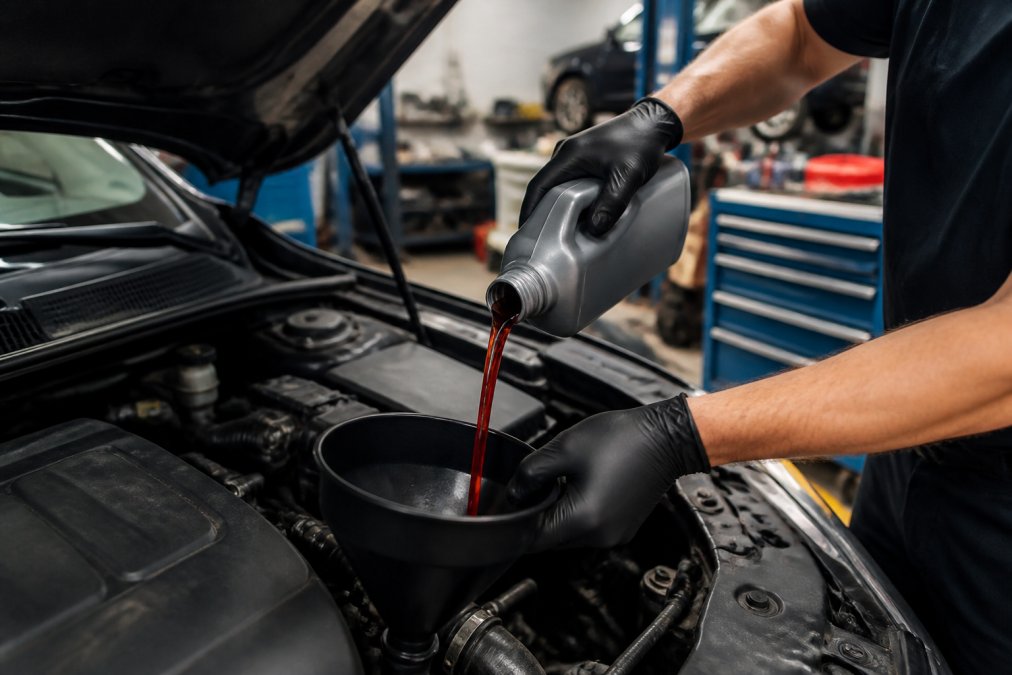
A drain and fill on a Honda is not a single-purchase job. Here is what a first-time DIYer typically buys:
| Item | Why You Need It | Notes |
|---|---|---|
| Honda OEM fluid (HCF-2, DW-1, ATF-Type 2.0, or ATF-Type 3.1) | Correct friction and viscosity spec | Sold by the quart; a drain and fill uses roughly 3-5 quarts depending on model |
| New crush washer / drain plug gasket | Seals the drain plug | Single-use; a reused washer is a common leak source |
| Transmission filter (if serviceable) | Some Hondas use an external or in-pan filter | Not every model has one; check before buying |
| Fluid pump or long funnel | Reaching the fill port on many CVTs | A hand pump is often required because the fill plug is not accessible from above |
| Torque wrench | Drain and fill plugs have specific torque specs | Over-torquing strips aluminum cases; under-torquing leaks |
| Drain pan and funnel | Catching and transferring used fluid | |
| Nitrile gloves, rags, cardboard | Spill control | |
| Used fluid disposal | Most municipalities require drop-off at a recycling center or auto parts store | Free at many retailers, but it is a trip |
What the Shop Price Actually Buys
When you pay a shop, you are paying for:
- Correct fluid identification. A Honda-focused shop knows HCF-2 from ATF-Type 2.0 without looking it up, and stocks both.
- Correct fill and level check. Many Honda CVTs require the fluid at a specific temperature range, engine running, transmission cycled through gears. Getting this wrong leads to overfill (foaming, seal damage) or underfill (slipping, overheating).
- A second set of eyes. A technician will notice a weeping seal, a worn mount, or fluid color suggesting a deeper problem, things a DIYer focused on the drain plug will miss.
- Documentation. A shop invoice with date, mileage, and fluid spec protects you if a warranty claim comes up.
Warranty Exposure: The Cost That Does Not Show on the Receipt
If your Honda is still within its powertrain warranty, an improper DIY fluid change can create a coverage dispute. Two risks:
- Wrong fluid. A non-OEM fluid that does not meet the Honda spec gives the manufacturer a basis to deny a transmission claim, even if the failure is unrelated.
- No documentation. Without a dated invoice or logged DIY record showing the correct fluid and mileage, proving the service was done correctly is your burden.
A Simple Decision Rule
DIY makes sense if:
- You have the correct fluid and the right tools, including a torque wrench and a fluid pump
- You can safely lift and support the vehicle
- Your Honda has a straightforward drain plug and dipstick for checking level
- You are comfortable disposing of used fluid properly
- You plan to keep the vehicle long enough to amortize the tool cost
A professional service makes sense if:
- Your Honda uses a CVT with a specific fill and check procedure, especially a temperature-dependent level check
- You're unsure of the service history
- You want the fluid level verified correctly
- The vehicle is under powertrain warranty and you want the documentation trail
- You'd rather not risk an expensive mistake on a transmission
The hidden costs of DIY aren't the parts. They're the risks: overfilling or underfilling, using the wrong fluid, stripping a drain plug, or missing a symptom a technician would have caught.
Conclusion
The cost of a Honda transmission fluid change comes down to variables you control: which fluid your model needs, whether a drain and fill or flush is right, and who does the work. Chasing the lowest quote without understanding those factors is how owners end up paying for a repair instead of a service.
Frequently Asked Questions
How often should transmission fluid be changed on a Honda?
Most Honda models since the mid-2000s use the Maintenance Minder system. When sub-symbol 3 appears, that signals a transmission fluid change is due, which usually works out to roughly every 30,000 to 60,000 miles depending on driving conditions. Older Hondas with a fixed schedule typically call for a change every 30,000 miles. Always check your specific model's service manual, since CVT and automatic transmissions can have different intervals.
Is it better to flush or just change transmission fluid?
For most Hondas, a drain and fill is the safer choice. It replaces roughly a third of the fluid at a time and avoids the risk of dislodging debris that a flush can push into narrow passages. A transmission flush uses pressure to exchange nearly all the fluid at once, which some shops recommend for high-mileage vehicles. If your Honda has over 100,000 miles and has never had service, a drain and fill is usually the wiser starting point.
Does my Honda model require specific transmission fluid?
Yes. Honda transmissions are designed around specific OEM fluids. Automatic transmissions typically use Honda ATF-DW1, while CVTs require Honda HCF-2 or CVTF depending on the model year. Using a generic multi-vehicle fluid can change shift quality and may affect your powertrain warranty. Check your owner's manual or verify the fluid specification using your vehicle identification number before buying anything.
Can I save money by performing a transmission fluid change at an independent shop?
Independent shops often charge less than dealerships for the same service because their labor rates are lower and they may not apply the same parts markup. The savings come from overhead, not from cutting corners, as long as the shop uses the correct OEM-specified fluid and follows Honda's service procedure. Ask what fluid they use and whether the filter and crush washer are included in the quote.