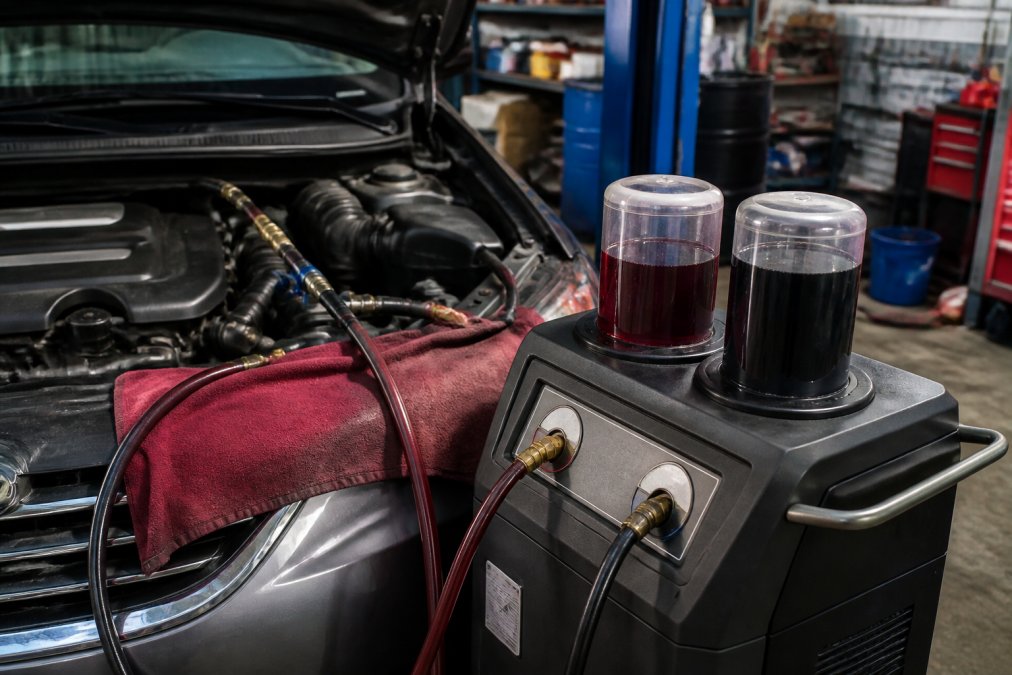
 comparison
Transmission Fluid Flush vs Drain and Fill: What to Choose
Table of Contents
- Transmission Fluid Flush vs Drain and Fill: The Core Differences
- Fluid Replacement Percentage: Flush vs Drain and Fill
- Pros and Cons of Each Service
- Signs of Bad Transmission Fluid and When to Service
- Transmission Fluid Change Interval for Japanese Vehicles
- Transmission Fluid Flush Cost and What Affects It
- Filter Replacement, CVT vs Automatic, and DIY Safety
- Frequently Asked Questions
Last Updated: September 15, 2026
Transmission Fluid Flush vs Drain and Fill: The Core Differences
The choice between a transmission fluid flush vs drain and fill comes down to how much old fluid leaves the system and how aggressively it's removed. A drain and fill replaces roughly a third of the fluid; a flush exchanges nearly all of it.
A drain and fill is the conservative option; a transmission fluid flush is the thorough one. Neither is universally better, the right pick depends on your mileage, transmission type, and how the fluid looks.
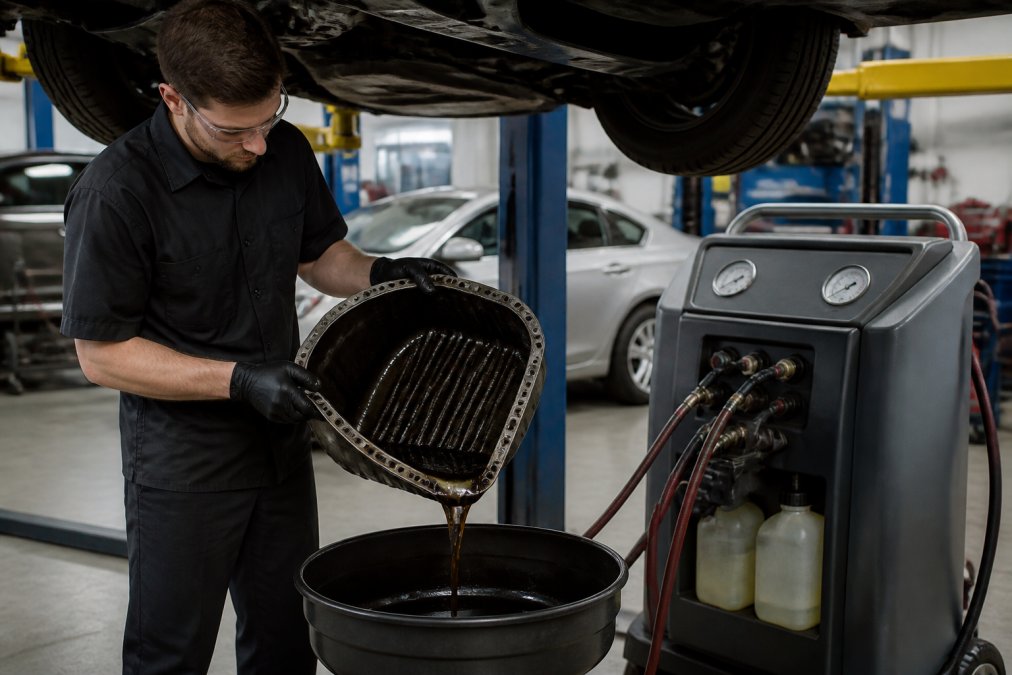
How a Drain and Fill Works
A drain and fill removes the transmission drain plug, lets gravity empty the pan, and refills with fresh automatic transmission fluid, or ATF. Because old fluid stays trapped in the torque converter and valve body, you're only swapping part of the total capacity, gentle, low-risk, and repeatable.
How a Flush Works
A flush uses a machine to push new fluid through the system while old fluid exits, performing a near-complete fluid exchange. It dislodges debris and replaces fluid held inside the torque converter, but the same pressure can push loosened clutch material into the solenoid block or valve body.
Fluid Replacement Percentage: Flush vs Drain and Fill
Replacement percentage separates these two services. A drain and fill typically replaces about one-third of total fluid capacity in a single visit; a flush can exchange the vast majority in one pass.
| Service | Fluid Replaced (per visit) | Filter Access | Relative Risk |
|---|---|---|---|
| Drain and fill | Roughly one-third | Yes, on pan-drop services | Low |
| Flush | Nearly all | No | Higher on high-mileage units |
That gap explains why a single drain and fill rarely restores fluid to like-new condition, most shops recommend repeating it across several intervals to gradually dilute old fluid. A flush gets you there in one appointment, but removes the buffer of suspended friction material a worn transmission may depend on.
Pros and Cons of Each Service
Drain and fill wins on safety and cost control; a flush wins on completeness and convenience. The deciding factor is almost always mileage and transmission condition.
Drain and Fill: Safer for High-Mileage Transmissions
For a high-mileage transmission that has never been serviced, a drain and fill is the conservative choice. It introduces fresh fluid and friction modifiers gradually, avoiding the sudden chemistry change that can trigger slipping. The drawback: you'll need repeat visits to see real improvement.
Flush: More Complete Fluid Exchange
A flush is the better call on a well-maintained transmission with moderate mileage, clearing thermal breakdown byproducts and restoring full fluid capacity in one service. It falls short on neglected, high-mileage units, where pressure can stir up debris that was harmlessly settled in the pan.
Signs of Bad Transmission Fluid and When to Service
The signs of bad transmission fluid show up before a failure does. Healthy ATF is translucent red or amber; dark, burnt-smelling fluid points to thermal breakdown and oxidation, and it's your cue to schedule service (How and Why You Should Check Your Transmission Fluid).
Watch for these drivability issues:
- Delayed or harsh shifting performance
- Slipping between gears under acceleration
- A burnt smell after highway driving
- Dark fluid on the dipstick or at the pan
Transmission Fluid Change Interval for Japanese Vehicles
There's no single transmission fluid change interval that fits every Japanese vehicle, but manufacturer specifications cluster into a few recognizable tiers. Knowing your tier is the difference between a transmission that reaches 200,000 miles and one that needs a rebuild at 120,000.
The Three Interval Tiers You'll Actually See
Tier 1, Severe service only (roughly 30,000-60,000 miles). Most Japanese automatics list a normal-service interval past 60,000 miles, but the owner's manual's severe-service footnote cuts that roughly in half. Towing, rideshare driving, mountain grades, and short cold-weather trips trigger the severe schedule, if any describe your driving, treat the severe number as your real interval.
Tier 2, Normal service (roughly 60,000-100,000 miles). Highway commuting with light loads and moderate ambient temperatures. This is the tier most owners assume they're in and most actually aren't.
Tier 3, "Lifetime" fluid (no listed interval). Several Japanese manufacturers now use sealed transmissions with a "lifetime fluid" claim. In practice, "lifetime" means the transmission's expected life under ideal conditions, not your ownership. Many high-mileage owners ignore the claim and service the fluid between 60,000 and 100,000 miles, then repeat every 30,000-60,000 miles.
Why the Interval Isn't the Whole Story
Mileage alone doesn't tell you whether the fluid is still doing its job, fluid degrades from heat cycles, not just distance. A vehicle in stop-and-go traffic at 90°F will cook its fluid far faster than one cruising at steady highway speed in a mild climate, even at identical odometer readings (energy.gov).
The more reliable trigger is mileage plus fluid condition. Check the dipstick (where one exists) at every oil change; if the fluid has shifted from translucent red toward dark brown or smells burnt, the interval is already overdue regardless of the odometer.
A Practical Mileage-Tier Framework
| Vehicle Mileage | Fluid History | Recommended Approach |
|---|---|---|
| Under 60,000 miles | Unknown or original | Drain and fill with filter service; recheck at 30,000-mile intervals |
| 60,000-100,000 miles | Regular prior service | Drain and fill, or a flush if the fluid still looks healthy |
| 60,000-100,000 miles | Never serviced | Drain and fill first; reassess after 500-1,000 miles of driving |
| 100,000-150,000 miles | Never serviced | Drain and fill only; avoid pressure flushes |
| Over 150,000 miles | Never serviced | Drain and fill with filter replacement; monitor for slipping |
This framework isn't a manufacturer schedule, it's a decision aid for owners whose service history is unknown. When in doubt, the conservative choice is the drain and fill, which introduces fresh fluid gradually instead of all at once.
Matching the Interval to Your Transmission Type
CVTs and traditional torque-converter automatics don't share intervals. A CVT's steel belt and pulley system shears its fluid differently than a planetary gearset, and many CVT manufacturers specify shorter intervals.
Transmission Fluid Flush Cost and What Affects It
The Two Cost Structures
What Actually Moves the Number
| Cost Factor | Why It Matters |
|---|---|
| Fluid volume | A flush uses several times the fluid of a drain and fill; total system capacity varies by transmission |
| Fluid type | Full-synthetic and CVT-specific fluids carry a premium over conventional ATF |
| Transmission type | CVTs and sealed "lifetime" units often require proprietary fluid and special procedures |
| Labor time | A pan-drop service (needed for filter access) takes longer than a basic drain |
| Filter and gasket | A pan-drop service adds a filter and pan gasket to the parts list |
| Diagnostic time | Shops that inspect fluid condition and scan for codes before quoting add a step |
Why Quotes Vary So Much Between Shops
Three things explain most of the spread:
How to Read a Quote
The Long-Term Cost Math
Filter Replacement, CVT vs Automatic, and DIY Safety
Why Filter Replacement Matters
CVT vs Traditional Automatic Transmissions
DIY vs Professional Service
Frequently Asked Questions
Why is a transmission flush sometimes not recommended?
A transmission fluid flush can dislodge debris and clutch material that have settled in the transmission. In high-mileage vehicles, this debris may be the only thing keeping the transmission functioning. A pressure flush can push that debris into the valve body or solenoid block, causing shifting problems or complete failure. Many manufacturers recommend a drain and fill instead for vehicles over 100,000 miles.
How much should a full transmission flush cost?
Transmission fluid flush cost varies based on your vehicle's transmission type and fluid capacity. CVT transmissions often require more expensive fluid. For an accurate quote on your specific Japanese vehicle, contact Speedy Roo Motorsports directly.
Is 100,000 miles too late to change transmission fluid?
It depends on your transmission's condition and service history. If the fluid has never been changed at 100,000 miles, a drain and fill is usually safer than a flush. A drain and fill replaces only part of the fluid, reducing the risk of dislodging debris. Have a technician inspect the fluid condition and pan for clutch material before deciding.
How often should you perform a drain and fill on a Japanese import?
Most Japanese manufacturers recommend a transmission fluid change interval of 30,000 to 60,000 miles for normal driving. Severe conditions like stop-and-go traffic or towing may require more frequent service. A drain and fill every 30,000 miles is a conservative maintenance approach that helps extend transmission life without the risks of a full flush.