 ultimate-guide
Honda Brake Fluid Change Interval: What Owners Should Know
Table of Contents
- What the Owner's Manual Says About the Honda Brake Fluid Change Interval
- Why Brake Fluid Goes Bad: Moisture, Heat, and Contamination
- Signs of Old Brake Fluid You Should Not Ignore
- DOT 3 vs DOT 4 Brake Fluid: What Your Honda Actually Needs
- Brake Fluid Flush Cost: What Affects the Price
- DIY vs. Professional Brake Fluid Service
- Climate and Driving Conditions: When to Shorten Your Interval
- Frequently Asked Questions
Last Updated: September 23, 2026
What the Owner's Manual Says About the Honda Brake Fluid Change Interval
Honda's official recommendation is to replace brake fluid every 3 years, regardless of mileage. Most Honda owner's manuals list this as a time-based service, and that distinction trips up owners who assume low mileage means low maintenance.
Your brake fluid doesn't care that your Civic only has 18,000 miles on it. It ages on the calendar because it absorbs moisture from the air, whether the car moves or sits. At Speedy Roo Motorsports, we've serviced Japanese vehicles since 2002, and the 3-year Honda brake fluid change interval is one of the most commonly skipped items.
Mileage vs. Time: Which Comes First?
Time wins. Honda specifies a 3-year interval with no mileage qualifier, so the clock starts the day the car leaves the factory.
Some newer Hondas with the Maintenance Minder system display a sub-code (typically "7") when the fluid is due, but that reminder is still tied to the same 3-year baseline rather than your odometer. If you drive 5,000 miles a year or 30,000, the answer is the same.
The one exception worth knowing: severe conditions can justify shortening the interval, which we'll cover further down.
Why Brake Fluid Goes Bad: Moisture, Heat, and Contamination
Brake fluid is hygroscopic, meaning it absorbs water from the surrounding air over time. That single property explains almost everything that goes wrong inside your brake system.
Water enters through the reservoir, microscopic pores in rubber brake lines, and seals, lowering the fluid's boiling point. Fresh DOT 3 boils around 401°F; with a few percent water content, that drops dramatically. Under hard braking, fluid near your calipers reaches those temperatures, and boiling creates compressible gas in a hydraulic system designed to move an incompressible liquid.
Signs of Old Brake Fluid You Should Not Ignore
The clearest signs of old brake fluid are a dark, murky appearance in the reservoir, a spongy or soft brake pedal, and longer stopping distances under hard braking. Any one of these warrants an inspection.
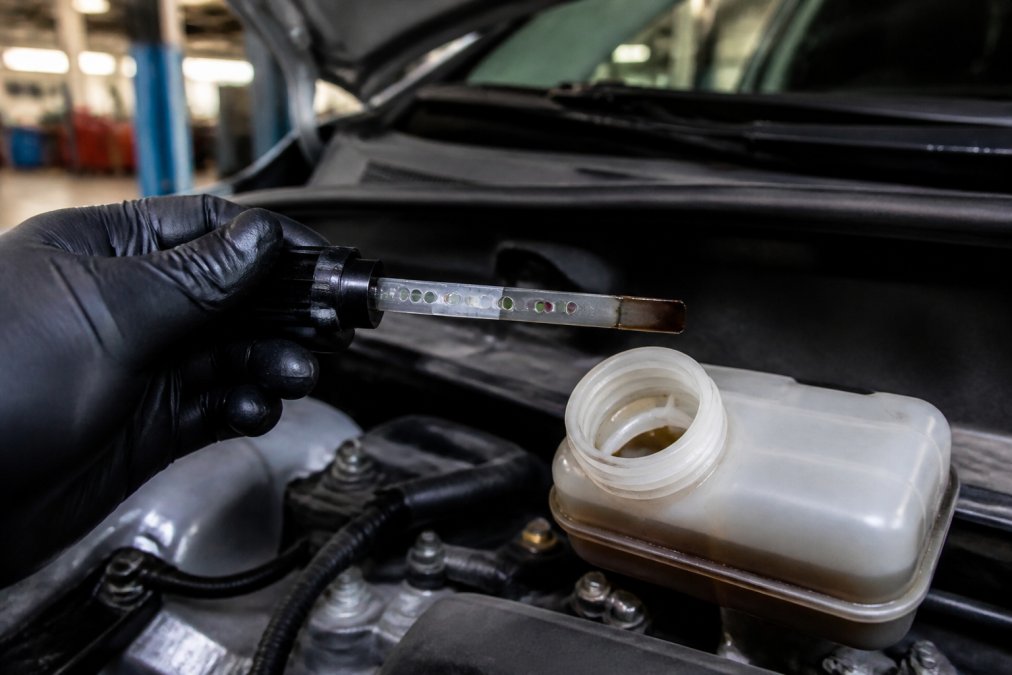
Other warning signs owners report:
- A pedal that feels soft or sinks slightly when held at a stop
- Brake fade after repeated hard stops, like a mountain descent
- A burning or "fishy" odor after aggressive braking
- Visible sediment or discoloration in the reservoir
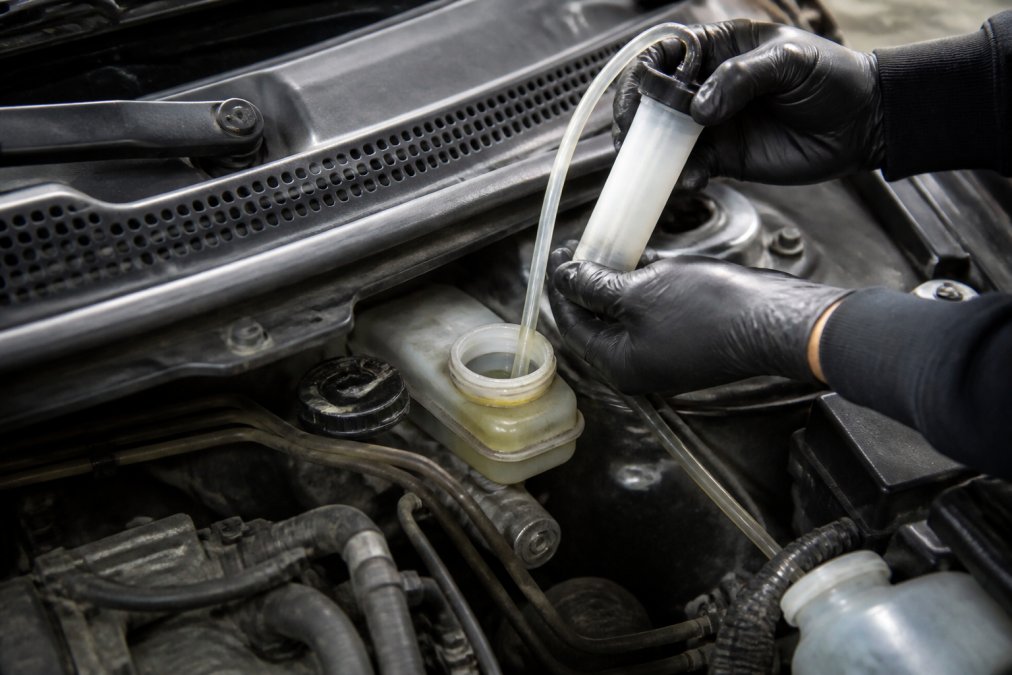
Can You Check Brake Fluid Without a Shop?
Yes, with a caveat. A visual check of the reservoir takes thirty seconds and tells you about color and level, but not water content, which requires a test strip or electronic tester.
DOT 3 vs DOT 4 Brake Fluid: What Your Honda Actually Needs
Most Honda vehicles specify DOT 3 brake fluid, and that is what you should use unless your owner's manual says otherwise. The two fluids are not interchangeable in the way many owners assume, the difference comes down to chemistry, not marketing.
What Actually Separates DOT 3 from DOT 4
Both fluids share a glycol-ether base, which is why they are hygroscopic and can be mixed in an emergency. DOT 4 adds borate esters, which raise the boiling point but attract and hold moisture more aggressively.
| Property | DOT 3 | DOT 4 |
|---|---|---|
| Base chemistry | Glycol ether | Glycol ether with borate esters |
| Dry boiling point (fresh fluid) | ~401°F | ~446°F |
| Wet boiling point (after moisture absorption) | ~284°F | ~311°F |
| Moisture absorption rate | Baseline | Faster |
| Typical Honda spec | Most Civics, Accords, CR-Vs, Pilots, Odysseys | Select performance and newer applications |
Which Hondas Take Which Fluid
Honda has historically specified DOT 3 across most of its lineup, including the Civic, Accord, CR-V, HR-V, Pilot, Odyssey, and Ridgeline. Some newer performance and hybrid models, plus certain Acura variants, call for DOT 4. The reliable answer for your vehicle is the reservoir cap and the owner's manual.
Why You Should Not 'Upgrade' to DOT 4
The instinct to pour in the higher-boiling-point fluid backfires in a DOT 3 system. Because DOT 4 absorbs moisture faster, you shorten the window before the wet boiling point drops into the range where hard braking can boil it, and you gain nothing from the higher dry boiling point if your driving never approaches those temperatures.
The One Rule You Cannot Break
Never mix DOT 5 (silicone-based) with DOT 3 or DOT 4, silicone and glycol-ether chemistries do not combine, and the result can damage seals throughout the hydraulic system. DOT 5.1 is glycol-based and technically compatible with DOT 3 and DOT 4, but it is not a drop-in substitute unless the manual calls for it.
How to Verify What Is in Your Reservoir
Pop the cap and look at the stamping, Honda reservoir caps are clearly marked with the required DOT specification. If the cap is missing or illegible, the owner's manual lists it under the brake system section. A shop can also identify the fluid type and test its moisture content in one visit.
Brake Fluid Flush Cost: What Affects the Price
Brake fluid flush cost varies by vehicle, shop, and region, so any single number online is a rough guide at best. A few factors drive the price most.
- Fluid type and volume. DOT 4 costs more than DOT 3, and larger vehicles with longer lines need more fluid.
- ABS system complexity. Vehicles with advanced ABS and stability control require a scan tool to cycle the modulator valves during bleeding. That adds labor time.
- Labor rates. Independent shops and dealerships charge differently, and metro-area rates run higher than rural ones.
- Bundled services. Some shops pair a flush with a brake inspection or pad replacement, which changes the total.
DIY vs. Professional Brake Fluid Service
A DIY brake fluid change is possible for a confident home mechanic, but the margin for error is wider than most tutorials admit.
DIY makes sense if:
- You have a helper to pump the brake pedal or a pressure bleeder
- Your car has a simple ABS system without special bleeding procedures
- You're comfortable working with hydraulic systems and disposing of used fluid properly
Professional service makes sense if:
- Your vehicle has advanced ABS or stability control requiring a scan tool
- You're not certain the system has never been contaminated
- You want a warranty behind the work
Climate and Driving Conditions: When to Shorten Your Interval
Honda's 3-year interval is a baseline, not a universal rule. Two conditions justify shortening it, and both are more common than most owners realize.
Humidity Is the Biggest Variable
Brake fluid absorbs moisture from the air, so the air around your car matters. In humid regions, the Gulf Coast, the Southeast, the Pacific Northwest, and anywhere summer dew points routinely climb above 60°F, absorption accelerates, and owners there often find a 2-year interval keeps water content safer than the full 3 years.
Heat and Braking Load Matter Just as Much
Long mountain descents, repeated hard stops, and towing push brake fluid temperatures far higher than flat commuting. Thermal breakdown accelerates at those temperatures, so the fluid degrades faster than the calendar suggests. If you regularly drive mountain passes, tow a trailer, or hit track days, your brake fluid works harder than the manual assumes.
A Simple Decision Framework
Use this as a starting point, then confirm with a moisture test:
- Humid climate, normal driving: consider a 2-year interval
- Humid climate, mountain or towing use: consider testing annually and replacing at 2 years or sooner
- Arid climate, normal driving: the 3-year baseline is reasonable
- Arid climate, mountain or towing use: test annually; replace based on moisture reading rather than the calendar
- Any climate, track use: follow the severe-service schedule in your manual, which is typically more aggressive than 3 years
How to Test Instead of Guess
A moisture test at your next oil change settles the question. Test strips and electronic testers read water content as a percentage, and most practitioners treat anything above roughly 3% as due for replacement regardless of months elapsed. The test takes minutes and gives you a real number instead of a guess.
Frequently Asked Questions
Does Honda recommend brake fluid flush?
Yes. Honda typically recommends a brake fluid change every 3 years regardless of mileage. This is because brake fluid absorbs moisture over time, which lowers its boiling point and can lead to brake fade or corrosion in the hydraulic system. Following this interval helps maintain brake system integrity and pedal feel.
How long does Honda brake fluid last?
Honda brake fluid generally lasts about 3 years under normal driving conditions. In humid climates or with aggressive driving, it may degrade sooner. The fluid is hygroscopic, meaning it absorbs moisture from the air, which gradually reduces its effectiveness. Regular testing can confirm when a change is due.
Is brake fluid flush really necessary?
Yes. Skipping a brake fluid flush allows moisture and contaminants to build up, which can cause corrosion in the master cylinder, ABS modulator, and brake lines. This may lead to costly repairs and reduced braking performance. A flush every 3 years is inexpensive preventative maintenance compared to replacing hydraulic components.
What are the signs that my brake fluid needs to be changed?
Signs of old brake fluid include a spongy brake pedal, dark or murky fluid in the reservoir, a burning smell after hard braking, and longer stopping distances. If you notice any of these, have the fluid tested. A qualified technician can measure moisture content and recommend a flush if needed.