 how-to
How Can You Prevent Premature Tire Wear on Your Honda Civic?
Last Updated: October 26, 2026
Quick Summary
You can prevent premature tire wear on your Honda Civic by maintaining correct tire pressure, rotating tires every 5,000-7,000 miles, and getting professional wheel alignment checks annually. Regular suspension inspections and monitoring tread wear patterns help catch issues before they damage your tires.
- Check tire pressure monthly when tires are cold using the PSI listed on your driver's door jamb sticker, not the tire's maximum pressure.
- Rotate front-wheel-drive Civic tires every 5,000-7,000 miles using the X pattern to distribute wear evenly.
- Get professional wheel alignment checked annually to prevent toe and camber angle issues that cause edge wear.
- Inspect suspension components like shocks, struts, bushings, and ball joints every 12-24 months for wear.
- Replace tires when the wear indicator is exposed, but catch wear early to fix underlying causes before the next set fails.
Table of Contents
- Why Honda Civic Tires Wear Out Faster Than Expected
- Honda Civic Tire Pressure: Getting It Right
- Honda Civic Tire Rotation Schedule and Best Practices
- Honda Civic Wheel Alignment and Tire Wear Prevention
- Diagnosing Honda Civic Tire Tread Wear Patterns
- Suspension and Steering Components That Drive Tire Wear
- Your Honda Civic Tire Maintenance and Prevention Schedule
- Schedule Your Civic's Tire and Suspension Check
- Frequently Asked Questions
Why Honda Civic Tires Wear Out Faster Than Expected
Premature tire wear on a Honda Civic frustrates owners, but you can prevent premature tire wear with the right maintenance approach. Your tires should last longer. When they don't, the culprit is rarely just bad luck. It's usually a combination of factors working against your tread.
Common causes of premature and uneven tire wear
Several factors can contribute to tire wear.
Tire pressure problems can contribute to uneven wear. Overinflated tires may wear faster in the center; underinflated tires may wear faster on the edges. Check pressure regularly.
Wheel alignment issues can contribute to tire wear. When front wheels point slightly inward or outward, or camber is off, tires may scrub as you drive. Alignment specifications vary by vehicle.
Worn suspension components can contribute to tire wear. Suspension problems may affect how tires contact the road.
Skipping tire rotations can contribute to uneven wear. Tire wear depends on the vehicle and driving conditions.
Civic-specific wear patterns and suspension geometry
According to Honda's 2026 Civic maintenance documentation, worn tires on a Civic should be replaced when the tread wears down until the wear indicator is exposed. But waiting until then means you've already lost significant traction, especially on wet roads.
Honda Civic Tire Pressure: Getting It Right
Tire pressure is one factor to monitor. Incorrect pressure can affect tire wear, fuel economy, and handling.
How overinflation and underinflation cause uneven wear
Overinflated tires can wear faster in the center than at the edges.
Underinflated tires can wear faster at the edges than in the center.
Step-by-step guide to checking and adjusting pressure
Follow this process monthly, or before long trips:
-
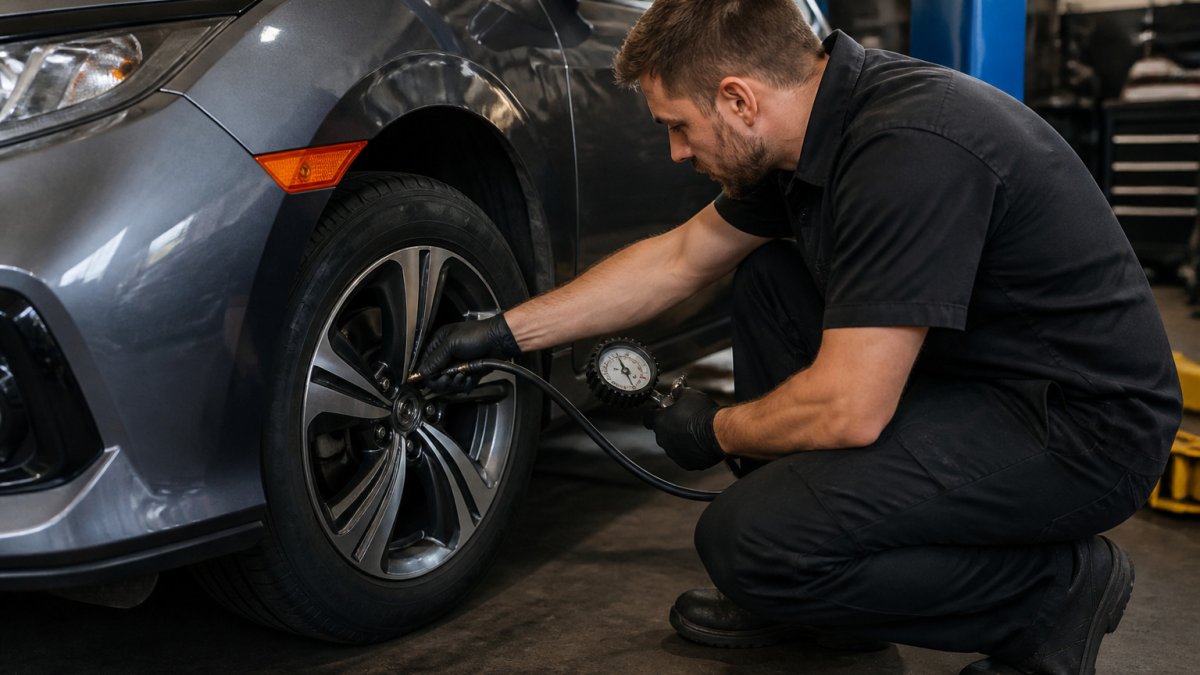
Check pressure when tires are cold. Drive less than a mile, or check first thing in the morning. Tire pressure rises as rubber heats up, giving false high readings.
-
Locate the recommended pressure. Look for the sticker on the inside of the driver's door jamb. It shows the exact PSI your Civic needs, not the maximum pressure printed on the tire itself, which is the tire's limit, not your car's requirement.
-
Use a reliable gauge. Digital gauges are more accurate than stick gauges, and gas-station pen gauges vary wildly. Spend $15 on a decent digital gauge and keep it in your car.
-
Remove the valve cap. Press the gauge onto the valve stem firmly. Hold it steady for 2-3 seconds until the reading stabilizes.
-
Record the reading. Track pressure over weeks, consistent drops may indicate a slow leak.
-
Adjust if needed. Add air if low, or press the small pin inside the valve stem to release air if high. Adjust 1 PSI at a time.
-
Recheck after adjustment. Wait 30 seconds, then verify the new reading.
-
Replace the valve cap. This protects the valve from dirt and moisture.
Honda Civic Tire Rotation Schedule and Best Practices
Tire rotation is a maintenance task to discuss with your vehicle's owner's manual. Learn the Honda Civic tire rotation schedule and best practices specific to your model.
Why rotation matters and how often to rotate
Tire wear can vary by position. Consult your owner's manual for rotation guidance for your vehicle.
Tire rotation changes the positions of the tires. Consult your owner's manual for the appropriate rotation guidance for your vehicle.
According to Colonial Honda's 2026 tire rotation guide, the recommended interval for AWD Honda models is around 3,000 to 5,000 miles. For front-wheel-drive Civics, many owners rotate every 5,000-7,000 miles. Check your owner's manual for the exact recommendation for your model year and configuration.
Rotation patterns for front-wheel and all-wheel drive models
Front-wheel-drive Civic rotation pattern:
- Front-left tire → Rear-right position
- Front-right tire → Rear-left position
- Rear-left tire → Front-right position
- Rear-right tire → Front-left position
This is the "X pattern."
All-wheel-drive Civic rotation pattern:
- Front-left tire → Rear-left position
- Front-right tire → Rear-right position
- Rear-left tire → Front-right position
- Rear-right tire → Front-left position
This is the "side-to-side" pattern.
Set a phone reminder for every 5,000 miles. When it pops up, schedule your rotation. Consistency matters more than perfection.
Honda Civic Wheel Alignment and Tire Wear Prevention
Alignment problems may not be apparent until tires show uneven wear.
How toe and camber angles affect tire lifespan
Toe angle is how much your front wheels point inward or outward. Perfect toe means both front wheels point straight ahead. If the wheels point slightly inward (toe-in), they scrub sideways as you drive. If they point outward (toe-out), they scrub the other direction. Either way, tires wear faster on the edges.
Camber angle is how much your wheels tilt inward or outward when viewed from the front. Perfect camber means wheels are perpendicular to the ground. If the top of the wheel tilts inward (negative camber), the inside edge of the tire wears faster. If the top tilts outward (positive camber), the outside edge wears faster.
Uneven wear can have several causes. A tire professional can assess the wear pattern and vehicle.
When to have alignment checked and corrected
Consider having alignment checked if you notice uneven tire wear or the steering wheel is off-center when driving straight.
Diagnosing Honda Civic Tire Tread Wear Patterns
Tire wear patterns can have different causes.
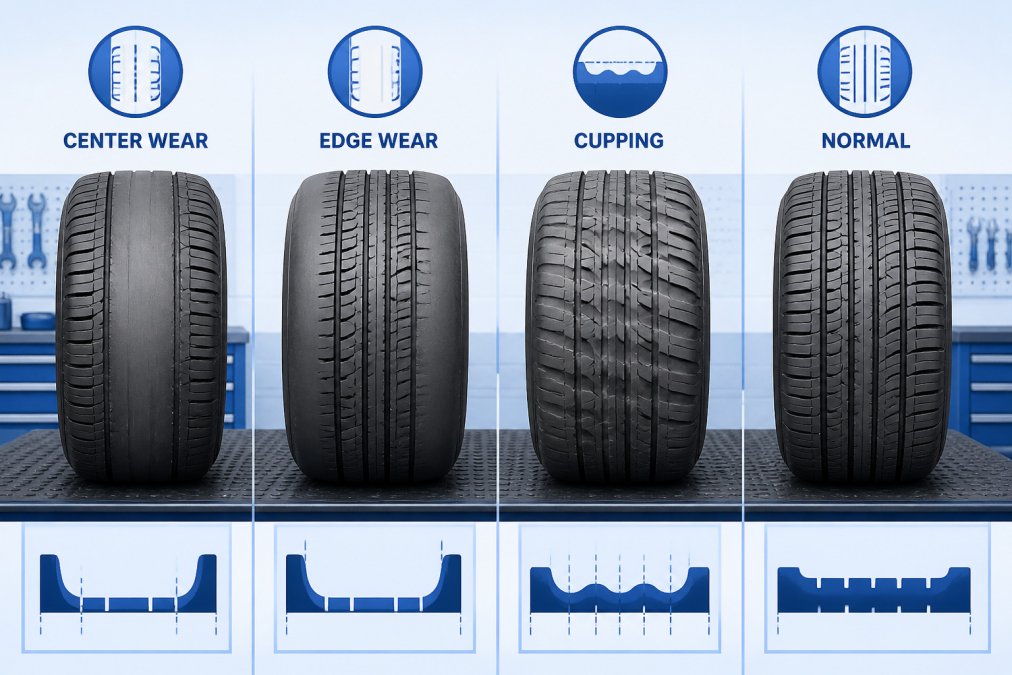
How to spot center wear, edge wear, and cupping
Center wear appears as a smooth band down the middle of the tire. This can be associated with overinflation. Check the vehicle's recommended tire pressure.
Edge wear can have several causes, including tire pressure or alignment. A tire professional can assess the wear pattern.
Cupping can appear as scalloped areas along the tire tread. A tire professional can assess the wear pattern and possible causes.
One-sided edge wear on just the inside or outside edge of one tire signals a localized alignment issue or a bent suspension component. This often follows hitting a pothole or curb. Fix: get alignment checked and suspension inspected.
Even tread wear describes tread loss that is similar across the tire surface.
Measuring tread depth and tracking wear over time
According to Honda's wear indicator guidance for 2026 Civic models, tires should be replaced when the wear indicator is exposed. But catching wear early, before the indicator appears, gives you time to fix the underlying cause before it destroys the next set.
Suspension and Steering Components That Drive Tire Wear
Suspension condition can be one factor in tire wear.
Shocks, struts, springs, and bushings inspection
Shocks and struts are suspension components. Their condition may be one factor to consider when assessing tire wear.
Springs support the weight of the vehicle. Weak or broken springs lower the ride height. This changes suspension geometry and wheel alignment angles. The result: accelerated tire wear.
Bushings are rubber components that connect suspension parts. They absorb vibration and allow controlled movement. Worn bushings allow excessive movement. This changes alignment angles and increases tire wear.
Ball joints, control arms, and wheel bearings
Ball joints connect the control arm to the steering knuckle. They allow the wheel to move up and down while turning. Worn ball joints create play in the suspension. The wheel tilts and moves more than it should. This accelerates tire wear, especially edge wear.
Control arms link the suspension to the frame. They keep the wheel aligned as the suspension moves. Bent or worn control arms change alignment angles. This causes uneven tire wear.
Wheel bearings allow the wheel to spin freely. Worn bearings create friction and heat. They can also allow the wheel to tilt slightly, changing alignment. This accelerates tire wear and can eventually cause wheel failure.
Your Honda Civic Tire Maintenance and Prevention Schedule
A regular maintenance routine can help you monitor tire condition. Follow the Honda specific maintenance schedule to know when to seek professional service and complete your inspection checklist.
Monthly and seasonal inspection checklist
Monthly (every 30 days):
- Check tire pressure on all four tires when cold
- Visually inspect tires for uneven wear, cuts, or bulges
- Look for debris lodged in treads
- Check that all valve caps are present and tight
Every 5,000 miles (or per your owner's manual):
- Rotate tires using the correct pattern for your drivetrain
- Inspect brake pads while wheels are off
- Check suspension components for visible wear or damage
Every 12 months:
- Get a professional wheel alignment check
- Have suspension components inspected by a technician
- Measure tread depth on all four tires
- Check for slow leaks (pressure loss over time)
Every 24 months:
- Full suspension inspection including shocks, struts, and bushings
- Wheel bearing inspection
- Ball joint and control arm inspection
Before long trips (500+ miles):
- Check tire pressure
- Visually inspect all tires
- Verify tread depth is adequate
- Have suspension checked if any unusual noises or handling changes
When to seek professional service
For Civics showing signs of suspension wear, our Honda Civic suspension problems guide walks you through common issues and what to watch for.
Follow this maintenance schedule to monitor tire condition and catch wear early.
| Task | Frequency | What to Check |
|---|---|---|
| Check tire pressure | Monthly | All four tires when cold |
| Visual tire inspection | Monthly | Uneven wear, cuts, bulges, debris |
| Tire rotation | Every 5,000 miles | Use correct pattern for drivetrain |
| Professional alignment | Every 12 months | Toe and camber angles |
| Suspension inspection | Every 12 months | Shocks, struts, bushings, joints |
| Tread depth measurement | Every 12 months | All four tires |
| Full suspension check | Every 24 months | Shocks, struts, bushings, bearings |
Schedule Your Civic's Tire and Suspension Check
Transparent communication and reliable service are part of how we've served customers since 2002.
Frequently Asked Questions
What causes one front tire to wear faster than the other on a Honda Civic?
Uneven tire wear can have several causes. A tire professional can assess the wear pattern and vehicle.
How often should I rotate Honda Civic tires?
Consult your owner's manual for tire rotation guidance for your model and configuration.
Should I use 35 or 40 PSI for my Honda Civic tires?
Check your vehicle's door jamb label or owner's manual for the tire pressure specification. Do not rely on the tire sidewall maximum.
Can wheel alignment prevent uneven tire wear on a Honda Civic?
Wheel alignment is one factor that may be relevant to tire wear. A tire professional can assess the vehicle and its wear pattern.