 ultimate-guide
Are You Missing the Signs of Nissan Suspension Problems?
Last Updated: November 4, 2026
Quick Summary
Nissan suspension problems are changes in ride quality, steering feel, tire wear, or noise that trace back to worn shocks, struts, springs, control arms, ball joints, bushings, or sway bar links. They show up early because the suspension carries the full weight of the car over every road surface, so wear compounds quietly before it becomes obvious.
- On a Frontier a clunk is often a ball joint; on a Rogue it is frequently a sway bar link.
- A healthy strut settles in one motion after a corner bounce test; a worn one keeps rocking.
- Cupping or scalloped tire edges mean the tire is not staying in contact with the road consistently.
- A ball joint that fails completely can separate the wheel from the control arm.
- Any job that changes suspension geometry ends with a wheel alignment.
Table of Contents
- Why Nissan Suspension Problems Show Up Early and What They Cost You
- How to Tell If Front Suspension Is Bad While Driving
- Visual Signs: Uneven Tire Wear, Leaking Struts, and Worn Bushings
- Noises Over Bumps: Creaking, Clunking, and Sway Bar Links
- Your Suspension Inspection Checklist for a Nissan
- Average Cost of Suspension Repair: DIY vs. Professional
- Safety Risks of Ignoring Nissan Suspension Symptoms
- Book a Suspension Inspection at Speedy Roo Motorsports
- Frequently Asked Questions
Why Nissan Suspension Problems Show Up Early and What They Cost You
Nissan suspension problems rarely announce themselves with a bang. They start as a small shimmy in the steering wheel, a faint clunk pulling out of a driveway, or a tire that wears oddly on one edge.
That matters because the suspension is not a comfort feature. It keeps the tires planted, the chassis stable, and the braking distance predictable. A worn component changes how the vehicle handles before it ever makes a sound you would notice.
How the Suspension System Works on Your Nissan
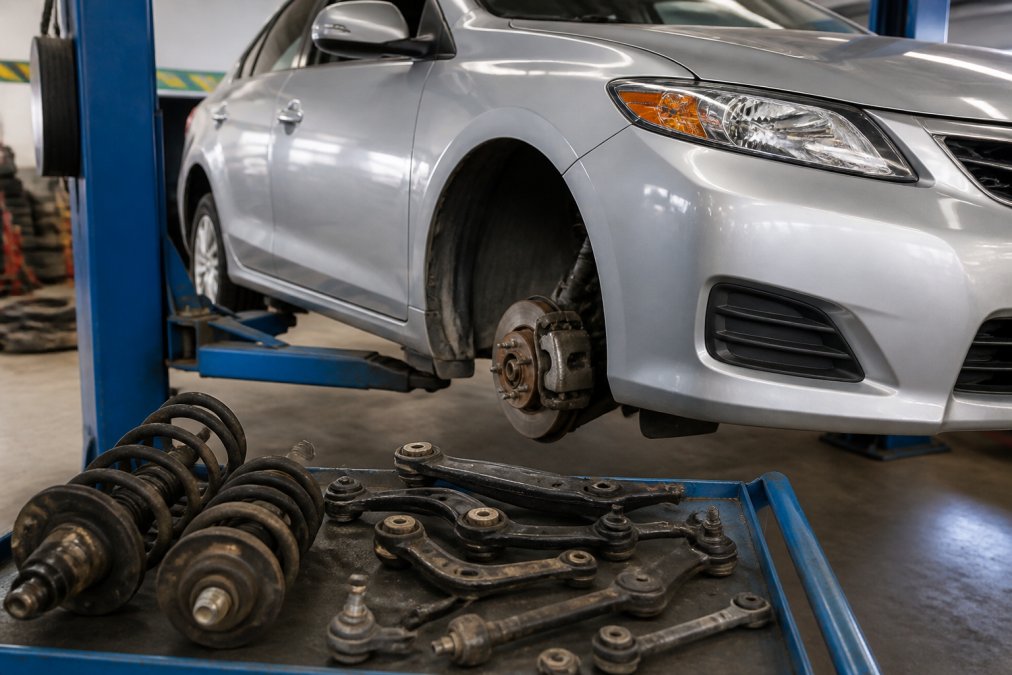
Your Nissan's suspension is a linked system, not a single part. Shock absorbers and struts control the dampening, meaning they manage how quickly the body settles after a bump. Coil springs carry the weight. Control arms, ball joints, and bushings connect the wheels to the chassis and let them move through their range. Sway bar links tie the left and right sides together to limit body roll.
Because those parts work as a set, one worn bushing puts extra load on the ball joint next to it. A leaking strut lets the spring bounce unchecked, which then chews the tire. This is why a proper diagnostic looks at the whole suspension geometry rather than one noisy part.
Model-Specific Failure Points: Altima, Rogue, Maxima, and Frontier
Different Nissans wear differently, and knowing your model narrows the search fast.
- Altima: Front lower control arm bushings and front strut mounts are common wear points, especially on higher-mileage commuter cars.
- Rogue: Front sway bar links and strut assemblies tend to go first; the heavier body puts more load through the front end.
- Maxima: Larger wheels and firmer tuning mean wheel alignment and tire wear patterns deserve a close look alongside the struts.
- Frontier: Truck duty cycles matter. Ball joints, tie rod ends, and bushings wear faster on trucks that tow or spend time on rough road surfaces.
A common mistake is assuming every clunk is the same part. On a Frontier it is often a ball joint; on a Rogue it is frequently a sway bar link. Same noise, different repair.
How to Tell If Front Suspension Is Bad While Driving
Learning how to tell if front suspension is bad while driving comes down to four signals: the car pulls or drifts, the nose dives under braking, the ride bounces or feels harsh, and the steering feels vague or vibrates. If two or more of those show up together, the front end needs an inspection.
Pulling, Drifting, and Vague Steering Feel
A car that drifts to one side on a flat road is telling you something. It could be worn control arm bushings letting the suspension geometry shift under load, a tired ball joint, or a steering linkage with play in it.
Watch out: a pull can also come from tire pressure or a brake dragging, so do not assume it is suspension until a technician checks the whole front end.
Nosediving, Bouncing, and Rough Ride Quality
Push down hard on one corner of the car and release it. A healthy strut settles in one motion. A worn one keeps rocking. That is a quick road feedback test for dampening.
On the road, worn struts show up as nosediving when you brake, a floaty feeling over dips, and a ride that feels harsh over small bumps because the suspension can no longer absorb them.
NHTSA vehicle safety information is a useful reference for understanding how suspension and steering faults relate to vehicle stability and control.
Visual Signs: Uneven Tire Wear, Leaking Struts, and Worn Bushings
The most reliable signs of Nissan suspension problems are often visible before they are audible. These visible clues can help you spot bad suspension early, before uneven wear or leaking struts lead to more noticeable changes in how the car rides.
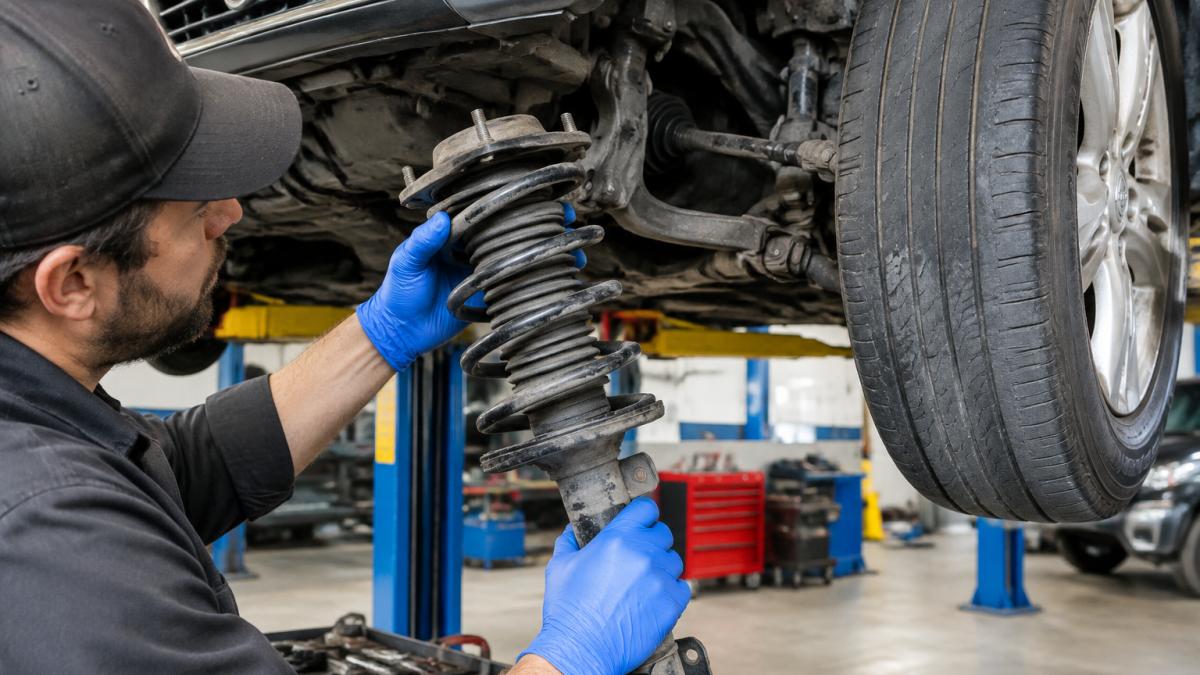
Start with tire tread depth. Run your hand across the tread; if you feel cupping or scalloped edges, the tire is not staying in contact with the road consistently.
Check the bushings and ball joints for cracked rubber, torn boots, and grease that has escaped. Any of those means the part is on its way out.
Noises Over Bumps: Creaking, Clunking, and Sway Bar Links
Noise is the symptom drivers notice first, and the type of noise narrows the cause. Creaking or squeaking over bumps usually points to dry or worn bushings.
Sway bar links are a frequent culprit on Nissans and a relatively straightforward replacement.
For a deeper look at grinding and clunking causes, our guide on car makes grinding noise turning wheel: causes & fixes walks through the diagnosis step by step.
Your Suspension Inspection Checklist for a Nissan
A good suspension inspection checklist covers the whole system, not just the noisy part.
- Bounce test each corner and note how many times the body rocks
- Measure tire tread depth at three points across each tire
- Look for cupping, scalloping, and one-sided wear
- Inspect struts and shocks for leaks and worn mounts
Pair this with Nissan's mileage-based service intervals. Our guide to Nissan factory scheduled maintenance in Denver by mileage explains what else should be checked at each stage, including the oil, battery, and driveline items that affect how the car drives.
Average Cost of Suspension Repair: DIY vs. Professional
The cost of suspension repair depends on which parts have failed and whether you do the work yourself. Pricing depends on the parts, labor and alignment involved, so direct readers to Speedy Roo Motorsports for current prices or a quote.
How to Read Suspension Repair Pricing
Suspension repair pricing breaks into three buckets: parts, labor, and alignment. Parts cost varies by brand tier, economy, OEM-equivalent, and premium, and by whether the part is sold as a bare component or an assembly. Labor is quoted in hours by the shop's labor guide, and front-end jobs typically run higher than rear jobs because more components come apart. Alignment is a separate line item and is required after any job that changes suspension geometry.
DIY vs. Professional: What Each Job Actually Requires
| Job | DIY Feasibility | Typical Tools Needed | Needs Alignment After | Why It Matters |
|---|---|---|---|---|
| Sway bar links | Good | Jack stands, hand tools | No | Simple bolt-on, low risk, good first DIY job |
| Shocks (rear, non-strut) | Moderate | Jack stands, hand tools, sometimes a spring compressor for the mount | Recommended | Easier than struts, but mount hardware often seizes |
| Struts (front) | Moderate to hard | Spring compressor, torque wrench | Yes | Spring compressor misuse is genuinely dangerous |
| Ball joints | Hard | Press or ball joint tool, torque wrench | Yes | Safety-critical part; a failed joint can separate the wheel |
| Control arm bushings | Hard | Press, alignment knowledge | Yes | Press required, affects alignment |
| Tie rod ends | Moderate | Hand tools, torque wrench | Yes | Steering accuracy depends on it; count threads before removal |
The DIY-versus-professional decision usually comes down to the part, the tools, and the alignment. Any job that changes suspension geometry ends with a wheel alignment.
The Hidden Costs of DIY
The sticker price of a part is not the cost of the job. Three hidden costs decide whether DIY actually saves money:
- Tool purchases: A spring compressor, a ball joint press, and a torque wrench can each cost more than the labor on a single sway bar link job. If you will only do the job once, the tools often erase the savings.
- Alignment: A DIY strut or control arm job still needs a professional alignment afterward. Budget for it before you start, not after.
- Comebacks: A mis-torqued bolt or a reused torque-to-yield fastener can turn a cheap DIY job into a repeat repair. Suspension fasteners are safety-critical and should be replaced per the service manual where specified.
When Professional Repair Is the Better Value
Professional repair wins on value when the job involves a press, a spring compressor, or a safety-critical part like a ball joint or tie rod end. It also wins when the diagnosis is unclear: paying for an inspection is cheaper than replacing parts by guesswork. If two or more symptoms overlap, a clunk plus uneven tire wear plus a pull, the odds of a single failed part drop, and a proper inspection pays for itself.
Safety Risks of Ignoring Nissan Suspension Symptoms
Ignoring suspension symptoms is a safety decision, not a maintenance one. Worn struts increase stopping distance because the tires skip and lose contact under hard braking. A worn ball joint can fail outright. Vague steering and a drifting front end reduce your ability to steer around a hazard when it matters.
The Insurance Institute for Highway Safety tracks how vehicle stability and control features affect crash outcomes, and the underlying principle is simple: the suspension is what keeps the tires doing their job. Our Nissan brake repair in Aurora service covers the brake and suspension systems as a pair, since they share the same safety job.
Book a Suspension Inspection at Speedy Roo Motorsports
If any of these signs sound familiar, the next step is a proper inspection, not another month of waiting. We are an independent repair facility in Aurora specializing in Japanese automobiles, including Nissan and Infiniti, and we have been serving customers since 2002.
You can book a suspension inspection at Speedy Roo Motorsports and get a clear diagnosis before a small clunk becomes a bigger repair. If you want a deeper look at how these problems present across models, our Honda Civic common suspension problems guide covers the same diagnostic logic from a different angle.
Frequently Asked Questions
How would I know if my suspension is bad?
Watch for a combination of symptoms rather than a single clue. A bad suspension usually shows up as a bouncy ride, nosediving when you brake, uneven tire wear, and noises like clunking or creaking over bumps. You may also notice the steering feels vague or the car drifts at highway speed. If two or more of these appear together, get a suspension inspection before the problem spreads to tires and steering components.
What are the most common suspension problems on a Nissan Altima?
Worn struts, leaking shock absorbers, and degraded sway bar links are common suspension wear points on many vehicles, including the Nissan Altima. Front control arm bushings and ball joints also wear with age, which can cause vague steering and uneven tire wear. A suspension inspection checklist that covers struts, bushings, ball joints, and tire tread depth will catch most of these early.
How much does suspension repair usually cost?
The average cost of suspension repair depends on which parts are worn and whether you choose DIY or a shop. Simple sway bar link replacements are on the low end, while strut and control arm jobs cost more in parts and labor. Because pricing varies by model and location, ask for an itemized quote before work begins. A professional inspection is the only way to know whether you need a small fix or a larger repair.
Can I drive with a bad suspension system?
You can often drive short distances, but it is not safe to ignore. Worn struts and shocks increase braking distance, reduce vehicle stability in turns, and speed up tire wear. A failing ball joint or control arm can fail suddenly and cause a loss of steering control. If you hear loud clunking, feel the car wander, or see a leaking strut, schedule an inspection right away rather than waiting for the next oil change.
A small shimmy or clunk is easy to ignore until it changes how your car stops and steers. Get the front end checked before that happens. Get started with Speedy Roo Motorsports and drive away knowing exactly what your suspension needs.
Consumer Reports auto maintenance guidance