 ultimate-guide
Why Japanese Cars Need Specialized Maintenance
Table of Contents
- Why Japanese Engineering Demands a Different Approach
- The Japanese Car Maintenance Schedule: Intervals That Actually Matter
- OEM vs Aftermarket Parts for Japanese Cars: What Fits and What Fails
- Common Repair Issues in Japanese Vehicles (and Why They're Different)
- Diagnostic Tools: DIY Scanners vs. Professional OBD-II Expertise
- Hybrid and Electric Japanese Powertrains: New Maintenance Rules
- Why Specialized Maintenance Protects Your Long-Term Cost of Ownership
- Frequently Asked Questions
Last Updated: September 11, 2026
Why Japanese Engineering Demands a Different Approach
Japanese vehicles are built to some of the tightest engineering tolerances in the industry, which is why Japanese cars need specialized maintenance and why they reward owners who follow precise service intervals and punish those who don't. At Speedy Roo Motorsports, we've worked on Subaru, Toyota, Lexus, Honda, Acura, Nissan, Infiniti, Mitsubishi, and Mazda vehicles since 2002, and we've observed that owners who prioritize specialized maintenance tend to get more longevity out of their powertrains.
Japanese manufacturers prioritize thermal management, tight component wear tolerances, and lightweight internal parts, which deliver excellent drivetrain efficiency and fuel economy, but the margin for error on fluid condition and part quality is narrower than on many domestic or European platforms.
The Japanese Car Maintenance Schedule: Intervals That Actually Matter
A Japanese car maintenance schedule should follow the severe-service column in your owner's manual, not the "normal" column, because most real-world driving qualifies as severe. Stop-and-go commuting, short trips that never fully warm the engine, and temperature swings all push a vehicle into that category.
Here's the interval framework we use as a starting point. Your manual overrides this, and the exact numbers vary by model and year.
| Service Item | Typical Severe-Service Interval | What It Protects |
|---|---|---|
| Engine oil and filter | 5,000-7,500 miles | Engine calibration, internal wear |
| Transmission fluid | 30,000-60,000 miles | Drivetrain efficiency, shift quality |
| Coolant | 30,000-50,000 miles | Thermal management, head gasket |
| Brake fluid flush | 24,000-36,000 miles | Brake system, ABS module |
| Cabin and engine air filters | 15,000-30,000 miles | Airflow, sensor calibration |
The manual is the authority here. Consult your specific owner's manual or the National Highway Traffic Safety Administration recall and safety database for model-specific guidance and open safety campaigns.
Fluid Service Intervals Most Owners Miss
Transmission fluid and brake fluid are the two most neglected services on Japanese vehicles. Both degrade quietly. Neither gives you a warning light until damage is already underway.
Brake fluid absorbs moisture from the air, which lowers its boiling point and corrodes internal brake components; a flush every 24,000 to 36,000 miles keeps the system clean and the pedal firm. Transmission fluid doesn't just lubricate, it carries heat away and maintains the hydraulic pressure that makes shifts crisp. Contamination shows up as hesitation, shudder, or delayed engagement.
The Myth of Lifetime Fluids
"Lifetime fluid" is a marketing phrase, not a maintenance plan. When a manufacturer says a fluid lasts the lifetime of the vehicle, they mean the warranty period, not the 200,000 miles you plan to drive.
A common mistake is trusting that label and never touching the transmission. The fluid still breaks down from heat cycling and picks up clutch material and metal particles, and by the time you notice a problem, the damage is often done.
OEM vs Aftermarket Parts for Japanese Cars: What Fits and What Fails
OEM parts match the factory standards your vehicle was engineered around, while aftermarket components vary widely in fit, material, and durability. But the more useful question isn't OEM versus aftermarket in the abstract, it's how to tell a genuine part from a counterfeit one, because counterfeit components are now the fastest-growing parts problem in the Japanese aftermarket.
Some aftermarket parts are excellent. Reputable brands make sensors, brake components, and suspension parts that meet or exceed factory standards. The problem is the low end of the market, where tolerances are loose and materials are cheap. A mass airflow sensor that reads slightly off can throw your fuel trim out of range and trigger a check engine light. A timing component made from inferior metal can fail and take the whole engine with it.
Our general recommendation is to use OEM or OEM-equivalent parts for anything electronic, anything inside the engine, and anything that affects timing or safety. Aftermarket parts can be suitable for wear items like wipers, filters, and many brake pads, provided they are from a trusted brand.
Why Japanese Vehicles Are a Counterfeit Target
Counterfeiters follow demand, and Japanese platforms represent one of the largest vehicle populations on the road. That makes their high-turnover parts, spark plugs, oil filters, cabin filters, oxygen sensors, mass airflow sensors, and brake pads, attractive, because the same fake part fits dozens of model years.
The National Intellectual Property Rights Coordination Center and U.S. Customs and Border Protection both publish guidance on identifying counterfeit automotive goods, and the pattern they describe is consistent: the fakes are getting better, and the price gap is often the only obvious tell.
How to Verify a Genuine OEM Part
A part number on a box proves nothing. Counterfeiters print part numbers. What you want is a chain of verification:
- Match the number to the catalog, not the box. Look up the part number in the manufacturer's official parts catalog for your specific VIN. A number that exists but is listed for a different model year or trim is a red flag.
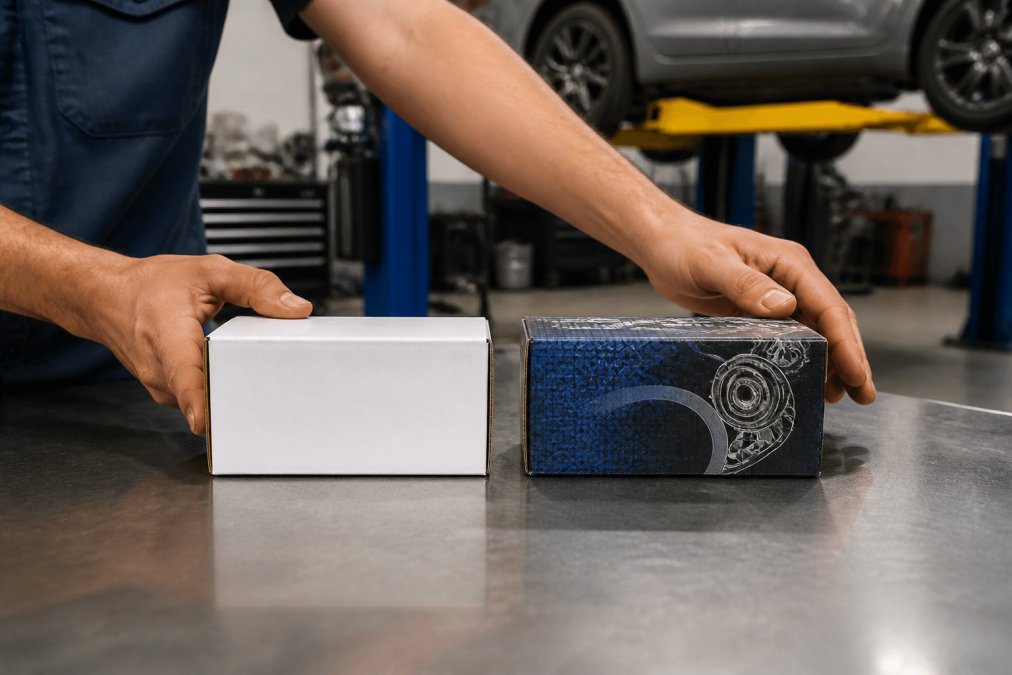
- Check the packaging construction. Genuine Japanese OEM packaging uses consistent fonts, consistent ink density, and a factory-applied label. Blurry print, a logo that's slightly off-center, or a label that peels cleanly off the box are common counterfeit tells.
- Inspect the part itself. Casting marks, mold seams, and the finish on machined surfaces are where counterfeits slip. A genuine sensor housing has crisp edges; a fake often has flash or a waxy surface.
- Weigh it if you can. Counterfeiters substitute cheaper metals. A genuine part and a counterfeit of the same part frequently differ in weight by a noticeable margin.
- Buy from a traceable channel. A dealer, a reputable independent shop, or a distributor with a published return address. Marketplace listings with no seller history and prices far below every legitimate seller are the highest-risk channel.
What This Means for Your Service Visit
When you bring a Japanese vehicle to a shop, ask where the parts come from. A shop that sources through dealer networks or authorized distributors can show you the invoice chain; one that can't name its supplier can't guarantee the part.
When working on vehicles, verifying part numbers against the manufacturer catalog before installation and keeping the packaging and invoice on file with the repair order can be beneficial. That record can matter at resale and if a part fails under warranty. Verifying a part number takes minutes; replacing an engine damaged by a counterfeit takes weeks.
Common Repair Issues in Japanese Vehicles (and Why They're Different)
The most common repair issues in Japanese vehicles cluster around wear-and-tear components and proprietary systems rather than structural failure. That's a good thing, but it means repairs demand diagnostic expertise rather than parts-swapping.
Timing chains and belts, water pumps, control arm bushings, and sensors top the list. What makes these jobs different on a Japanese platform is how tightly everything is packaged. Clearances are small, fasteners are often single-use, and the service procedure matters as much as the part. A technician who's never worked on the platform can easily damage a component while removing it.
Regional Climate Impact on Japanese Components
Climate changes which components fail first. In a region with wide temperature swings and cold winters, rubber bushings, seals, and plastic cooling system parts take a harder hit, because repeated freeze-thaw cycles stress the same materials that summer heat degrades from the other direction.
Cold starts also load the battery and starter, and short winter trips never let the engine reach full operating temperature, the same severe-service condition that shortens fluid life. If you drive mostly short trips in cold months, treat your service intervals as the aggressive end of the range.
Diagnostic Tools: DIY Scanners vs. Professional OBD-II Expertise
A basic OBD-II scanner can read and clear trouble codes, which makes it useful for quick checks. It cannot tell you why a code set, and that's the part that actually fixes the car.
Modern Japanese vehicles run dozens of control modules that talk over proprietary systems. A generic scanner may read a code but miss the live data, freeze-frame information, and manufacturer-specific parameters that point to the real cause. Professional tools read those deeper layers, and a technician interprets them against known failure patterns for that platform.
Here's the honest breakdown:
- DIY scanner: Good for reading a check engine light, checking readiness monitors before an emissions test, and clearing a code after a simple fix.
- Professional diagnostics: Necessary for intermittent faults, drivability issues, sensor calibration, and anything involving multiple modules.
A common mistake is throwing parts at a code. The code tells you a symptom, not a diagnosis; replacing a sensor without confirming the circuit and live data is how a cheap fix becomes an expensive one.
Hybrid and Electric Japanese Powertrains: New Maintenance Rules
Hybrid and electric Japanese powertrains follow different maintenance rules than a conventional gas engine, and treating them the same way causes problems. There's no oil change on a full EV, but there are still fluids, filters, and cooling systems that need attention, and on a hybrid, an entire second powertrain most owners never think about until it fails.
What Actually Needs Service on a Hybrid
A hybrid like a Toyota Prius, a Honda Insight, or a Lexus hybrid carries a gasoline engine, electric motor-generators, a high-voltage battery pack, an inverter, and a power control unit, all coordinated by software. Each subsystem has its own service needs:
- Inverter coolant. The inverter converts DC battery power to AC for the motor-generators, and it generates heat doing it. That coolant is a separate circuit from engine coolant on most Japanese hybrids and has its own interval. It degrades like any coolant, the corrosion inhibitors deplete and the fluid's ability to carry heat drops.
- Battery cooling. Most Japanese hybrid battery packs are air-cooled, with a dedicated blower and filter. A clogged battery cooling filter is one of the most common and most overlooked hybrid service items, and restricted airflow shortens battery pack life.
- Transmission fluid. Hybrid transaxles use their own fluid specification, often a low-viscosity formulation that is not interchangeable with conventional automatic transmission fluid. Using the wrong fluid is a common and expensive mistake.
- Engine oil. The gasoline engine in a hybrid cycles on and off, which means it spends more time at lower operating temperatures than a conventional engine. That's a severe-service condition, and it argues for the shorter end of the oil interval, not the longer one.
- Brake fluid. Regenerative braking does most of the stopping, so pads and rotors last far longer than on a conventional car. The brake fluid still absorbs moisture from the air and still needs periodic flushing, because the hydraulic system is still doing the emergency and low-speed stopping.
What Actually Needs Service on a Full EV
A battery-electric Japanese vehicle has no engine oil, no spark plugs, no timing components, and no exhaust. What it does have:
- Reduction gear fluid. The single-speed reduction gearbox between the motor and the wheels uses fluid that shears and contaminates over time. It is not a lifetime fill in practice, regardless of what the marketing says.
- Battery thermal management coolant. Liquid-cooled packs use a dedicated coolant loop. The fluid needs periodic service, and the loop needs inspection for leaks.
- Brake fluid. Same moisture problem, same interval logic.
- Cabin air filter. More important on an EV than most owners realize, because the cabin is the only air the occupants breathe and the HVAC system runs differently than on a combustion car.
The High-Voltage Line
High-voltage systems are not a DIY project. The pack on a modern Japanese hybrid or EV runs in the hundreds of volts, and servicing it requires training, insulated tools, a documented de-energization procedure, and an understanding of how the vehicle isolates power. This is one area where specialized knowledge isn't optional, it's the difference between a repair and an injury.
Why This Matters for Long-Term Cost
The high-voltage battery is the single most expensive component on a hybrid or EV, and its lifespan is tied to how well its thermal management system is maintained. A clogged cooling filter or degraded inverter coolant forces the pack to run hotter, and heat ages a battery. The service costs a fraction of the pack.
Why Specialized Maintenance Protects Your Long-Term Cost of Ownership
Specialized maintenance lowers your long-term cost of ownership by preventing expensive failures and keeping the vehicle in a condition that holds its value. A well-maintained Japanese car regularly reaches 200,000 miles; a neglected one often needs a major repair long before that.
The math is simple. Routine services cost far less than the components they protect. A transmission service costs a fraction of a transmission replacement. A coolant flush costs a fraction of a head gasket job. Every interval you follow is money you don't spend later.
There's a resale angle too. Buyers and inspectors can tell the difference between a car with a documented service history and one without. Chassis integrity, sensor calibration, and mechanical reliability all show up in how the car drives and in what a pre-purchase inspection finds.
Speedy Roo Motorsports has served drivers across the Denver Metro area since 2002, and we've built our reputation on providing reliable service. We have the diagnostic equipment for luxury and performance Japanese platforms, and we offer local rentals and towing so a repair doesn't leave you stranded. If you're weighing a dealership visit against an independent shop, we encourage you to bring us the vehicle and the service history, and we'll provide transparent communication about what it needs and why.
Japanese vehicles don't fail because they're fragile. They fail when precision-engineered systems get generic care. If your service intervals have slipped, or a warning light has been on longer than you'd like to admit, that's the moment to act. Speedy Roo Motorsports specializes in Japanese automobiles, from routine maintenance to AWD dyno tuning and performance upgrades, backed by more than two decades of experience and a team that treats every customer with respect. Get started with Speedy Roo Motorsports and keep your Japanese car running the way it was engineered to.
Frequently Asked Questions
Are Japanese cars really low maintenance?
Japanese cars are reliable, but 'low maintenance' is misleading. They still need regular oil changes, fluid flushes, brake inspections, and timing belt or chain service per the factory schedule. Skipping these intervals leads to the same wear-and-tear problems as any vehicle. The difference is that when maintenance is done correctly with OEM parts and proper fluids, Japanese powertrains often reach 200,000 miles or more. Deferred service is what shortens vehicle lifespan, not the engineering itself.
What specific components in Japanese vehicles require specialized tools?
Several components may require specialized tools. For example, some engines require specific head bolt tools and valve adjustment procedures, and certain hybrid systems may need insulated high-voltage gloves and factory scan tools. Some transmissions require proprietary diagnostic software for relearn procedures. Timing chain tools, fuel line disconnects, and sensor calibration equipment can also be brand-specific. A shop without the appropriate tools risks damaging precision-engineered parts during what should be routine service.
Does using OEM parts matter for Japanese vehicle longevity?
Yes, especially for critical components. OEM parts are manufactured to the factory standards and engineering tolerances your vehicle was designed around. Aftermarket parts vary widely in quality; some meet or exceed OEM specs, but many do not. For sensors, timing components, and transmission parts, the difference shows up in long-term reliability. Counterfeit parts are also a real risk online. Ask your shop to confirm parts are genuine OEM or from a reputable aftermarket brand with verifiable sourcing.
How does the maintenance schedule for a Japanese car differ from domestic models?
Japanese maintenance schedules often call for shorter fluid intervals and specific viscosities that domestic schedules do not. Many Japanese engines use 0W-20 or 0W-16 oil, and CVT transmissions require exact fluid types. Some models specify timing belt replacement at 60,000 to 100,000 miles, while others use chains that still need inspection. Coolant types also differ; mixing incompatible coolants causes degradation. Following the manufacturer's schedule, not a generic one, protects the powertrain and keeps the warranty valid.