 listicle
Signs Your Honda Needs Service: 12 Key Indicators
Table of Contents
- 12 Signs Your Honda Needs Service
- 1. Dashboard Warning Lights and Check Engine Light
- 2. Unusual Engine Noises: Squealing, Grinding, and Thudding
- 3. Steering Wheel and Pedal Vibrations
- 4. Fluid Leaks and Strange Odors
- 5. Changes in Braking Performance
- 6. Poor Fuel Economy and Acceleration Issues
- 7. Difficulty Starting or Engine Stalling
- 8. Transmission Fluid Issues and Shifting Problems
- 9. Worn Tire Condition and Uneven Wear Patterns
- 10. Overheating and Operating Temperature Warnings
- 11. Suspension and Steering Handling Changes
- 12. Engine Mount Deterioration and Excessive Vibration
- Understanding Honda Warning Lights Explained
- Decoding Honda Maintenance Minder Codes
- Common Honda Problems and Model-Specific Issues
- DIY vs. Professional Service: When to Visit a Certified Technician
- Cost of Honda Service and Budget Planning
- Preventative Maintenance: Your Best Defense Against Costly Repairs
- Frequently Asked Questions
Last Updated: July 17, 2026
Recognizing signs your Honda needs service is essential for maintaining your vehicle's performance and safety. At Speedy Roo Motorsports, we've spent over two decades helping Honda owners in Aurora, Colorado understand what their vehicles are telling them before small issues become expensive repairs. Your Honda communicates through warning lights, sounds, and performance changes, knowing how to interpret these signals separates proactive maintenance from costly emergency visits.
This guide covers the 12 most critical signs your Honda needs service, from dashboard warnings to mechanical changes you can feel while driving. We'll also explain Honda's Maintenance Minder system, decode common warning codes, and help you determine when a problem requires immediate professional attention.
12 Signs Your Honda Needs Service
1. Dashboard Warning Lights and Check Engine Light
Your Honda's dashboard is a communication hub. The check engine light is the most common warning, triggered when the onboard diagnostic system detects an issue with the engine, emissions system, or transmission. According to Honda's official owner resources, the check engine light can indicate anything from a loose gas cap to a failing catalytic converter.
Other critical dashboard warnings include the oil pressure light (shaped like an oil can), which signals low oil levels or failing oil pump components. The temperature gauge pointing into the red zone indicates overheating, pull over immediately. The battery warning light suggests charging system failure. The brake warning light means brake fluid is low or brake pads are worn dangerously thin.
2. Unusual Engine Noises: Squealing, Grinding, and Thudding
Squealing noises typically point to worn serpentine belts. Grinding sounds suggest metal-on-metal contact, often a bearing failing. Thudding or knocking during acceleration indicates pre-ignition, where fuel ignites improperly inside cylinders, this requires immediate attention. Clunking sounds when starting suggest weak motor mounts.
3. Steering Wheel and Pedal Vibrations
Vibration in the steering wheel during braking indicates worn brake pads or warped rotors. Steering wheel vibration during normal driving often points to wheel balance issues, bent rims, or suspension problems. Light vibration that appears occasionally can be scheduled for your next service. Severe vibration that makes steering difficult requires immediate professional evaluation.
4. Fluid Leaks and Strange Odors
Fluid leaks are visible warnings that something inside your Honda is failing. Engine oil leaks appear as dark stains under the vehicle. Transmission fluid leaks show as red or pink spots. Coolant leaks are bright green, orange, or pink. Brake fluid leaks are clear to light yellow.
Strange odors accompany many mechanical failures. A burning smell suggests overheating brakes, transmission, or engine components. A sweet smell indicates coolant leaking. A rotten egg smell points to catalytic converter problems. A musty smell inside the cabin suggests mold in the air conditioning system.
5. Changes in Braking Performance
Your brake pedal should feel firm and responsive. A soft, spongy pedal indicates air in the brake lines or brake fluid contamination. A pedal that sinks slowly to the floor suggests brake fluid is leaking from master cylinder seals. A pedal that requires excessive pressure to stop signals worn brake pads or glazed rotors.
Brake fade, reduced stopping power after repeated hard braking, indicates overheated brake components and requires immediate service. Pulling to one side during braking points to uneven pad wear or stuck calipers. Grinding sounds combined with reduced stopping power mean brake pads are completely worn.
6. Poor Fuel Economy and Acceleration Issues
A sudden drop in fuel efficiency signals several possible issues. A clogged air filter restricts oxygen to the engine. A failing oxygen sensor prevents the engine computer from adjusting the fuel mixture properly. A dirty fuel injector reduces combustion efficiency. Worn spark plugs increase ignition delay.
Acceleration problems, hesitation when pressing the gas pedal, sluggish response, or lack of power, indicate fuel delivery issues, ignition problems, or engine computer errors. A failing fuel pump struggles to maintain pressure. Clogged fuel injectors spray unevenly.
7. Difficulty Starting or Engine Stalling
An engine that cranks slowly or won't turn over typically points to battery or starter issues. A weak battery struggles to spin the starter motor fast enough to ignite the engine. A failing starter motor can't engage the flywheel. A corroded battery connection prevents current flow.
Frequent stalling during normal driving indicates fuel system problems, ignition timing issues, or transmission control problems. Cold-start difficulty shouldn't persist beyond a few seconds, if your Honda struggles to start at moderate temperatures, the battery is aging or the starter is weakening.
8. Transmission Fluid Issues and Shifting Problems
Transmission fluid is bright red and has a distinct smell. Dark, burnt-smelling transmission fluid indicates overheating or internal wear. Fluid leaks from the transmission are serious, transmission fluid cools and lubricates internal components, and loss of fluid leads to catastrophic failure within hours or days.
Automatic transmissions that shift roughly, hesitate between gears, or refuse to shift indicate low fluid, burnt fluid, or internal component wear. Manual transmissions with grinding noises when shifting suggest worn synchronizers or clutch problems. Slipping, engine RPM increasing without acceleration, indicates the transmission isn't engaging engine power to the wheels.
9. Worn Tire Condition and Uneven Wear Patterns
Tire condition directly affects safety and fuel economy. Tread depth should be at least 4/32 of an inch for safe wet-weather braking. Most Hondas experience tire wear every 25,000 to 50,000 miles depending on driving style and road conditions.
Uneven wear patterns reveal alignment and suspension problems. Wear on the outer edges suggests over-inflation or aggressive cornering. Wear on the inner edges indicates under-inflation or worn suspension components. Center wear points to consistent over-inflation. Cupping, scalloped wear patterns around the tire circumference, signals worn shocks or struts.
| Tire Wear Pattern | Likely Cause | Recommended Action |
|---|---|---|
| Outer edge wear | Over-inflation or aggressive cornering | Check pressure, inspect suspension |
| Inner edge wear | Under-inflation or worn suspension | Check pressure, inspect struts/shocks |
| Center wear | Consistent over-inflation | Reduce tire pressure to specification |
| Cupping/scalloping | Worn shocks or struts | Replace suspension components |
| One-sided wear | Misalignment | Get wheel alignment performed |
10. Overheating and Operating Temperature Warnings
Your Honda's engine operates at approximately 195-220 degrees Fahrenheit under normal conditions. The temperature gauge should stay in the middle of the normal range. Rising toward the hot side indicates cooling system problems. Prolonged overheating warps cylinder heads and damages gaskets.
Common causes include low coolant levels, thermostat failure, water pump wear, cooling fan malfunction, or radiator blockage. Preventative coolant flushes every 30,000 miles keep the cooling system clean and efficient.
11. Suspension and Steering Handling Changes
Your Honda should feel stable and predictable through corners. Excessive body roll indicates worn stabilizer links or bushings. Bouncing after bumps suggests worn shocks or struts. Clunking sounds from the suspension point to worn control arm bushings or ball joints.
Steering should be responsive and centered. Loose steering indicates worn steering components or tie rod ends. Steering that pulls to one side suggests alignment problems or worn suspension components. Heavy steering effort indicates power steering fluid loss or pump failure.
12. Engine Mount Deterioration and Excessive Vibration
Engine mounts are rubber and metal components that isolate engine vibration from the chassis. Worn mounts allow excessive engine movement, creating vibrations felt throughout the vehicle. Vibration at idle, most noticeable when stopped at a traffic light, indicates worn motor mounts. Vibration during acceleration suggests the engine is moving excessively under load. Clunking sounds when shifting from park to drive or reverse indicate severely worn mounts.
Understanding Honda Warning Lights Explained
Your Honda's dashboard displays dozens of warning lights, each communicating a specific system status. The check engine light (typically amber) indicates an emissions or engine system problem and requires professional scanning to identify the exact issue.
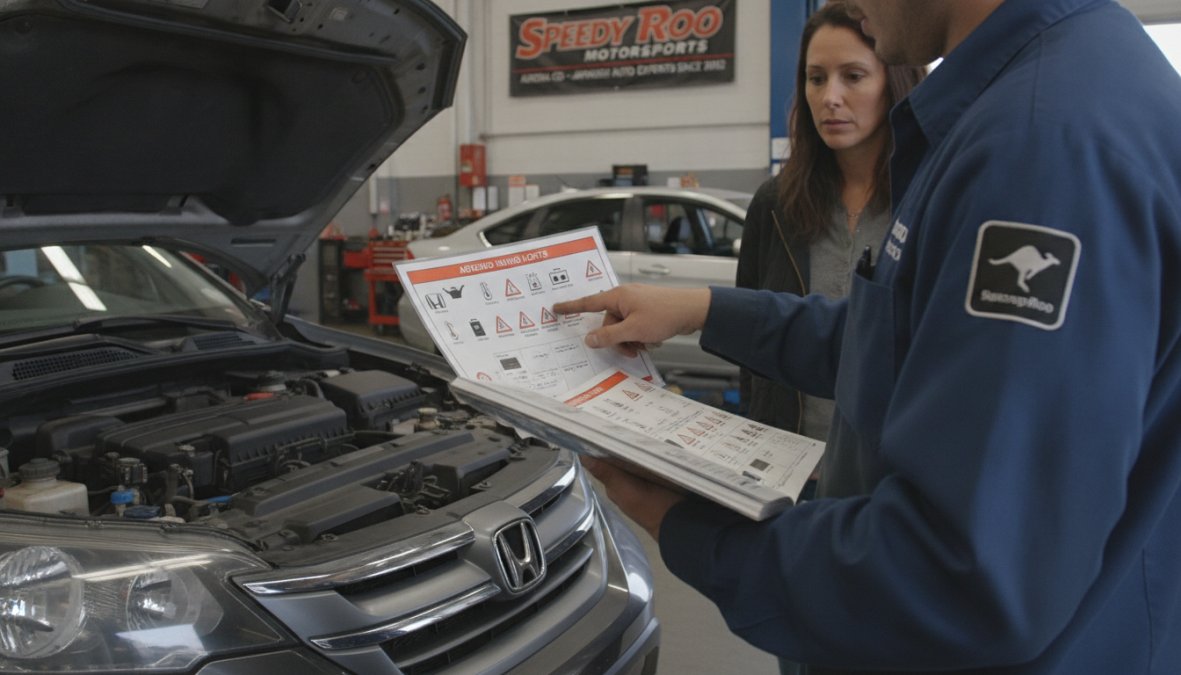
The brake warning light (typically red, shaped like a brake pad or exclamation mark in a circle) indicates low brake fluid or brake system failure, a safety-critical warning. The oil pressure light (shaped like an oil can) signals low oil pressure or oil level. The battery light (shaped like a battery) indicates charging system failure. The temperature light (shaped like a thermometer) signals engine overheating, pull over immediately. The tire pressure monitoring system light indicates low tire pressure in one or more tires. The service required light indicates the Maintenance Minder system has detected a scheduled service is due.
A steady check engine light can usually wait until your next scheduled service. A flashing check engine light requires immediate professional evaluation.
Decoding Honda Maintenance Minder Codes
The Honda Maintenance Minder system monitors driving conditions and engine operating parameters to determine optimal service intervals. This system accounts for individual driving patterns, a driver who takes frequent short trips in cold weather needs more frequent oil changes than a driver who takes long highway trips.
The system displays service codes using letters and numbers. Code A1 means oil change only. Code A2 means oil change plus engine air filter replacement. Code B1 means oil change plus tire rotation. Code B2 means oil change, tire rotation, and engine air filter replacement. Code B3 adds transmission fluid service.
The percentage displayed next to the service code indicates remaining oil life. When oil life reaches 15%, the Maintenance Minder alerts you that service is due soon. At 0% oil life, service is overdue. The percentage is condition-based, not time-based, an oil change might be due in 3,000 miles or 10,000 miles depending on driving conditions.
Common Honda Problems and Model-Specific Issues
Different Honda models exhibit distinct wear patterns. The Honda Civic is prone to transmission issues on certain model years, particularly 2006-2011 automatic transmissions that may shift roughly or hesitate. The Honda Accord frequently experiences VTEC solenoid issues on higher-mileage examples. The Honda CR-V, especially 2010-2016 models, commonly experiences transmission fluid leaks from the cooler lines. The Honda Odyssey minivan frequently develops transmission problems on 2005-2010 models.
Understanding model-specific issues helps owners prioritize preventative maintenance and catch problems early.
DIY vs. Professional Service: When to Visit a Certified Technician
Some Honda maintenance tasks are accessible to DIY mechanics. Oil changes, air filter replacement, cabin air filter replacement, and wiper blade replacement are straightforward tasks requiring basic tools and minimal mechanical knowledge.
More complex tasks require professional equipment and expertise. Transmission service requires specialized fluid and procedures. Brake service requires proper bleeding procedures to ensure safety. Electrical diagnostics require specialized scanners. Suspension work requires alignment equipment.
Professional technicians at certified service centers use manufacturer-specific diagnostic equipment, factory procedures, and genuine parts. They have training on model-specific quirks and common issues.
Cost of Honda Service and Budget Planning
Honda service costs vary significantly based on the specific service needed, your vehicle's age and mileage, and whether you choose an authorized dealership or independent shop. The best approach to budgeting for Honda service is understanding your vehicle's maintenance schedule and planning for predictable expenses. Your Maintenance Minder system tells you exactly what services are due. Preventative maintenance is far less expensive than emergency repairs.
Many Honda owners find that setting aside a small monthly amount for maintenance prevents financial stress when service is due.
Preventative Maintenance: Your Best Defense Against Costly Repairs
Preventative maintenance is the most cost-effective approach to Honda ownership. Following the manufacturer's recommended service schedule catches wear before it becomes critical. Regular oil changes keep engine components lubricated and protected. Scheduled fluid services prevent system degradation. Planned component replacement prevents catastrophic failure.
The Honda Maintenance Minder system simplifies preventative maintenance by telling you exactly what service is due based on your vehicle's condition and driving patterns. Vehicles receiving regular preventative maintenance often last 200,000 miles or more with minimal major repairs. Vehicles with neglected maintenance often experience catastrophic failures at 100,000 to 150,000 miles.
Recognizing signs your Honda needs service protects your investment and keeps you safe on Colorado roads. Dashboard warning lights, unusual noises, vibrations, fluid leaks, and performance changes are your Honda's way of asking for attention. The earlier you respond to these signals, the simpler and less expensive the repair.
Speedy Roo Motorsports has helped thousands of Honda owners in Aurora maintain their vehicles reliably since 2002. Our certified technicians understand Honda systems completely, use factory-approved diagnostic equipment, and stand behind every repair with our commitment to quality work and friendly customer service. When you notice any signs your Honda needs service, contact us for honest evaluation and transparent communication about what your vehicle needs.
Frequently Asked Questions
What does the Honda Maintenance Minder system mean?
The Honda Maintenance Minder is an intelligent onboard computer system that monitors your driving habits and engine operating conditions to determine when your Honda needs service. It displays codes like A, B, and numbers 1-7 to indicate specific maintenance tasks. The system calculates oil life based on actual driving conditions rather than just mileage, and alerts you when service is needed, typically at 15% oil life remaining. This personalized approach helps optimize your vehicle's performance and longevity.
What are the most common problems with Honda cars?
Common Honda problems vary by model but often include transmission issues in certain Accord and Civic generations, engine carbon buildup affecting fuel efficiency, worn engine mounts causing excessive vibration, and brake pad wear on higher-mileage vehicles. HVAC system failures, water leaks in door seals, and steering component wear are also frequently reported. The specific issues depend on your model year and driving conditions. Regular preventative maintenance through scheduled service intervals helps catch these problems early before they become costly repairs.
How often should a Honda be serviced?
Honda recommends following the Maintenance Minder system, which provides personalized service intervals based on your driving habits and conditions. Typically, Hondas need service every 10,000 miles or annually, whichever comes first, though this varies based on vehicle use. Cold weather, short-trip driving, and towing increase service frequency. Rather than guessing, check your dashboard for the Maintenance Minder alert, it accounts for ambient temperature, vehicle use, and operating conditions to determine the optimal service schedule for your specific Honda.
How much does Honda service usually cost?
Honda service costs depend on the specific maintenance needed and whether you visit a dealership or independent repair shop. Routine services like oil changes and tire rotations are generally affordable, while more complex repairs involving transmission fluid, brake pads, or engine components cost more. Costs also vary by location and service provider. For accurate pricing on your specific Honda's needs, contact an authorized service center or certified technician who can provide a quote based on your vehicle's condition and required maintenance.