 how-to
Risks of Driving With a Worn Timing Belt
Table of Contents
- Why a Worn Timing Belt Is a Risk You Shouldn't Ignore
- Worn Timing Belt Symptoms You Can Catch Early
- What Happens When a Timing Belt Breaks While Driving
- What to Do If a Timing Belt Breaks or You Suspect It's Failing
- Timing Belt Replacement Interval: Time and Mileage Both Matter
- How to Tell If Your Engine Is Interference or Non-Interference
- Conclusion
- Frequently Asked Questions
Last Updated: October 14, 2026
Why a Worn Timing Belt Is a Risk You Shouldn't Ignore
A worn timing belt can fail without warning, and the damage often runs into the thousands.
The core problem: a timing belt gives almost no warning before it lets go, so most drivers only learn it was overdue when the engine quits.
This guide covers what the belt does, the symptoms you can catch early, what happens when it snaps, and what to do if you suspect yours is failing.
What the Timing Belt Actually Does
When the belt slips or breaks, timing is lost: the camshaft stops while the crankshaft keeps spinning, and on many engines the pistons strike the open valves.
The belt also drives related parts on many Japanese engines, including the water pump and tensioner, so a belt service is the right time to address those too.
Interference vs. Non-Interference Engines
Interference engines have valves and pistons occupying the same space at different times.
Non-interference engines have enough clearance that valves and pistons never meet, even if the belt snaps. They stall, but the internals survive.
The catch: most modern Japanese engines are interference designs, so a broken belt is usually a major repair.
| Engine Type | Valve/Piston Clearance | Result of Belt Failure |
|---|---|---|
| Interference | No clearance at overlap | Bent valves, piston damage |
| Non-interference | Clearance at all times | Engine stalls, no internal damage |
Worn Timing Belt Symptoms You Can Catch Early
Worn timing belt symptoms are subtle at first, which is why they get missed. Catching them early is your best chance to avoid a roadside failure.
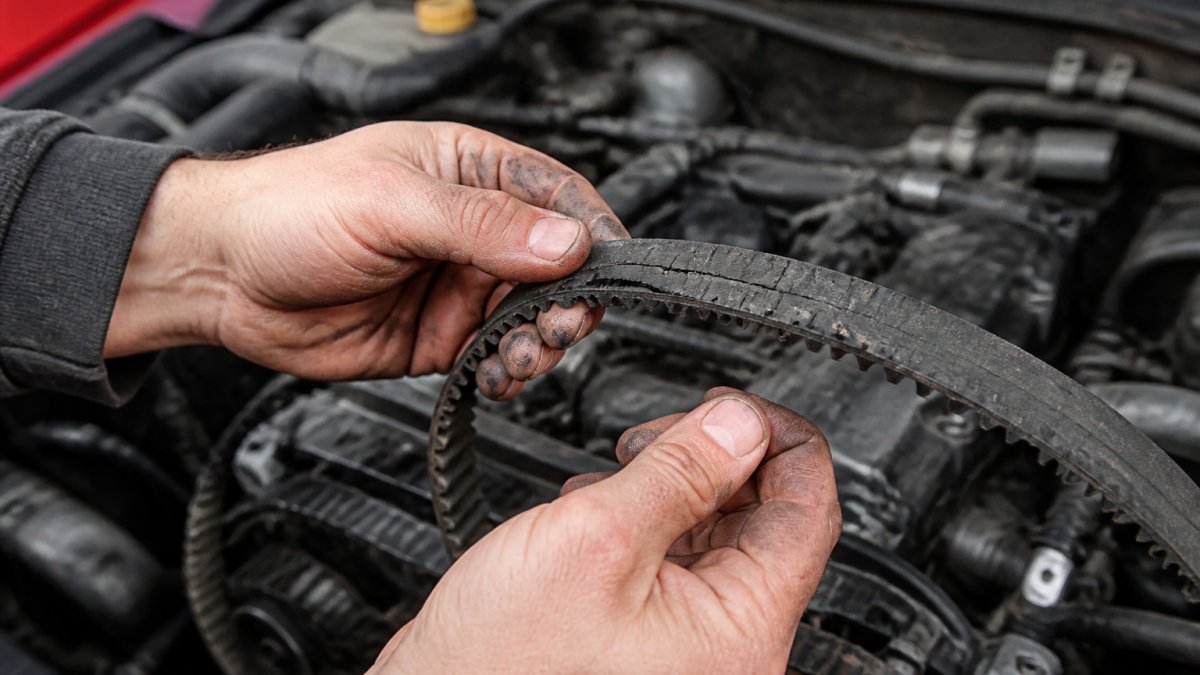
Most drivers notice something feels off before the belt breaks. The trick is knowing which signs point to the belt.
Difficulty Starting, Misfires, and Rough Running
A slipping belt throws off engine timing, showing up as hard starting, a rough idle, or an intermittent misfire.
You might feel the engine stumble at stoplights or crank longer than usual. These signs worsen as the belt wears.
If your check engine light shows a misfire code, don't assume spark plugs.
Unusual Engine Noises and Sudden Loss of Power
A failing belt or worn tensioner often makes noise, listen for chirping, squealing, or ticking from the front of the engine.
Loss of power is another red flag. The engine may feel flat or hesitate under acceleration as timing drifts.
- Chirping or squealing from the belt area
- Ticking or rattling near the timing cover
- Hesitation or sluggish acceleration
What Happens When a Timing Belt Breaks While Driving
You lose power steering and brake assist at once, making the car hard to steer and stop, a real collision risk, especially at highway speed.
On an interference engine, damage happens in the first second: the crankshaft keeps turning while the camshaft stops, and pistons slam into open valves.
The repairs that follow can include:
- Bent or broken valves
- Damaged pistons and cylinder walls
- A warped or cracked cylinder head
A snapped belt rarely means just a new belt, usually a top-end rebuild, or a replacement engine in severe cases.
What to Do If a Timing Belt Breaks or You Suspect It's Failing
What to do if a timing belt breaks comes down to one rule: stop driving.
Do not try to restart it. Cranking an engine with a broken belt turns minor damage into major damage, every rotation risks another valve strike.
Follow these steps:
- Pull to a safe spot and turn off the engine.
- Do not attempt to restart it.
- Turn on your hazards and get to safety.
- Call for a tow to a qualified shop.
- Ask for a timing inspection before any repair estimate.
If you suspect the belt is failing but the car still runs, treat it the same way.
Timing Belt Replacement Interval: Time and Mileage Both Matter
The timing belt replacement interval is set by the manufacturer in two forms: mileage and time. Whichever comes first counts.
Find the Interval for Your Specific Vehicle
Don't rely on a generic number. Intervals vary widely by make, model, engine code, and year, even within a brand. The authoritative source is your owner's manual maintenance schedule, then a factory service manual or a shop that services your make.
If you cannot find the schedule, treat an unknown-history belt on a high-mileage vehicle as due.
Why Time Matters as Much as Mileage
Rubber degrades with age regardless of mileage. Heat cycles, ozone, and oil or coolant contamination accelerate decay, a low-mileage 10-year-old car can still have a brittle, cracked belt.
That's why a garage-kept weekend car isn't automatically safe. If the belt has never been changed and the vehicle is past the time interval, it's due even with a low odometer.
Operating Conditions That Shorten Belt Life
- Extreme underhood heat and repeated short trips that never fully warm the engine
- Stop-and-go driving that adds heat cycles without racking up highway miles
- Oil or coolant leaks that contaminate the belt and soften the rubber
Service History: The Factor Most Owners Overlook
If you bought the car used and cannot document when the belt was last replaced, treat it as overdue. A missing record is not proof the work was done.
When you do schedule the service, replace the belt as part of a kit that includes the tensioner, idler pulleys, and water pump when the design routes the pump through the timing system.
Preventive Replacement vs. Post-Failure Repair
A preventive timing belt service is planned maintenance with a known scope.
On a non-interference engine, a failed belt usually means a tow, a new belt, and related components, with no internal engine damage.
Exact prices vary by vehicle, region, and the extent of damage, so get a written estimate for your specific make and model rather than relying on a general figure.
| Scenario | Typical Scope | Predictability |
|---|---|---|
| Preventive belt service | Belt, tensioner, idlers, water pump as applicable | Known scope, scheduled cost |
| Non-interference belt failure | Tow, belt service, related components | Moderate, no internal damage |
| Interference belt failure | Tow, top-end rebuild or engine replacement | High variability, potentially severe |
What to Do If You Are Past the Interval
If you are past the mileage or time interval, or you do not know the service history, do not keep driving on the assumption that it will hold. Schedule an inspection and a replacement. If the belt is already showing symptoms such as chirping, ticking, misfires, or rough running, treat it as urgent and avoid high-speed driving until it is inspected.
How to Tell If Your Engine Is Interference or Non-Interference
Whether your engine is interference or non-interference changes everything about the risk of driving on a worn belt. On an interference engine, a snapped belt is a countdown to bent valves.
The problem is that "most modern engines are interference" is a generalization, not an answer for your car. You need to confirm it for your specific year, make, model, and engine code.
Step 1: Check the Owner's Manual and Maintenance Schedule
Open the maintenance section of your owner's manual and look for a timing belt replacement interval. If the manufacturer lists a required belt service (for example, at a specific mileage or time), that is a strong signal the engine is interference.
If the manual shows a timing chain instead of a belt, you are in a different maintenance category entirely. Chains are designed to last much longer, though they are not lifetime parts on every design.
Step 2: Confirm by Engine Code, Not Just Model Name
The same model year and nameplate can ship with two or three different engines, and they may not share the same interference status.
To confirm correctly, find your engine code. It is usually on a sticker under the hood, on the engine block, or in the VIN decode.
A practical shortcut: if a manufacturer specifies a timing belt replacement interval for your engine code, treat it as interference until a qualified shop tells you otherwise.
Step 3: Ask a Shop That Works on Your Brand
A shop that services your make regularly will know the interference status of common engine codes without looking it up. Ask directly: "Is this engine interference, and does it use a belt or a chain?" A good shop will answer in seconds. If they hedge, get a second opinion.
Why Visual Inspection Is Not a Reliable Substitute
Even a trained eye cannot always predict a belt failure from a visual check. A belt can look intact on the outside while the internal cords are fatigued, or while the teeth are beginning to separate from the backing.
The tensioner, idler pulleys, and water pump matter just as much. A belt that looks fine can fail because a seized idler or a weak tensioner destroys it in minutes.
Timing Belt vs. Timing Chain vs. Serpentine Belt
Readers often confuse three different components. Getting them straight prevents a costly misunderstanding.
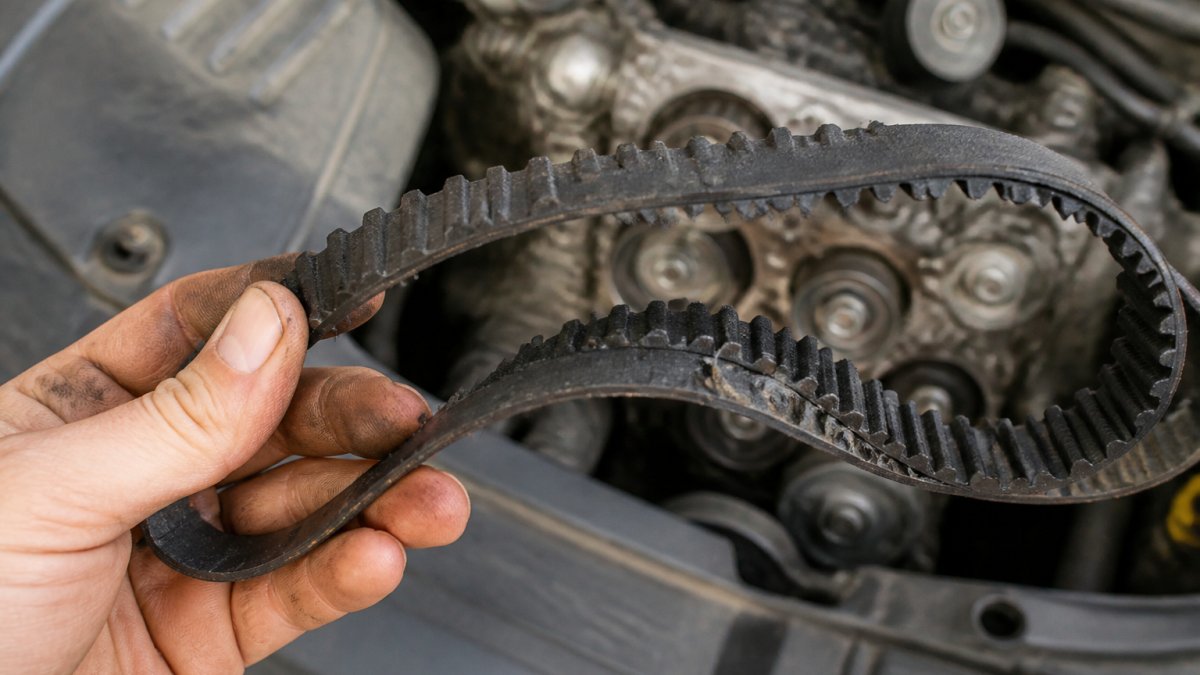
- Timing belt: A toothed rubber belt inside the engine that synchronizes the camshaft and crankshaft. Failure on an interference engine can destroy the top end.
- Timing chain: A metal chain that performs the same synchronization job. It generally lasts longer but can stretch, wear guides, or fail on some designs.
- Serpentine (accessory) belt: An external belt that drives the alternator, power steering pump, and air conditioning compressor. A failed serpentine belt leaves you with a dead battery and no power steering, but it does not cause valve-to-piston contact.
If a shop tells you your "belt" is worn, confirm which belt they mean before you authorize anything. The repair cost and the risk profile are completely different.
| Component | Location | What It Drives | Failure Consequence |
|---|---|---|---|
| Timing belt | Inside engine, under cover | Camshaft and crankshaft sync | Possible valve and piston damage on interference engines |
| Timing chain | Inside engine, under cover | Camshaft and crankshaft sync | Stretch, rattle, possible timing jump |
| Serpentine belt | External, front of engine | Alternator, power steering, A/C | Dead battery, no power assist, overheating |
Conclusion
The risks of driving with a worn timing belt come down to one hard truth: the cost of prevention is far lower than the cost of failure. A belt service is planned maintenance.
At Speedy Roo Motorsports, we've serviced Japanese vehicles since 2002, and we know exactly which engines are interference designs and which aren't.
Frequently Asked Questions
How long can you drive with a worn timing belt?
There's no safe mileage window once a timing belt shows wear. A belt can fail without warning, and continuing to drive risks sudden engine failure and bent valves. If you're past the manufacturer's recommended replacement interval, typically 60,000 to 105,000 miles depending on the vehicle, schedule service immediately rather than waiting for symptoms.
Can a worn timing belt damage the engine?
Yes, especially in interference engines. When the belt breaks, the pistons and valves can collide, bending valves and damaging pistons or cylinder walls. Repair costs for this type of damage often run into the thousands of dollars, far more than a preventive timing belt replacement, which is why replacing the belt on schedule matters.
What are the warning signs of a worn timing belt?
Common worn timing belt symptoms include difficulty starting, engine misfires, rough running, unusual noises like ticking or squealing from the belt area, and sudden loss of power. Some belts fail with no symptoms at all, which is why mileage and time-based replacement intervals matter more than waiting for warning signs.
Should you tow a car with a suspected worn timing belt?
Yes. If you suspect the belt is worn or failing, avoid driving and have the vehicle towed to a repair shop. Continuing to drive, even a short distance, can turn a simple belt replacement into major engine repair if the belt snaps. A tow is far cheaper than rebuilding a damaged engine.