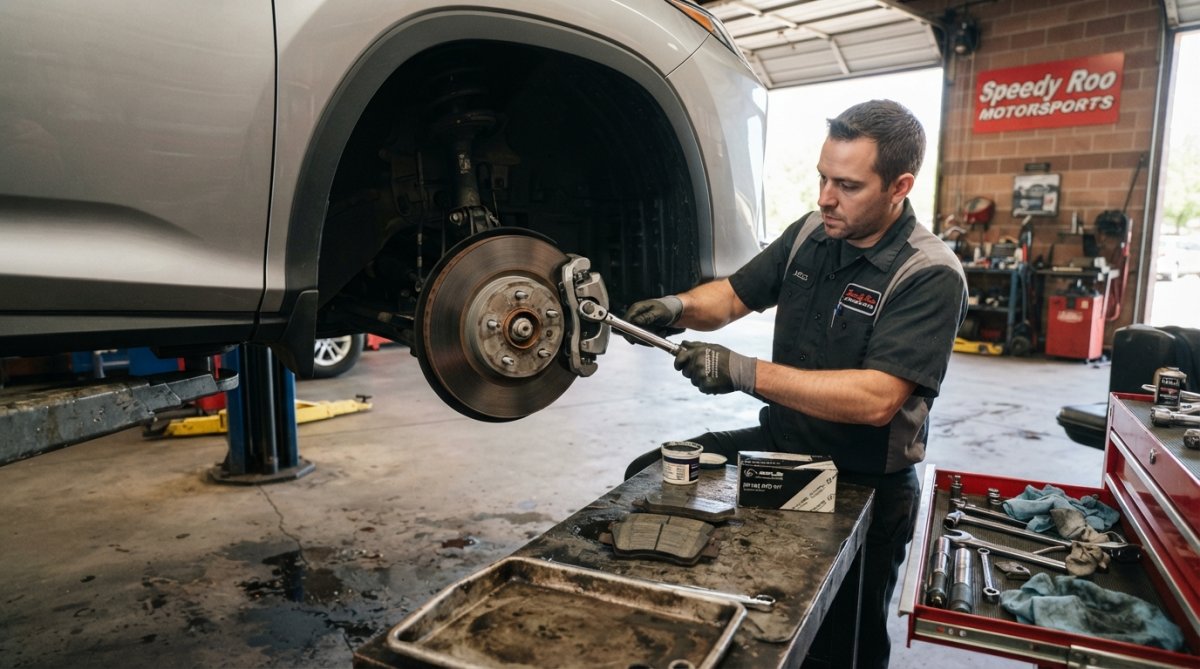
 ultimate-guide
Lexus Brake Pad Replacement Cost: 2026 Pricing Guide
Table of Contents
- Understanding Lexus Brake Pad Replacement Cost
- Average Brake Pad Replacement Cost for Lexus Models
- Lexus Brake Service Cost: Dealership vs. Independent Mechanic
- Lexus Brake Pad and Rotor Replacement Cost: Full Job Breakdown
- Lexus Brake Pad Life Expectancy and Replacement Timing
- DIY Lexus Brake Pad Replacement Cost vs. Professional Service
- OEM vs. Aftermarket Brake Pads: Cost and Quality Comparison
- Warranty Coverage and Additional Services to Know About
- Frequently Asked Questions
Lexus Brake Pad Replacement Cost: 2026 Pricing Guide
Last Updated: July 27, 2026
When you hear squealing from your Lexus brakes, the question isn't whether you need service, it's how much it will cost. Lexus brake pad replacement cost varies significantly based on your model, whether you choose a dealership or independent mechanic, and whether additional work like rotor service is needed. At Speedy Roo Motorsports, we've spent over two decades helping Denver-area Lexus owners understand exactly what they're paying for.
Understanding Lexus Brake Pad Replacement Cost
Lexus brake pad replacement cost depends on your specific model year, brake system configuration, parts quality choice, and service location. The cost breakdown separates into parts and labor. Parts costs vary based on whether you choose OEM (Original Equipment Manufacturer) Lexus pads or aftermarket alternatives. Labor costs depend on dealership rates, which run higher, or independent shop rates, which are typically 30-50% lower for identical work.
Average Brake Pad Replacement Cost for Lexus Models
Pricing varies across Lexus's lineup because different models use different brake system configurations. The RX350 uses a different brake assembly than the lighter ES sedan, meaning different pad sizes, labor times, and sometimes rotor requirements.
| Lexus Model | Typical Service Range | Complexity | Notes |
|---|---|---|---|
| CT 200h | Lower | Simple | Regenerative braking extends pad life |
| IS 250/350 | Lower-Middle | Moderate | Performance-oriented brake design |
| ES 300/350 | Middle | Moderate | Balanced sedan brake system |
| NX 250/350 | Middle | Moderate | Compact crossover standard setup |
| RX 350/450h | Middle-Higher | More complex | Larger vehicle, heavier braking demands |
| GX 460 | Higher | Complex | Heavy SUV, more aggressive pad wear |
| LX 570 | Highest | Most complex | Largest model, premium brake components |
Labor time varies dramatically based on brake system design. Some models have pads that are quick to access; others require removing wheels, calipers, and suspension components.
Lexus Brake Service Cost: Dealership vs. Independent Mechanic
Dealerships have higher overhead costs, factory-trained technicians, and stock OEM parts at full retail pricing. Independent shops typically operate with lower overhead, translating to 30-50% lower pricing for identical work.
Dealerships offer one genuine advantage: immediate access to OEM parts and warranty coverage guarantees. If your Lexus is under warranty, dealership service may be required to maintain that coverage. A newer Lexus under warranty probably belongs at the dealership; a paid-off Lexus with 80,000 miles benefits from independent shop pricing.
Why Independent Shops Cost Less
Independent repair facilities operate on thinner margins, relying on volume and customer retention rather than premium pricing. They buy parts through distributors, reducing costs by 15-25% compared to dealership pricing. A shop operating for over two decades survives only by doing quality work, one bad brake job leads to liability, reputation damage, and lost customers.
Dealership Advantages and Trade-Offs
Dealerships offer diagnostic certainty and parts availability. If your Lexus has complex electrical issues affecting brakes, dealership technicians have access to factory diagnostic software and specific trouble codes. The trade-off is price and convenience. Dealership service appointments often require longer waits, and you're paying for the facility, certification, and brand name alongside actual work.
For most Lexus owners, the sweet spot is dealership service during the warranty period, then transitioning to a trusted independent shop once warranty coverage ends.
Lexus Brake Pad and Rotor Replacement Cost: Full Job Breakdown
A complete brake job involves more than pads. When rotors are worn, scored, or warped, they must be addressed through resurfacing or replacement. This is where brake service costs escalate dramatically.
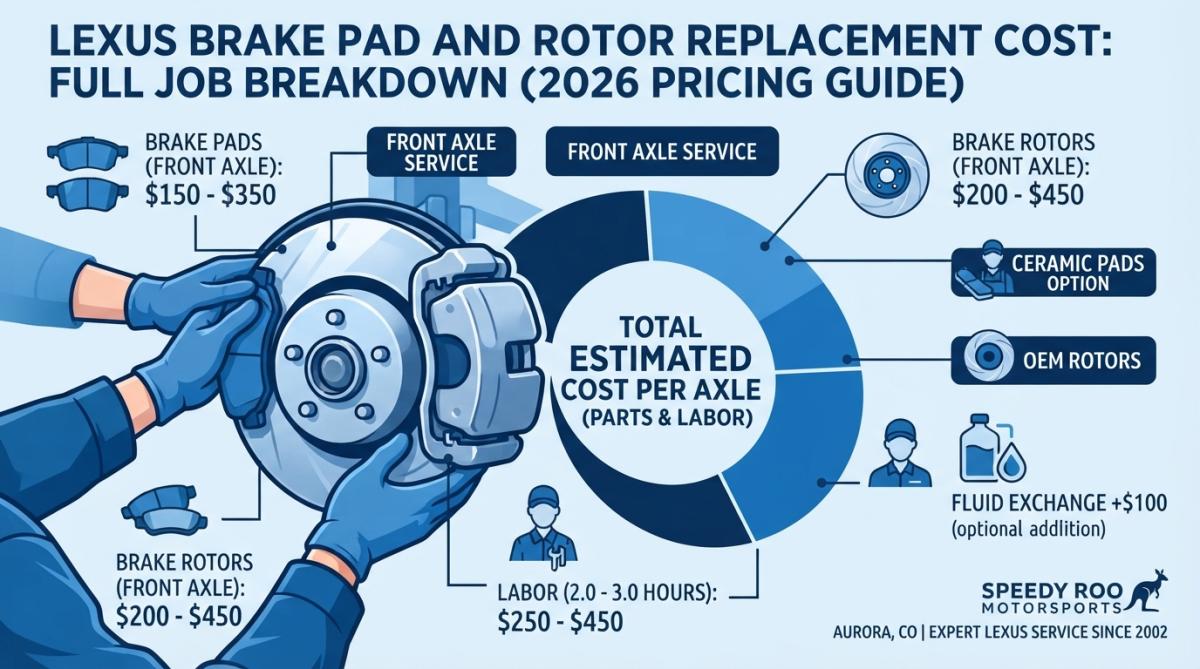
Rotors are disc-shaped components that brake pads clamp against to stop your vehicle. The decision between resurfacing and replacement depends on rotor thickness. Most rotors have a minimum thickness specification. If your rotor can be resurfaced and still meet that minimum, resurfacing is cheaper. If it's already too thin or too damaged, replacement is necessary.
Many shops automatically recommend rotor replacement because it's more profitable. The honest assessment: if rotors are within specification with minor damage, resurfacing works fine. If they're already thin or severely damaged, replacement is the right call.
When Rotors Need Replacement vs. Resurfacing
Rotor replacement becomes necessary when thickness measurements show wear below minimum specification, when deep cracks are visible, or when warping causes vibration during braking. Rotor resurfacing works when the rotor has surface rust or minor scoring but adequate thickness remains.
Modern brake pads often wear rotors faster than older formulations. Ceramic pads, popular on newer Lexus models, can be harder on rotors than semi-metallic pads.
Front vs. Rear Brake Work
Front brakes do most stopping work; rear brakes provide supplemental power and handle parking brake duties. Front brake pads typically wear faster than rear pads, sometimes twice as fast in city driving. You'll often need front brake service before rear service becomes necessary.
Rear brake service on some Lexus models involves more complexity because rear brakes incorporate the parking brake mechanism. A rear brake job on an RX350 might take longer than the same job on an ES due to additional components.
Lexus Brake Pad Life Expectancy and Replacement Timing
Brake pad life varies based on driving habits, road conditions, and pad material. Highway drivers with gentle braking might get 70,000 miles from a set; urban drivers in stop-and-go traffic might need new pads every 40,000 miles.
Brake pad material composition affects longevity significantly. Ceramic pads, standard on most newer Lexus models, last longer than semi-metallic pads but cost more upfront. Driving style matters more than most drivers realize, aggressive braking accelerates pad wear dramatically, while smooth, gradual braking extends pad life significantly.
Signs Your Pads Need Replacement
A squealing noise when braking indicates pads have worn to approximately 2mm of friction material remaining. Most modern brake pads have a metal wear indicator tab that creates this intentional noise.
Grinding sounds indicate pads have worn completely through to the backing plate, and metal is grinding against the rotor. Stop driving immediately; continuing will cause rotor damage requiring replacement.
Soft or spongy brake pedal feel suggests air in brake lines or brake fluid degradation, not necessarily pad wear. Reduced braking performance can indicate pad wear, rotor problems, brake fluid issues, or caliper problems. Don't assume pad replacement will fix reduced braking without proper diagnosis.
Maintenance Schedule Guidelines
Lexus recommends inspecting brake pads every 10,000 miles and replacing them when worn to approximately 2mm. Most owners can safely go 20,000-30,000 miles between inspections with moderate driving. The key is inspection, not guessing. Many shops offer free brake inspections, which tell you exactly how much pad material remains and whether rotors show wear or damage.
DIY Lexus Brake Pad Replacement Cost vs. Professional Service
Brake pad parts cost significantly less than total service cost. A set of OEM Lexus brake pads might cost a quarter of what you'd pay for complete service, parts and labor combined. However, brake work requires specific tools, a jack, jack stands, wrench set, and possibly a brake caliper compression tool. You need a clean, safe workspace and knowledge to properly bleed air from brake lines.
More importantly, brake work has safety implications. A mistake in brake pad installation might cause brake failure weeks later, at a critical moment. Improperly bled brake lines can lead to spongy brakes or complete brake failure.
Tools, Parts, and Hidden Risks of DIY Work
Basic brake pad replacement tools are relatively modest: a jack, jack stands, basic wrench set, and possibly a brake pad spreader. Total tool cost might be $50-100 if you don't already own these. Parts cost for OEM pads is typically $75-150.
If the job requires rotor work, complexity increases dramatically. Some Lexus models have electronic brake proportioning systems requiring specific procedures during pad replacement. Some have brake pad wear sensors that must be properly reinstalled or replaced. Damaging these sensors means expensive repairs.
Brake fluid handling is another risk. Brake fluid is hygroscopic, absorbing moisture from air. Opening the reservoir without proper sealing introduces moisture that degrades your brake system.
When Professional Service Saves Money Long-Term
Professional brake service costs more upfront but often saves money long-term by catching problems early. A shop performing brake inspection identifies rotor wear, brake fluid degradation, and caliper issues that DIY work would miss. Professional service includes proper brake fluid disposal, required by law in many jurisdictions, and proper torque specifications for all fasteners.
OEM vs. Aftermarket Brake Pads: Cost and Quality Comparison
OEM Lexus brake pads are manufactured to Lexus specifications, often by the same suppliers providing pads for new vehicles. Aftermarket pads are made by third-party manufacturers and sold through independent retailers or online. The price difference is substantial, but performance difference isn't always proportional.
Ceramic, Semi-Metallic, and Performance Options
Ceramic brake pads are the most common choice for modern Lexus vehicles. They offer quiet operation, minimal dust, and good longevity. Most newer Lexus models come equipped with ceramic pads from the factory.
Semi-metallic pads contain metal particles improving heat transfer and braking power. They generate more dust, are noisier, and wear faster than ceramic pads. However, they excel in heavy braking situations and perform better at higher temperatures. Drivers who tow, drive in mountainous terrain, or brake frequently might benefit from semi-metallic pads.
Organic pads are the least expensive option but wear fastest. For light-duty driving with gentle braking, organic pads are adequate and cost-effective.
Performance pads are engineered for high-performance driving, track use, or heavy braking demands. They cost more, wear faster, and generate more dust than standard pads. For most daily drivers, performance pads are overkill.
If you drive a Lexus with ceramic pads from the factory, stick with ceramic pads at replacement. For most owners, OEM-equivalent ceramic pads from reputable aftermarket manufacturers perform identically to OEM pads at lower cost.
| Pad Type | Cost | Longevity | Noise | Dust | Best For |
|---|---|---|---|---|---|
| Ceramic | Higher | Longest | Quiet | Minimal | Daily driving, most conditions |
| Semi-Metallic | Moderate | Moderate | Loud | Moderate | Heavy braking, mountainous terrain |
| Organic | Lowest | Shortest | Quiet | Minimal | Light-duty driving only |
| Performance | Highest | Short | Variable | High | Track use, spirited driving |
Warranty Coverage and Additional Services to Know About
Most brake pad replacement comes with a limited warranty, typically 12 months or 12,000 miles. This covers defects in the pads themselves but not wear-related issues. Dealership brake service often includes manufacturer warranty coverage extending beyond the shop's standard warranty.
Brake Fluid Flush and Sensor Replacement Costs
Brake fluid degrades over time as it absorbs moisture from air. Lexus recommends flushing brake fluid every two years or 20,000 miles. A brake fluid flush removes old fluid and replaces it with fresh fluid, costing less than brake pad replacement but often overlooked.
Some shops recommend a brake fluid flush whenever brake pads are replaced. This is good practice because you've already broken into the brake system, and fresh fluid costs relatively little to add.
Brake pad wear sensors are electronic components triggering a warning light when pads are nearly worn. Some sensors are reusable; others are single-use and must be replaced. Replacement sensor cost is typically $20-50 per sensor.
When getting a brake service estimate, ask specifically whether it includes brake fluid top-off, brake fluid flush, and wear sensor replacement.
Brake service is one of those vehicle maintenance items where understanding your options pays real dividends. The difference between an informed decision and an uninformed one can easily be several hundred dollars. Whether you choose dealership service, independent shop service, or attempt DIY work, knowing what you're paying for puts you in control.
At Speedy Roo Motorsports, we've helped thousands of Lexus owners in the Denver area navigate brake service decisions. We inspect your brakes thoroughly, show you photos of the wear, explain exactly what work is necessary and what's optional, and provide transparent pricing upfront. Our technicians have decades of combined experience with Lexus vehicles and maintain the same diagnostic equipment as dealerships, without the dealership price markup. If you're facing brake service on your Lexus, get a detailed inspection and honest estimate from a shop that treats you with respect and values your business long-term.
Frequently Asked Questions
How much does Lexus brake pad replacement cost on average?
Lexus brake pad replacement cost varies significantly based on model, whether you choose OEM or aftermarket pads, and whether you visit a dealership or independent mechanic. Pricing depends on your specific vehicle year and the shop's labor rates. Contact Speedy Roo Motorsports for a personalized quote based on your Lexus model and current condition.
What's the difference between dealership and independent mechanic pricing for Lexus brake service?
Dealership service typically costs more due to higher labor rates and OEM-only parts requirements, but includes manufacturer-backed warranty coverage. Independent mechanics like Speedy Roo Motorsports offer competitive pricing through lower overhead while maintaining quality standards. Both can provide reliable brake service, the choice depends on your warranty priorities and budget.
How long do Lexus brake pads typically last before needing replacement?
Lexus brake pad life expectancy typically ranges from 25,000 to 70,000 miles, depending on driving habits, pad material (ceramic vs. semi-metallic), and road conditions. City driving with frequent braking wears pads faster than highway driving. Watch for squealing noise, grinding sounds, or reduced stopping distance as warning signs that your pads need inspection.
Should I replace brake pads and rotors together?
Not always. Rotors can often be resurfaced or turned rather than replaced, reducing costs. However, if rotors show excessive wear, scoring, or uneven thickness, replacement is necessary. A professional inspection determines whether your rotor resurfacing is safe or if full replacement is required. This assessment is essential for proper brake job completion.
Can I save money doing Lexus brake pad replacement myself?
While DIY work eliminates labor costs, brake work carries significant risks if done improperly, compromised stopping power endangers you and others. You'll need specialized tools, knowledge of brake caliper removal, and proper pad bedding procedures. Professional service ensures safety, warranty protection, and proper brake fluid and sensor checks that DIY work often misses.
[EXTERNAL_LINK: Lexus recommended maintenance schedule and service intervals | lexus.com]
[EXTERNAL_LINK: National Highway Traffic Safety Administration brake system safety guidelines | nhtsa.gov]
[EXTERNAL_LINK: Consumer Reports brake pad testing and longevity data | consumerreports.org]