 how-to
Honda HR-V AC Not Working? Fix It Fast (2026 Guide)
Table of Contents
- Honda HR-V AC Not Working: Start With These Symptoms
- Honda HR-V AC Blowing Warm Air: Common Causes
- Honda HR-V AC Refrigerant Recharge: Step-by-Step
- Honda HR-V AC Compressor Replacement Cost: What to Expect
- DIY vs. Professional Repair: A Cost-Benefit Analysis
- Year-Specific Known Defects and Visual Diagnostic Guide
- Frequently Asked Questions
Last Updated: September 29, 2026
Honda HR-V AC Not Working: Start With These Symptoms
When your Honda HR-V AC stops working, the first clue is usually how it fails, not just that it failed. A Honda HR-V AC blowing warm air feels different from one that never gets cold at all, and that difference points you toward the right fix. At Speedy Roo Motorsports, we've worked on Japanese vehicles since 2002. Below, we'll show you how to read the symptoms, then walk through the fixes in order.
Warm Air From Vents
Warm air from the vents is the most common complaint. The system runs, the fan blows, but the air never cools.
This usually means one of three things:
- Low refrigerant from a slow leak
- A failing compressor clutch that won't engage
- A blocked expansion valve restricting flow
Start by checking whether the compressor clutch spins when you turn the AC on. If it doesn't, the system is protecting itself.
Weak Airflow or Strange Noises
Weak airflow points to a different problem than warm air. If the air is cold but barely moving, your cabin air filter is likely clogged. A restricted filter chokes the evaporator core and cuts cooling fast.
Strange noises tell another story:
- Squealing suggests a slipping belt or pulley
- Clicking often means a weak compressor clutch
- Hissing can signal a refrigerant leak
A clogged cabin air filter is cheap to fix and easy to overlook. Most guides skip it. Don't.
Honda HR-V AC Blowing Warm Air: Common Causes
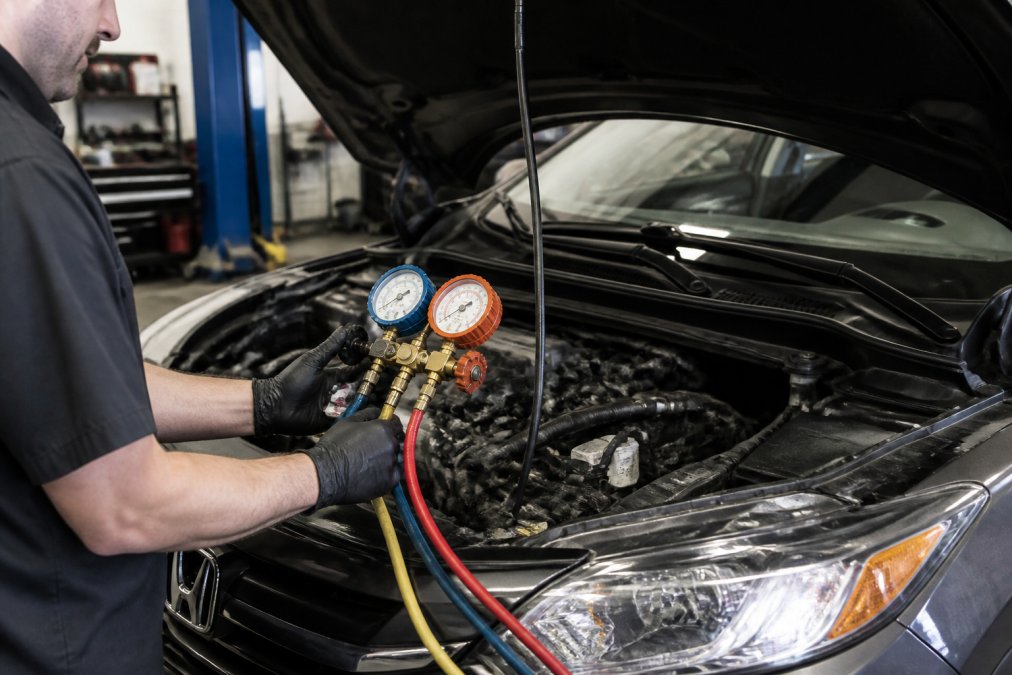
A Honda HR-V AC blowing warm air usually traces back to low refrigerant or a dead compressor clutch. Those two causes cover most cases we see. Here's how to tell them apart.
Low Refrigerant or a Leak
Low refrigerant is the top cause of weak cooling. Refrigerant doesn't get "used up" like fuel. If it's low, it leaked out somewhere.
Common leak points include:
- O-ring seals that dry out and crack
- The condenser, which takes road debris hits
- The evaporator core, hidden behind the dash
A pressure decay test or nitrogen pressure test finds leaks a simple recharge misses. Adding refrigerant without finding the leak just delays the problem.
Compressor Clutch Failure
A bad compressor clutch is the second big culprit. The clutch is the electromagnetic hub that locks the compressor to the belt when you hit the AC button.
Signs it's failing:
- The clutch won't engage at all
- It engages, then cycles on and off rapidly
- You hear a loud click but no cooling follows
A worn clutch can often be replaced on its own. A seized compressor means a full replacement, plus a system evacuation to clear debris.
Honda HR-V AC Refrigerant Recharge: Step-by-Step
A Honda HR-V AC refrigerant recharge restores cooling only when the system is sealed and holds pressure. If you've confirmed there's no leak, a recharge is a job you can do at home with the right tools.
Tools You'll Need
- Manifold gauge set for reading high and low side pressure
- Vacuum pump for system evacuation
- Refrigerant (check your model year's spec)
- Safety glasses and gloves
- A thermometer for vent temperature checks
Recharge Procedure
- Connect the manifold gauges to the low and high service ports.
- Read system pressure with the AC off to get a baseline.
- Pull a vacuum for at least 30 minutes to remove moisture and air.
- Watch the gauge hold steady. If it climbs, you have a leak.
- Add refrigerant through the low side only, never the high side.
- Check vent temperature at the center vent with the AC on max.
- Confirm the compressor cycles normally and cooling holds.
The ambient temperature sensor and climate control module also affect how the system behaves. If pressures look right but cooling doesn't, those are the next suspects.
Honda HR-V AC Compressor Replacement Cost: What to Expect
Honda HR-V AC compressor replacement cost is the question most owners actually have, and the honest answer is a range, not a single number. The range is driven by four things: the compressor itself, labor hours, whether the system needs a flush, and the parts you should always replace alongside it.
What Drives the Price
The compressor. The HR-V uses different compressor part numbers across model years, and pricing reflects that. A remanufactured unit typically costs meaningfully less than a new OEM unit, but reman quality varies by rebuilder. Ask which one you're getting before you approve the job.
Labor time. The compressor sits low on the engine and is driven off the accessory belt, so the job involves recovering refrigerant, removing the belt, disconnecting lines, swapping the unit, and recharging. Most shops book this as a multi-hour job. Labor rate is the single biggest variable between shops in the same metro.
System flush and evacuation. If the old compressor seized or shed debris, the condenser and lines need flushing.
Parts That Commonly Get Replaced at the Same Time
- Receiver-drier, always
- Expansion valve, often, especially if pressures were abnormal
- O-rings and seals at every connection you open
- Serpentine belt, cheap insurance while the belt is already off
- Condenser, only if it's damaged or clogged beyond cleaning
How to Get a Real Number
When you call, ask three questions:
- Is the quote for a new OEM, a remanufactured, or an aftermarket compressor?
- Does it include a flush and a new receiver-drier?
- What's the warranty on the compressor and on the labor?
If a shop can't answer those three, keep calling.
For a current quote on your specific HR-V, reach out to Speedy Roo Motorsports with your model year and mileage and we'll price the job against your actual vehicle.
DIY vs. Professional Repair: A Cost-Benefit Analysis
DIY vs. professional AC repair comes down to tools, time, and risk. Some jobs pay off at home. Others cost more when they go wrong.
| Task | DIY Feasible? | Tools Needed | Risk If Done Wrong |
|---|---|---|---|
| Cabin air filter swap | Yes | None | Low |
| Recharge (sealed system) | Sometimes | Manifold gauges, vacuum pump | Refrigerant loss |
| Leak diagnosis | Rarely | Nitrogen test gear | Missed leak, repeat cost |
| Compressor replacement | No | Full AC tool set | System damage |
| Electrical diagnosis | No | Scan tool, wiring diagrams | Misdiagnosis |
Year-Specific Known Defects and Visual Diagnostic Guide
Year-specific defects matter because the HR-V's climate system changed across its production run, and the failure pattern most owners report shifts with it. Generic "check your refrigerant" advice misses this. Here's how to narrow the diagnosis by generation, then a visual walk-through you can run in your driveway.
Narrowing by Model Year
The HR-V has been sold in two distinct generations, and the AC complaints cluster differently between them.
Visual Diagnostic Walk-Through
You can rule in or out several common failures without any tools. Work through these in order.
Reading Diagnostic Trouble Codes
If your coolant levels or broader HVAC system show other odd behavior, that's worth a look too. According to the EPA's motor vehicle air conditioning guidance, handling refrigerant requires proper recovery equipment, which is one more reason some jobs belong in a shop.
Frequently Asked Questions
Is there a recall on the air conditioners for the Honda HR-V?
As of 2026, Honda has issued recalls for certain HR-V model years related to the AC system, including a 2019 recall for a faulty condenser. To check if your specific vehicle is affected, visit the NHTSA website and enter your VIN. Recalls are free to repair at any authorized Honda dealership, regardless of mileage or warranty status.
Why isn't my Honda car's AC blowing cold air?
The most frequent cause is low refrigerant due to a leak in the system. Other possibilities include a failed compressor clutch, a clogged expansion valve, or an electrical issue like a blown fuse. A professional diagnostic with manifold gauges and a pressure decay test can pinpoint the exact problem quickly.
How much does it cost to fix an AC compressor on a Honda HR-V?
The cost to replace a Honda HR-V AC compressor varies based on the model year and whether you choose a new or remanufactured part. It includes the compressor, refrigerant, and labor. For an accurate quote, contact a trusted repair shop like Speedy Roo Motorsports with your VIN.
Can I just recharge my Honda HR-V AC myself?
You can add refrigerant using a DIY recharge kit, but this only treats the symptom, not the leak. If your system has a leak, the new refrigerant will escape again. A proper repair involves finding and fixing the leak, then evacuating and recharging the system with the exact amount of refrigerant.
A failed AC turns every commute into a sweaty grind, and guessing at the fix usually costs more than the repair itself. Speedy Roo Motorsports has repaired Japanese automobiles since 2002, with the diagnostic tools and experience to find your HR-V's real problem the first time. We offer transparent communication, friendly service, and local rentals and towing for added convenience. Get started with Speedy Roo Motorsports and get your cool air back.