 how-to
Honda Accord Rough Idle Fix: 7 Steps to a Smooth Engine
Table of Contents
- Symptoms of a Rough Idle in Your Honda Accord
- Start Here: Pull Diagnostic Trouble Codes With an OBD2 Scanner
- Check for Vacuum Leaks and Inspect Spark Plugs
- Honda Accord Throttle Body Cleaning Step by Step
- Idle Air Control Valve Symptoms and What They Mean
- The Honda Idle Relearn Procedure After Repairs
- DIY or Shop? Cost and Warranty Considerations for Your Fix
- Frequently Asked Questions
Last Updated: September 28, 2026
Symptoms of a Rough Idle in Your Honda Accord
A Honda Accord rough idle usually shows up as shaking, vibration, or a wandering RPM needle when the car sits still, stumbling at stoplights, feeling like it wants to stall, or shuddering through the wheel and seats.
Common signs include:
- Shaking felt through the seats, wheel, or floor
- RPM needle bouncing instead of holding steady
- Engine vibration that gets worse when you turn on the A/C
- A check engine light that comes and goes
- Stalling when you slow to a stop
What the Shaking Feels Like at a Stop
Most drivers notice it first at a red light: the car idles fine while moving, then rattles the moment you stop. That pattern points to problems that only appear under low engine load.
Start Here: Pull Diagnostic Trouble Codes With an OBD2 Scanner
An OBD2 scanner is the fastest way to find out why your Accord idles rough. It reads the diagnostic trouble codes stored in your car's computer and points you toward the failing system, but the real value is the data captured alongside the code.
Read the Freeze Frame, Not Just the Code
A stored code tells you what failed. The freeze frame tells you the conditions when it failed. Most scanners $80 and up capture this snapshot automatically. Look at three values:
- Engine RPM at the time of the fault, a misfire that only sets at 650 RPM at idle points to a vacuum leak or dirty throttle body; one that sets at 2,500 RPM under load points to an ignition coil or plug.
- Coolant temperature, a fault that only appears cold often means a sticking IAC valve or a failing coolant temperature sensor skewing fuel trim.
- Short-term and long-term fuel trim, positive trim (the computer adding fuel) above roughly +10% at idle suggests unmetered air. Negative trim suggests a rich condition from a leaking injector or a MAF reading high.
Use Live Data to Confirm the Cause
If no codes are stored, switch to live data and watch these PIDs while the engine idles:
- Fuel trim at idle vs. 2,500 RPM. If idle trim is lean but trim at higher RPM normalizes, you have a vacuum leak, the leak matters less as airflow rises. If trim stays lean everywhere, suspect a weak fuel pump or clogged filter.
- Misfire counters per cylinder. Most scanners show a misfire count for cylinders 1-4 (or 1-6). A single cylinder counting up points to that cylinder's coil, plug, or injector. All cylinders counting points to a shared cause, vacuum leak, MAF, or fuel pressure.
- O2 sensor voltage switching. A healthy upstream sensor should toggle rapidly between roughly 0.1V and 0.9V. A lazy or flat-lined sensor skews fuel delivery and can cause a rough idle on its own.
Generation-Specific Notes
- 7th-gen (2003-2007) 4-cylinder and V6: Cable throttle with a separate IAC valve, so P0505/P0506 codes are common and usually trace to a carboned-up IAC. The V6 adds a second O2 bank, so P0150-series codes point to the rear bank.
- 8th-gen (2008-2012): Drive-by-wire throttle bodies arrived, and Honda issued software updates for idle-learn issues on some 2008-2010 models. If your relearn won't take, a dealer reflash may be required.
- 9th-gen (2013-2017) and later: Very sensitive to dirty throttle bodies and MAF sensors. A P050A or P050B (cold-start idle) code often clears after a proper throttle body cleaning and relearn, no parts needed.
A common mistake is clearing codes first, then driving around hoping they come back. You lose the freeze frame and the clues you need. Read, record, then diagnose.
EPA guidance on vehicle emissions and check engine lights
Check for Vacuum Leaks and Inspect Spark Plugs
Vacuum leaks and worn spark plugs are two of the most common causes of a rough idle. Both let the engine run lean or misfire, and both are cheap to check.
Then pull your spark plugs. Look for:
- Dark, oily deposits that point to rich running or oil burning
- White, chalky tips that point to a lean condition
- Worn or rounded electrodes that weaken the spark
- Cracked porcelain that can cause a misfire
Ignition Coil Testing and MAF Sensor Maintenance
A weak ignition coil can misfire under load but test fine when cold. Swap coils between cylinders; if the misfire code moves with the coil, replace it.
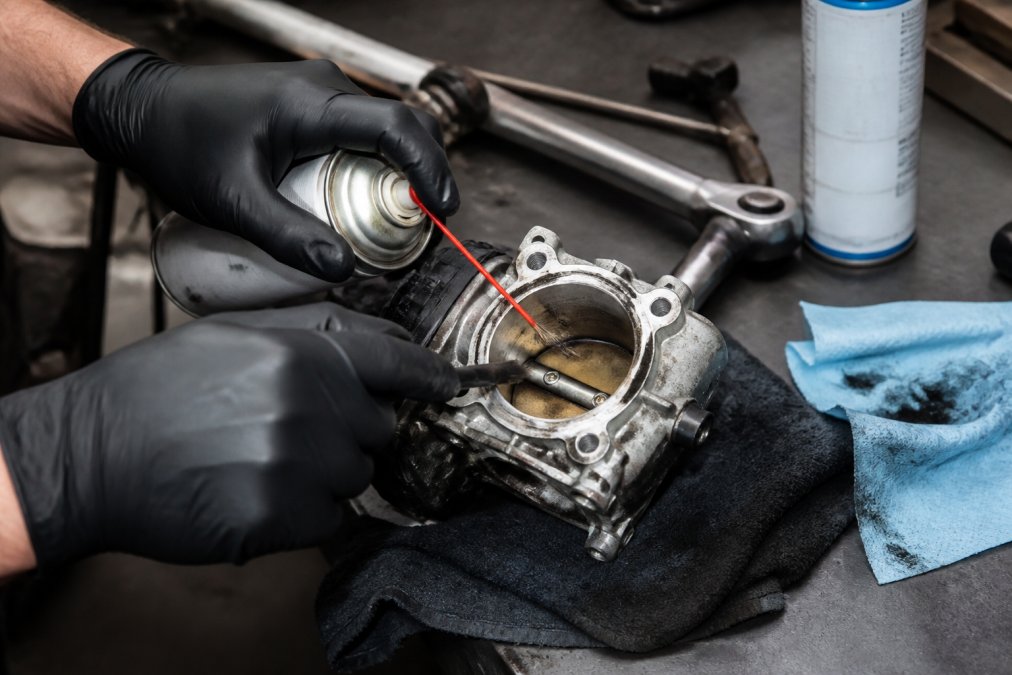
Honda Accord Throttle Body Cleaning Step by Step
Here is the step-by-step process:
- Disconnect the negative battery terminal and let the car sit for a few minutes.
- Remove the air intake tube to expose the throttle body.
- Spray throttle body cleaner onto a soft brush or lint-free cloth.
- Wipe the throttle plate and bore, including the edges where carbon collects.
- Avoid soaking the throttle position sensor or any electrical connector.
- Reassemble the intake tube and reconnect the battery.
- Start the car and let it idle, then perform the idle relearn.
Do not force the throttle plate open with your fingers. The plate is driven by a small motor, and forcing it can strip the gears.
Idle Air Control Valve Symptoms and What They Mean
Idle air control valve symptoms show up as an idle that hunts, dips, or stalls. The IAC valve controls how much air bypasses the throttle plate at idle. When it sticks or clogs, the engine cannot hold a steady RPM. Cleaning this component restores consistent airflow, much like how proper car undercoating maintenance preserves the integrity of your vehicle's chassis against environmental decay.
Watch for these signs:
- Idle that surges up and down on its own
- Engine that stalls when you come to a stop
- Rough idle only when the engine is cold
- Idle that drops too low when you turn on the A/C or lights
The Honda Idle Relearn Procedure After Repairs
The Honda idle relearn procedure teaches the computer the correct idle position after you clean or replace throttle parts. Skip it, and your Accord may idle high, low, or rough even though the repair was done right.
The general process works like this:
- Make sure the engine is cold and all accessories are off.
- Disconnect the battery for a few minutes to reset the ECU.
- Reconnect the battery and start the engine without touching the gas.
- Let the engine idle until the radiator fan cycles on, then off.
- Let it idle for a few more minutes, then shut it off.
- Restart and drive normally to confirm a smooth idle.
DIY or Shop? Cost and Warranty Considerations for Your Fix
Some rough idle fixes are simple enough for a driveway; others need a scan tool, a lift, or a trained eye. Knowing where to draw the line saves time and money, and knowing which parts to buy saves you from doing the job twice.
The DIY-vs-Shop Decision Framework
Ask three questions before you pick up a wrench:
- Does the fix require a bidirectional scan tool? Throttle body cleaning on 2008-and-newer Accords requires an idle relearn. Some relearns complete on their own after a few drive cycles; others need a scan tool that can command the relearn routine. If yours needs the tool, that's a shop job unless you own one.
- Does the fix require lifting the car or removing major components? Vacuum leaks at the intake manifold gasket, fuel injector replacement, and compression testing all fall here. A leaking intake gasket on a V6 can mean several hours of labor.
- Is the part a sensor or an actuator? Sensors and actuators are where cheap aftermarket parts bite you. See the parts guidance below.
Year-Specific Parts Guidance
This is where most guides stop short. The right part depends on your generation:
- 7th-gen (2003-2007): The IAC valve is a separate, serviceable part. OEM Honda IAC valves are the safe choice, aftermarket units frequently cause a hunting idle out of the box. Spark plugs: use the exact NGK or Denso plug listed in your owner's manual; the V6 uses iridium plugs with a longer service interval than the 4-cylinder.
- 8th-gen (2008-2012): No separate IAC valve. Idle is managed by the drive-by-wire throttle body. Cleaning is usually enough; replacement throttle bodies are expensive and rarely needed. Ignition coils: OEM or a known Japanese-brand equivalent. Cheap coils are a common cause of recurring P030x codes.
- 9th-gen (2013-2017) and later: MAF sensors and throttle bodies are the usual suspects. Clean before you replace. If replacement is needed, OEM MAF sensors are strongly preferred, aftermarket units often have calibration drift that causes lean codes and rough idle.
Cost Trade-Offs
A DIY throttle body cleaning costs a can of cleaner and an afternoon; a shop repair adds labor but gives you a warranty and a proper relearn. A DIY spark plug job on a 4-cylinder Accord is straightforward; on a V6 with rear-bank plugs, the intake may need to come off, pushing many owners to a shop.
When to Stop and Hand It Off
If your Accord keeps idling rough after basic fixes, new plugs, cleaned throttle body, cleaned MAF, no obvious vacuum leak, a shop with the right scan tool can read live data and find the real cause. That is where RepairPal's guide to finding a trusted shop helps you compare options.
Frequently Asked Questions
What is the most common cause of a rough idle in a Honda Accord?
Carbon buildup on the throttle body is the most frequent cause, especially on Accords with 60,000 miles or more. A dirty throttle body disrupts the air-fuel ratio at idle, causing RPM fluctuation and engine vibration. Vacuum leaks from cracked intake manifold gaskets and worn spark plugs are the next most common culprits. Start by pulling diagnostic trouble codes with an OBD2 scanner to narrow the list before replacing parts.
How do I perform an idle relearn procedure on my Honda Accord?
After cleaning the throttle body or replacing the IAC valve, disconnect the battery for 10 minutes to reset the ECU. Reconnect it, then start the engine and let it idle without touching the gas pedal until the radiator fan cycles on twice. Turn on the headlights and A/C, let it idle another minute, then drive normally for 10 minutes. This lets the ECU relearn idle fuel trim. If the idle stays rough, a shop with a scan tool can force the relearn directly.
Can a dirty throttle body cause rough idling?
Yes. Carbon deposits narrow the throttle plate gap, so the engine gets less air than the ECU expects at idle. The result is a lean condition that shows up as RPM dips, shaking at stoplights, and occasional stalling on cold start. Cleaning the throttle body with a dedicated cleaner solvent and a soft brush restores the correct airflow. On most Accords this takes under an hour, and the idle relearn afterward locks in the fix.
When should I take my Honda Accord to a professional for idle issues?
Bring it in if the check engine light flashes, if you see misfire codes tied to a specific cylinder, or if compression test results are low. Flashing check engine lights mean active misfires that can damage catalytic converters. Persistent rough idle after throttle body cleaning, spark plug replacement, and an idle relearn usually points to deeper issues like fuel injectors, ignition timing, or an electrical ground fault. A shop with Honda-specific scan tools can trace those faster than parts swapping at home.
A rough idle rarely fixes itself, and small ignition or air problems can grow into costly repairs. Speedy Roo Motorsports brings over two decades of Japanese vehicle experience to every diagnosis, with transparent communication and friendly service. We handle OBD2 scanning, throttle body cleaning, idle relearn, and full engine diagnostics for Honda, Acura, and other Japanese makes. Get started with Speedy Roo Motorsports and get your Accord idling smooth again.