 listicle
Common Subaru Engine Issues 2026: What Owners Need to Know
Table of Contents
- Common Subaru Engine Issues in 2026
- Subaru Maintenance Schedule 2026: Prevention Over Repair
- Subaru Warranty Coverage 2026: What's Protected
- First-Year Model Reliability Concerns
- Hybrid-Specific Maintenance Protocols
- Real-World Owner Diagnostic Tips
- When to Seek Professional Help
- Frequently Asked Questions
Last Updated: August 8, 2026
Common Subaru Engine Issues in 2026
Subaru owners in the Denver metro area know their cars are built tough, but certain powertrain weaknesses show up across model years with frustrating regularity. At Speedy Roo Motorsports, we've diagnosed thousands of Subaru engine problems, and the patterns are clear: some issues are preventable with proper maintenance, while others stem from design choices that plague entire generations.
The most common Subaru engine issues fall into predictable categories: head gasket failures, carbon buildup on intake valves, excessive oil consumption, and timing belt tensioner problems. What separates owners who catch these early from those facing catastrophic repairs is understanding what to watch for and when to act.
Head Gasket Failures and Coolant Contamination
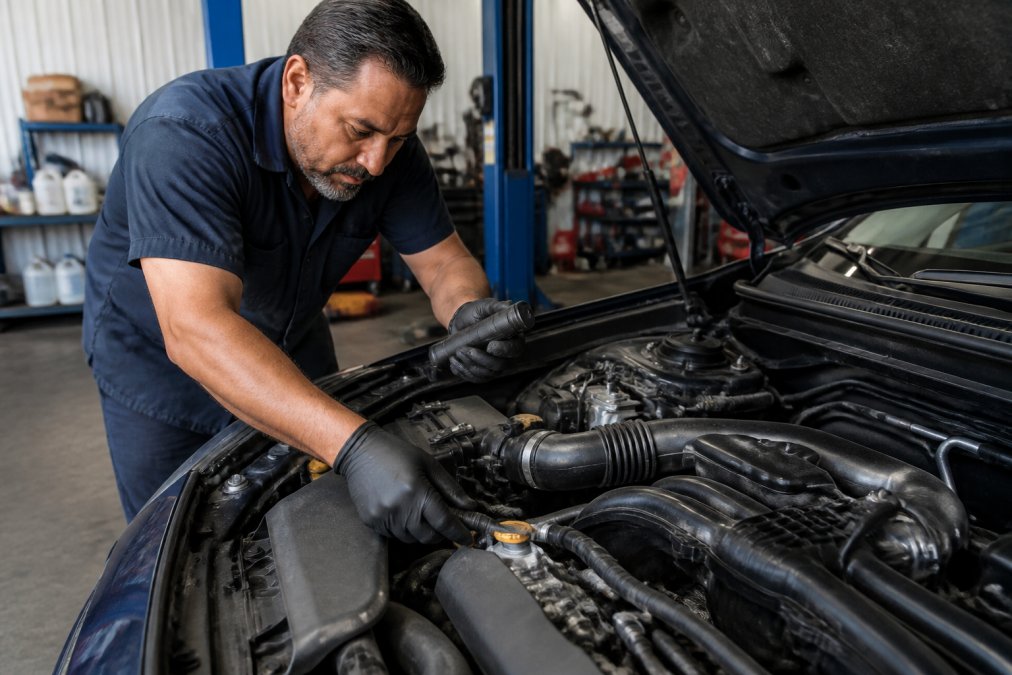
Head gasket failures represent the single most persistent Subaru engine issue, plaguing models since the late 1990s. The EJ series engines, particularly in non-turbo applications, are notorious for external coolant leaks at the cylinder head gaskets. Coolant seeps past the gasket seal, pooling around the engine block and dripping onto the ground. The leak worsens with temperature cycling, and eventually internal leakage can occur, mixing coolant with oil and creating a milky sludge that accelerates engine wear.
Early intervention matters enormously. Genuine Subaru Coolant Conditioner (SOA635071) can arrest small external leaks before they become expensive repairs. This additive conditions the gasket material and helps seal micro-gaps caused by normal expansion and contraction. It's not a permanent fix for severe failures, but it extends the life of marginal gaskets and costs under $15.
For serious head gasket failures, replacement requires removing the cylinder head, a labor-intensive job that typically takes 8-12 hours. A comprehensive head gasket repair kit like the Six-Star Head Gasket Repair Kit (Non-Turbo) includes multi-layer stainless steel gaskets with Viton rubber coating, designed specifically for non-turbo EJ engines. These kits run around $250-$290 for the complete set of seals and gaskets, though labor costs dwarf parts expenses.
Once the head is off, it's the perfect time to address other engine concerns. Replacing spark plugs, cleaning valve deposits, and inspecting piston rings costs almost nothing extra, preventing the need to do the job twice.
Carbon Buildup on Intake Valves
Carbon accumulation on intake valves creates drivability problems before catastrophic failure occurs. Subaru engines, particularly those with direct fuel injection, develop carbon deposits on valve seats and stems, restricting airflow and disrupting the fuel-air mixture. Symptoms include rough idle, hesitation during acceleration, and increased emissions.
Preventative cleaning is far simpler than waiting for problems. The Genuine Subaru Engine Maintenance Kit (SOA868V9341) includes three specialized cleaners: Fuel Injector Cleaner, Throttle Plate and Induction Cleaner, and Top Engine Cleaner. Applied during routine maintenance, these products remove gums, resins, varnish, and carbon deposits before they accumulate, costing around $30-$50 for the complete kit.
Professional carbon cleaning using ultrasonic or walnut shell blasting removes stubborn deposits that chemical cleaners cannot. This service typically runs $300-$500 depending on severity, but it's essential for engines showing significant performance loss.
Oil Consumption and Piston Ring Wear
Excessive oil consumption, burning more than a quart per 1,000 miles, signals piston ring wear or valve guide deterioration. The problem develops gradually: oil level drops between changes, the exhaust smells slightly burned, and blue smoke appears under hard acceleration.
Switching to a full synthetic motor oil formulated to reduce oil consumption can help. Valvoline Restore & Protect Motor Oil is engineered to condition piston rings and reduce burning. It won't fix severe mechanical wear, but it addresses early-stage consumption and protects against further deterioration, costing around $25-$35 for a 5-quart change.
For confirmed piston ring failure, engine rebuilding or replacement becomes necessary, typically ranging from $3,000 to $6,000 depending on engine type and labor rates.
Timing Belt and Tensioner Failures
Timing belt failure represents an absolute worst-case scenario. Unlike many engine problems that provide warning signs, timing belt failure often happens suddenly. When it does, the crankshaft and camshaft fall out of synchronization, causing valves to collide with pistons and resulting in catastrophic internal engine damage requiring complete engine replacement.
Subaru recommends timing belt replacement at 105,000 miles or 10 years, whichever comes first. This interval is non-negotiable. The timing belt tensioner, which maintains proper belt tension, fails more frequently than the belt itself. A worn tensioner allows belt slack, disrupting timing and accelerating belt wear.
Professional timing belt service requires specialized tools and expertise. The IAG Red Racing Timing Belt Kit provides a complete solution for EJ20 and EJ25 engines, including a high-strength racing belt, OEM-quality idler pulleys, and tensioner. Installation requires 6-10 hours of specialized work.
For DIY enthusiasts, the Company23 Crank Pulley Tool V2 simplifies removing the harmonic balancer, eliminating the need for impact wrenches and radiator removal, saving hours of labor.
Subaru Maintenance Schedule 2026: Prevention Over Repair
The Subaru maintenance schedule exists for a reason: it's engineered to prevent the issues discussed above. Following the schedule religiously costs a fraction of emergency repairs.
Oil Change and Filter Intervals
Oil changes remain the foundation of engine health. Subaru recommends oil changes every 6 months or 6,000 miles for conventional oil, or every 12 months or 12,000 miles for synthetic oil. Fresh oil circulates through the engine, carrying away microscopic metal particles, combustion byproducts, and moisture. As oil ages, it loses viscosity and protective properties, leading to sludge buildup and accelerated wear.
Using the correct oil grade is equally important. For most 2026 Subarus, 0W-20 synthetic is the standard, though some turbocharged models require 0W-30. OEM Subaru filters cost slightly more than aftermarket options but feature superior filtration media and bypass valves that protect the engine during cold starts.
Coolant Flush and Spark Plug Replacement
Coolant doesn't last forever. Subaru specifies coolant replacement every 30,000 miles or 24 months. Old coolant loses its corrosion inhibitors, allowing rust and scale to accumulate in the cooling system, accelerating gasket degradation and radiator clogging.
Most 2026 Subarus use iridium spark plugs rated for 60,000 miles. Worn plugs increase fuel consumption and create rough idle. Replacing spark plugs yourself is feasible on many Subaru models, though on turbocharged engines the rear plugs become nearly inaccessible, making professional service worth the cost.
Fuel Filter and Air Filter Service
Fuel filters typically require replacement every 30,000-50,000 miles. A clogged fuel filter reduces fuel pressure, causing hesitation and starting difficulty. Air filters should be inspected every oil change and replaced when visibly dirty, typically every 15,000-30,000 miles depending on driving conditions. Both are straightforward maintenance items that prevent larger problems.
Subaru Warranty Coverage 2026: What's Protected
Understanding your warranty prevents expensive surprises and helps you navigate claims effectively.
Powertrain Warranty and Engine Components
Subaru's basic powertrain warranty covers the engine, transmission, drivetrain, and related components for 3 years or 36,000 miles. The warranty covers manufacturing defects, not wear items or damage from neglect. Engine components covered include the cylinder block, cylinder head, pistons, crankshaft, camshaft, timing belt, water pump, fuel injectors, and intake manifold. Wear items like spark plugs, filters, and belts are explicitly excluded.
Safety Recalls and Warranty Claims
Subaru issues recalls for safety defects and powertrain problems affecting reliability. Recalls are performed free of charge, regardless of warranty status or mileage. Check the NHTSA website regularly for recalls affecting your vehicle.
Warranty claims require documentation of maintenance. Keep all service records from dealer or independent shop. Subaru may deny claims if maintenance intervals weren't followed. When filing a claim, be specific about symptoms and when they started. Dealers process claims faster than independent shops, but independent shops like Speedy Roo Motorsports can submit warranty claims on your behalf.
First-Year Model Reliability Concerns
New model years sometimes introduce reliability issues that earlier generations avoided. Early 2026 models should be monitored carefully during the first 10,000 miles. This break-in period reveals manufacturing defects and assembly issues.
The FA20 engine, found in many 2026 Subarus, has a solid reliability record, but early production runs occasionally show oil consumption issues. If your 2026 Subaru exhibits oil burning before 5,000 miles, document it immediately and report it to your dealer. Transmission cooler leaks have appeared in some 2026 models with automatic transmissions. Catching this early allows warranty replacement before contamination damages the transmission.
Hybrid-Specific Maintenance Protocols
Subaru hybrid models introduce electrical and battery management systems absent from conventional engines. The hybrid battery pack, located beneath the rear seats, requires no owner maintenance but should be inspected by qualified technicians every 30,000 miles. Battery performance degrades gradually, reducing fuel economy before failing completely.
Regenerative braking systems in hybrids reduce conventional brake wear, but brake fluid still requires replacement every 24 months. Engine oil changes in hybrids follow the same intervals as conventional Subarus, but using the correct viscosity grade is even more critical due to cooler engine operation. The integrated starter-generator in hybrid Subarus is more complex than conventional starters. If starting becomes sluggish, have the system diagnosed before assuming battery failure.
Real-World Owner Diagnostic Tips
Not every engine problem requires a trip to the shop. Understanding what you can diagnose yourself saves money and time.
Using an OBD2 Scanner to Read Trouble Codes
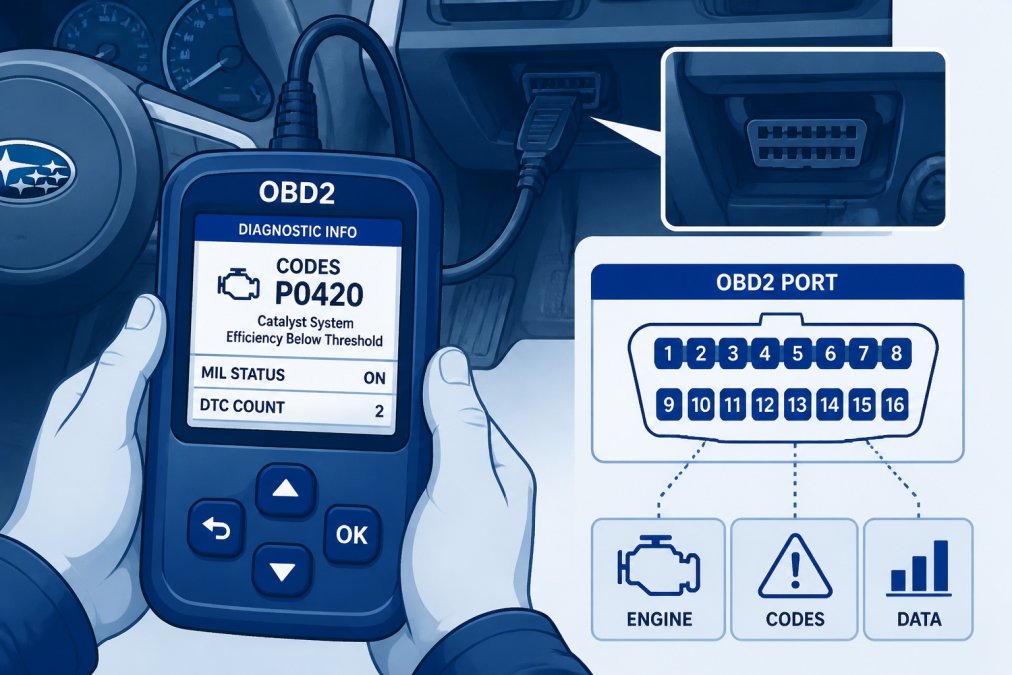
When the check engine light illuminates, an OBD2 scanner retrieves diagnostic trouble codes stored in the engine computer. The BLCKTEC OBD2 Scanner is designed specifically for Subaru owners. It reads and clears codes across all Subaru systems without subscription fees.
Common trouble codes include:
- P0300: Random misfire. Suggests spark plug wear, fuel injector fouling, or ignition coil failure.
- P0171/P0174: Fuel system too lean. Indicates oxygen sensor failure, vacuum leak, or fuel pressure regulator problem.
- P0420: Catalyst system efficiency below threshold. Suggests catalytic converter degradation or oxygen sensor malfunction.
- P0101: Mass airflow sensor out of range. Carbon buildup on the sensor or vacuum leak.
Reading codes yourself doesn't diagnose the root cause, but it narrows possibilities.
Identifying Drivability Issues Early
Drivability problems often precede check engine lights. Rough idle at stops suggests carbon buildup on intake valves or a failing idle control solenoid. Hesitation during acceleration usually indicates fuel delivery problems. Stalling while driving suggests ignition system failure, fuel system shutdown, or transmission control issues. Addressing these issues early prevents them from escalating into catastrophic problems.
When to Seek Professional Help
Some problems demand professional diagnosis. Anything involving the timing belt should go to a professional. Head gasket replacement requires precision and specialized tools. Check engine lights related to the transmission, ABS, or airbag systems require professional scanning. Engine noises, knocking, grinding, or ticking warrant immediate professional evaluation. Fluid leaks demand diagnosis to determine severity.
At Speedy Roo Motorsports, we specialize in exactly these situations. Our technicians have decades of combined experience diagnosing Subaru engine problems. We use professional-grade diagnostic equipment and provide transparent communication about what we find and what it costs to fix.
Subaru engine problems develop gradually, with early signs that alert attentive owners. Staying on top of your Subaru maintenance schedule prevents most common issues. When problems do emerge, catching them early minimizes repair costs and keeps your car reliable. At Speedy Roo Motorsports in Aurora, we've built our reputation on transparent diagnosis and quality repairs for Subaru owners throughout the Denver metro area. If your Subaru is showing symptoms of engine trouble, contact us for a comprehensive diagnostic evaluation and honest recommendations about what needs attention now versus what can wait.
Frequently Asked Questions
What are the most common Subaru engine issues in 2026?
The most common Subaru engine issues include head gasket failures leading to coolant contamination, carbon buildup on intake valves affecting drivability, excessive oil consumption from piston ring wear, timing belt and tensioner failures, and check engine light triggered by various diagnostic trouble codes. Many of these stem from the boxer engine design and can be prevented through regular maintenance intervals and using quality fluids.
What does the Subaru maintenance schedule 2026 recommend for engine health?
A proper Subaru maintenance schedule 2026 includes oil changes every 6 months or 6,000 miles, coolant flushes every 30,000 miles to prevent contamination issues, spark plug replacement every 60,000 miles, fuel filter service every 60,000 miles, and timing belt inspection at manufacturer intervals. Following the service interval prevents many engine problems and maintains warranty coverage. Check your owner's manual for model-specific guidance.
Does Subaru warranty coverage 2026 include head gasket failures?
Subaru warranty coverage 2026 typically includes powertrain components like head gaskets under the basic powertrain warranty for the first 3 years or 36,000 miles. Extended warranties may cover additional years. However, warranty claims depend on proper maintenance records and whether the failure resulted from a manufacturing defect versus normal wear. Safety recalls are always covered. Contact your dealership with maintenance records to discuss specific claims.
How can I tell if my Subaru has engine problems before they become serious?
Watch for warning signs: a check engine light appearing on your dashboard, rough idle or engine stall during acceleration, visible coolant leaks at the head gaskets, a burning oil smell, or reduced drivability and power. An OBD2 scanner can read diagnostic trouble codes to identify the specific issue. Early detection through regular inspections and addressing small leaks or performance changes prevents costly engine damage and keeps your vehicle reliable.