 how-to guide
Why Is My Toyota Vibrating? A Diagnostic Guide
Table of Contents
- Why Is My Toyota Vibrating? Common Causes Explained
- Toyota Shaking When Accelerating: Engine and Drivetrain Issues
- Toyota Vibrating at High Speeds: Suspension and Tire Diagnostics
- Toyota Rough Idle Fix: Engine and Fuel System Solutions
- Toyota Steering Wheel Vibration: When to Seek Professional Help
- DIY Diagnostic Flowchart: Pinpoint Your Toyota's Vibration
- Cost-to-Repair Estimates and When to Visit a Specialist
- Conclusion: Don't Ignore Vibration, Get a Professional Diagnosis
- Frequently Asked Questions
Last Updated: July 22, 2026
Why Is My Toyota Vibrating? Common Causes Explained
If you're asking "why is my toyota vibrating," you're dealing with one of the most common issues that brings Toyota owners into repair shops. At Speedy Roo Motorsports, we've diagnosed thousands of vibration complaints across every Toyota model, and the good news is that most causes are identifiable with some systematic troubleshooting. Vibration can originate from your engine, drivetrain, suspension, or braking system, and pinpointing the source is the first step toward a reliable fix.
The location and timing of the vibration matter tremendously. A shaking sensation you feel through the steering wheel tells a completely different story than vibration in your floorboard or seat. Some vibrations appear only during acceleration, others show up at highway speeds, and some persist whether you're moving or sitting at a red light. Understanding these distinctions helps you communicate the problem to a mechanic and narrows down the likely culprits significantly.
How to Identify Where the Vibration Originates
Your first diagnostic task is determining where you feel the vibration most intensely. Does it come through the steering wheel, the seat, the gas pedal, or the entire vehicle? This distinction eliminates half the potential causes immediately.
Steering wheel vibration typically points to front-end issues: unbalanced tires, wheel alignment problems, brake rotor warping, or suspension component wear. When the vibration concentrates in your seat or floorboard, you're likely dealing with engine mounts, driveshaft issues, or transmission problems. A vibration that affects your entire vehicle equally suggests engine-based causes like spark plug failure or harmonic balancer issues.
Test the vibration under different conditions. Does it appear only when accelerating, or does it persist at constant speed? Does it worsen at idle, or does it disappear when you're moving? Does it change intensity as your RPM climbs? These observations form the foundation of accurate diagnosis. Take a 10-minute test drive on a quiet road where you can safely focus on the vibration's behavior without traffic distractions.
Toyota Shaking When Accelerating: Engine and Drivetrain Issues
When your Toyota vibrates specifically during acceleration, the problem almost always involves engine power delivery or drivetrain engagement. This is distinct from vibration that occurs at constant speed, which points to different mechanical failures. The shaking you feel when pressing the gas pedal indicates that something in the power transmission chain isn't working smoothly.
Worn Engine Mounts and Harmonic Balancer Problems
Engine mounts are rubber-and-metal components that secure your engine to the frame while isolating vibration. When these wear out, your engine rocks excessively during acceleration, transmitting that motion directly to the steering wheel and cabin. You'll typically feel this as a rhythmic shaking that intensifies as you accelerate harder.
Diagnosing worn mounts is straightforward: have someone watch your engine from the side while you gently press the gas pedal in park. A healthy engine should barely move. If it rocks visibly, your mounts are failing. Replacement usually takes 1-3 hours depending on which mount has failed, and costs vary based on your Toyota model and whether you visit a dealership or independent shop like Speedy Roo Motorsports.
The harmonic balancer is a weighted wheel attached to your crankshaft that absorbs vibration from the engine's power strokes. When it fails, you get intense vibration during acceleration that may feel like your engine is about to shake apart. This is a more serious issue than worn mounts because a completely failed balancer can damage your timing belt or serpentine belt. You'll often see a check engine light or notice the vibration worsens progressively over days or weeks.
Spark Plugs, Ignition Coils, and Misfire
A misfiring cylinder creates a rhythmic stumble during acceleration. Your engine fires cylinders in sequence, and when one cylinder fails to ignite properly, you feel a distinct hesitation combined with vibration. This is especially noticeable when accelerating from a stop or climbing a hill.
Spark plugs wear gradually over 30,000-100,000 miles depending on type. Ignition coils can fail suddenly, often triggered by heat exposure or moisture. When either component fails, your engine runs on fewer cylinders than it should, creating that characteristic shaking sensation. Many Toyota owners mistake this for transmission problems, but it's purely an ignition system issue.
Check your dashboard for a check engine light. If one appears alongside acceleration vibration, have the code read immediately. Codes P0300-P0308 indicate misfires. Replacing spark plugs costs minimal money but can dramatically improve drivability. Ignition coil replacement is slightly more expensive but equally important when codes point to coil failure.
Toyota Vibrating at High Speeds: Suspension and Tire Diagnostics
Highway vibration is fundamentally different from acceleration vibration. When your Toyota shakes at speeds above 50 mph, you're dealing with balance, alignment, or suspension issues rather than engine problems. These vibrations often worsen as speed increases, sometimes becoming severe enough to make highway driving uncomfortable.
Unbalanced Tires and Wheel Alignment
Tire imbalance is the single most common cause of high-speed vibration. When tire weight distribution is uneven, centrifugal force creates a wobbling effect that intensifies with speed. You'll typically feel this as a rhythmic pulsing in the steering wheel that starts around 40-50 mph and peaks at 55-65 mph.
Modern tire shops balance tires using computerized equipment that identifies weight distribution precisely. Many shops offer free rebalancing if vibration persists after the initial balance. Costs range from $15-40 per tire, and the service takes 30 minutes total.
Wheel alignment involves adjusting the angle at which your tires contact the road. When alignment drifts, your tires fight each other slightly, creating vibration and uneven wear. Alignment checks are often free at quality shops, and full alignment typically costs $100-200. Symptoms beyond vibration include your vehicle pulling left or right and uneven tire wear patterns.
Driveshaft and CV Joint Wear
Your driveshaft transfers engine power to the wheels. When it becomes bent or imbalanced, you feel vibration that increases with speed. CV joints (constant velocity joints) on front-wheel-drive Toyotas can develop play or wear, creating a similar effect. These failures typically show up as a noticeable vibration starting around 40 mph.
Driveshaft issues often require replacement rather than repair, which is more expensive than tire balancing. CV joint replacement costs vary based on whether you're replacing just the joint or the entire axle assembly. Independent shops like Speedy Roo Motorsports often can rebuild or replace these components more cost-effectively than dealerships.
Toyota Rough Idle Fix: Engine and Fuel System Solutions
Rough idle means your engine vibrates noticeably when stopped at a traffic light or in park. This is distinct from vibration during driving and suggests engine combustion issues rather than mechanical wear.
Diagnosing Idle Vibration and Check Engine Light Codes
A rough idle almost always triggers a check engine light. The code will point you toward the specific cause: misfires, vacuum leaks, fuel injector problems, or intake valve carbon buildup. Have the code read before attempting any repairs, this single diagnostic step eliminates guesswork.
Vacuum leaks are common culprits. Your engine uses vacuum to control various systems, and even a small leak disrupts the air-fuel balance, causing rough idle. You can sometimes hear a hissing sound if a leak is significant. Fuel injector cleaning or replacement addresses a different category of rough idle where fuel delivery is inconsistent.
Many Toyota owners experience rough idle after 80,000+ miles due to carbon buildup on intake valves. This restricts airflow slightly and disrupts combustion. Professional fuel system cleaning or intake valve cleaning can resolve this without replacing major components. The service costs less than major repairs and often improves overall performance.
Toyota Steering Wheel Vibration: When to Seek Professional Help
Steering wheel vibration demands attention because it indicates a problem affecting your control of the vehicle. Unlike vibration you feel in your seat, steering wheel shaking directly impacts your ability to steer safely at highway speeds.
Warped Brake Rotors and Suspension Component Failure
Warped brake rotors are the most common cause of steering wheel vibration during braking. When you apply the brakes, a warped rotor creates an uneven contact surface, causing the caliper to pulse. You'll feel this as a rhythmic vibration in the steering wheel when braking, particularly at higher speeds.
Brake rotor replacement is straightforward and relatively affordable. Most shops replace rotors in pairs (front or rear) to ensure balanced braking. The service typically costs $200-400 for front brakes depending on your Toyota model and whether you need new pads simultaneously.
Suspension component failure, worn ball joints, tie rods, or struts, can also cause steering wheel vibration. These components wear gradually, and the vibration often worsens progressively. A professional alignment and suspension inspection will identify which components need replacement. Delaying suspension repairs risks safety and accelerates tire wear.
DIY Diagnostic Flowchart: Pinpoint Your Toyota's Vibration
A systematic approach to diagnosis saves time and money. Start with the most obvious questions and work toward more complex causes.
Step-by-Step Troubleshooting Process
Does the vibration occur only during acceleration? If yes, focus on engine mounts, harmonic balancer, spark plugs, and ignition coils. Check for a check engine light. If no light appears, suspect engine mounts or harmonic balancer. If a light appears, have the code read immediately.
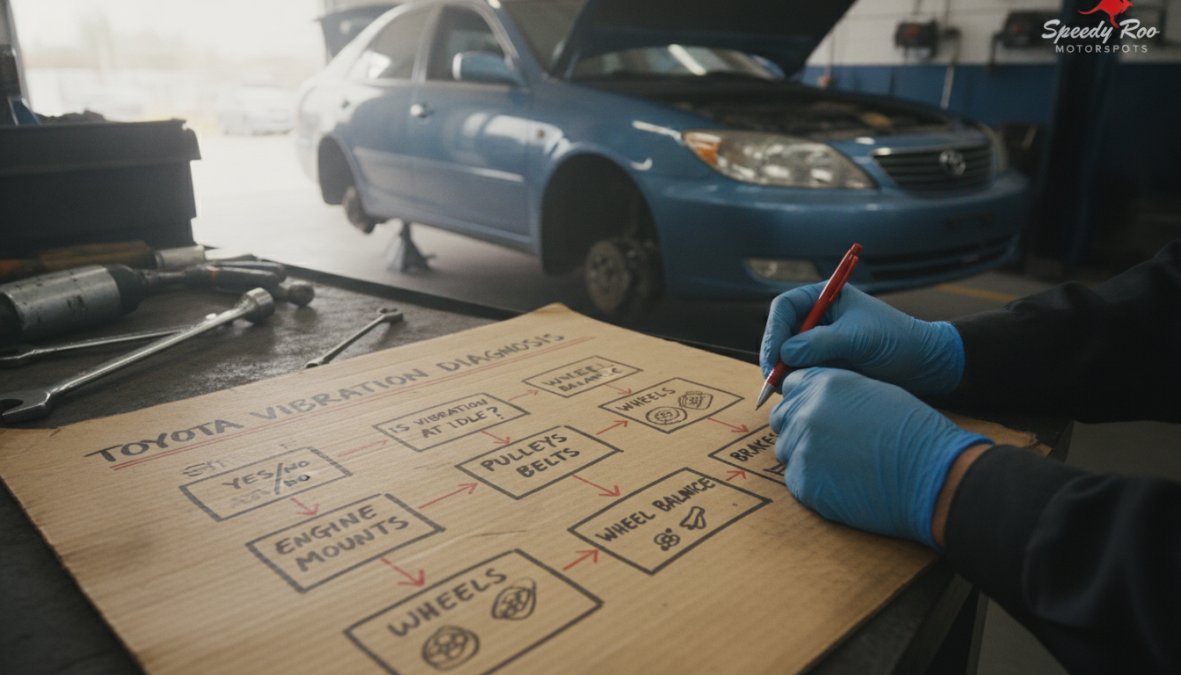
Does the vibration occur only at highway speeds (above 50 mph)? If yes, suspect tire imbalance, wheel alignment, or driveshaft issues. Get your tires balanced first, this is the cheapest diagnostic step. If vibration persists, have alignment checked.
Does the vibration occur at idle or low speeds regardless of driving? If yes, suspect rough idle causes: check engine light codes, vacuum leaks, fuel injector issues, or carbon buildup. Have codes read before proceeding.
Does the vibration concentrate in the steering wheel? If yes, suspect brake rotor warping or suspension wear. Check your brakes first, this is simpler to diagnose. If brakes are fine, have suspension inspected.
Does the vibration affect your entire vehicle equally? If yes, suspect engine-based causes like harmonic balancer failure or serious transmission issues. This requires professional diagnosis.
When to Stop Diagnosing and Call a Mechanic
You've reached the limit of safe DIY diagnosis when you need to inspect components that require lifting the vehicle safely or when you encounter check engine codes you can't interpret. Professional mechanics have lift equipment, code readers, and experience with your specific Toyota model.
Stop diagnosing if you feel unsafe performing the test drive. If vibration is severe enough to affect steering control or braking feel, stop driving immediately and have the vehicle towed to a shop. Never continue driving a vehicle with severe vibration, you risk damaging additional components and creating a safety hazard.
| Vibration Type | Most Likely Causes | Diagnostic Cost | Repair Cost Range |
|---|---|---|---|
| Acceleration shaking | Engine mounts, harmonic balancer, spark plugs | Free-$100 | $200-$800 |
| Highway vibration | Tire imbalance, wheel alignment, CV joints | Free-$100 | $50-$600 |
| Idle vibration | Spark plugs, vacuum leaks, fuel injectors | Free-$100 | $100-$500 |
| Steering wheel vibration | Brake rotors, suspension wear | $50-$150 | $200-$800 |
Cost-to-Repair Estimates and When to Visit a Specialist
Repair costs vary dramatically based on the specific cause and your location. Independent shops typically charge 30-50% less than dealerships for the same work, though quality varies. Speedy Roo Motorsports specializes in Japanese automobiles and handles vibration diagnostics efficiently because our technicians see these issues regularly.
Common vibration repairs range from $50 (tire balancing) to $800+ (driveshaft replacement or harmonic balancer failure). Most vibration issues fall in the $200-400 range when caught early. Delaying diagnosis often means additional damage, a small vacuum leak ignored can eventually damage your catalytic converter, turning a $150 repair into a $1,200 one.
When choosing a shop, prioritize experience with your specific Toyota model. According to Toyota's vehicle maintenance guidelines, regular maintenance prevents many vibration issues. A shop familiar with your model year knows common failure patterns and can often diagnose problems faster than a general mechanic.
Ask about diagnostic fees upfront. Some shops charge $50-100 for diagnosis, which applies toward repair costs if you proceed with them. Others offer free diagnostics. Either approach is reasonable, but transparency matters. A shop that explains what they found and why repair is necessary builds trust.
Conclusion: Don't Ignore Vibration, Get a Professional Diagnosis
Toyota vibration rarely resolves on its own. What starts as a minor annoyance often progresses into a serious safety issue or expensive repair. The good news is that most vibration causes are identifiable and fixable with straightforward repairs.
Vibration that persists despite your troubleshooting efforts needs professional evaluation. The Speedy Roo Motorsports team diagnoses vibration issues efficiently using computerized equipment and two decades of experience with Japanese automobiles. We offer transparent communication about what's causing your Toyota's vibration and provide honest repair estimates without surprise charges. Speedy Roo Motorsports specializes in Toyota, Lexus, and Japanese vehicle repair and maintains the equipment needed to diagnose and repair all vibration-related issues. Contact us for a diagnostic appointment and get your Toyota running smoothly again.
Frequently Asked Questions
What causes a Toyota to vibrate at high speeds?
Vibration at high speeds typically stems from unbalanced tires, wheel misalignment, or worn CV joints and axles. Warped brake rotors can also cause steering wheel vibration when braking at highway speeds. A road test at specific RPM ranges helps isolate whether the issue is tire-related or drivetrain-related. Professional wheel balancing and alignment checks are often the first diagnostic steps.
Why is my Toyota shaking when accelerating?
Acceleration-related shaking usually indicates engine mount wear, spark plug or ignition coil failure, or driveshaft issues. Worn engine mounts allow excessive engine movement under torque. A misfire caused by bad spark plugs creates rhythmic vibration. Check your dashboard for a check engine light, which may reveal ignition system codes. Have a mechanic perform a torque test to confirm engine mount condition.
Can a bad engine mount cause my Toyota to vibrate during idle?
Yes, worn engine mounts are a common cause of rough idle vibration in Toyota vehicles. Engine mounts absorb vibration from the engine and transfer it to the frame. When mounts deteriorate, excess vibration transmits to the steering wheel, floorboard, and dashboard. Idle vibration may also indicate spark plug wear or fuel system issues. A visual inspection of engine mounts and a diagnostic scan can confirm the root cause.
How do I know if my Toyota's vibration is from tires or something more serious?
Tire-related vibration typically appears at specific speeds and improves after wheel balancing and alignment. Engine or drivetrain vibration occurs across multiple speed ranges and often worsens during acceleration. If vibration occurs at idle or low speeds in park, it's likely engine-related. Note when vibration appears, check tire tread depth, and listen for unusual noises. A mechanic can perform a diagnostic road test to differentiate between suspension, tire, and mechanical causes.