 ultimate_guide
When to Replace Timing Belt: Complete Guide
Table of Contents
- What Is a Timing Belt and Why It Matters
- When to Replace Your Timing Belt: Mileage and Time Intervals
- Signs of a Bad Timing Belt: Warning Signals to Watch For
- Timing Belt vs. Timing Chain: Understanding the Difference
- Consequences of Ignoring Timing Belt Replacement
- Timing Belt Replacement Cost and What to Budget
- Environmental Factors and Preventative Maintenance
- Interference vs. Non-Interference Engines: Critical Implications
- External Sources Cited
- Frequently Asked Questions
When to Replace Timing Belt: Complete Guide
Last Updated: July 19, 2026
What Is a Timing Belt and Why It Matters
A timing belt is a rubber belt with teeth that synchronizes your engine's crankshaft and camshaft, ensuring pistons and valves operate in perfect coordination. Without it, your engine cannot function. If it breaks while running, the crankshaft and camshaft fall out of sync. In interference engines (most modern cars), this causes pistons to collide with valves, resulting in bent valves, damaged pistons, and potentially a destroyed engine block. Repair costs easily exceed $3,000 to $5,000.
Unlike a serpentine belt, your timing belt operates inside a sealed cover and rarely shows external wear. The belt degrades internally, rubber becomes brittle, teeth wear down, cracks develop, all without obvious external signs until catastrophic failure occurs.
When to Replace Your Timing Belt: Mileage and Time Intervals
Timing belt replacement depends on two factors: mileage and elapsed time, whichever comes first. Rubber degrades from both use and age. A timing belt sitting unused for eight years will be more brittle than one driven hard for five years.
Most Japanese vehicles follow these general intervals:
- Toyota and Lexus: 60,000 to 100,000 miles or 5-10 years
- Honda and Acura: 105,000 to 110,000 miles or 10 years
- Subaru: 105,000 miles or 10 years
- Nissan and Infiniti: 105,000 miles or 5 years
- Mazda: 60,000 to 100,000 miles depending on model year
Your owner's manual is the authoritative source. If you've lost it, visit your dealership or search online for your specific year, make, and model.
Common Manufacturer Intervals by Vehicle Make
Toyota and Lexus models typically recommend 60,000 miles or 5 years for older vehicles, extending to 100,000 miles or 10 years on newer models. Toyota's conservative approach reflects its design philosophy of frequent preventative maintenance.
Honda and Acura vehicles often have longer intervals: 105,000 to 110,000 miles or 10 years. However, the time limit cannot be ignored. A 2006 Honda Accord with 60,000 miles is due for replacement if it hasn't been serviced in 10 years.
Subaru models follow a 105,000-mile or 10-year interval across most of their lineup.
Nissan and Infiniti vehicles specify 105,000 miles but with a shorter time limit of 5 years, reflecting Nissan's engineering assumptions about belt degradation.
Mazda vehicles vary by generation and engine type, ranging from 60,000 to 100,000 miles. Always confirm with your owner's manual.
The safest approach: find your vehicle's specific interval in the owner's manual and mark both the mileage milestone and year deadline on your calendar.
Signs of a Bad Timing Belt: Warning Signals to Watch For
A failing timing belt rarely announces itself politely. Most vehicles give few warning signs before catastrophic failure.
Ticking or rattling noise from the front of the engine is the most common warning sign, coming from the timing belt tensioner or idler pulleys losing tension. As the belt wears, it slips slightly on the pulleys, creating a rhythmic clicking sound that worsens with acceleration. If the ticking is consistent and comes from deep inside the engine, have a mechanic inspect the timing belt immediately.
Difficulty starting the engine can indicate timing belt wear. As the belt stretches or slips, the camshaft falls out of sync with the crankshaft, and the engine struggles to fire.
Engine misfires or rough idling occur when valve timing drifts too far. Misfires often trigger the check engine light with timing-related fault codes (P0010, P0014, P0016). Any misfire combined with an age-appropriate vehicle should trigger a timing belt inspection.
Visible oil leaks near the timing belt cover suggest failing seals. While the leak itself isn't the belt failing, it indicates the seal is compromised and the belt may be exposed to contaminants.
Exhaust smoke or decreased engine power under acceleration can result from severe timing misalignment. This is a critical sign.
The hard truth: many timing belt failures produce ZERO warning signs. The belt can snap without any prior symptoms. This is why age and mileage intervals exist, they're insurance against sudden, catastrophic failure.
Visual Inspection and Early Detection
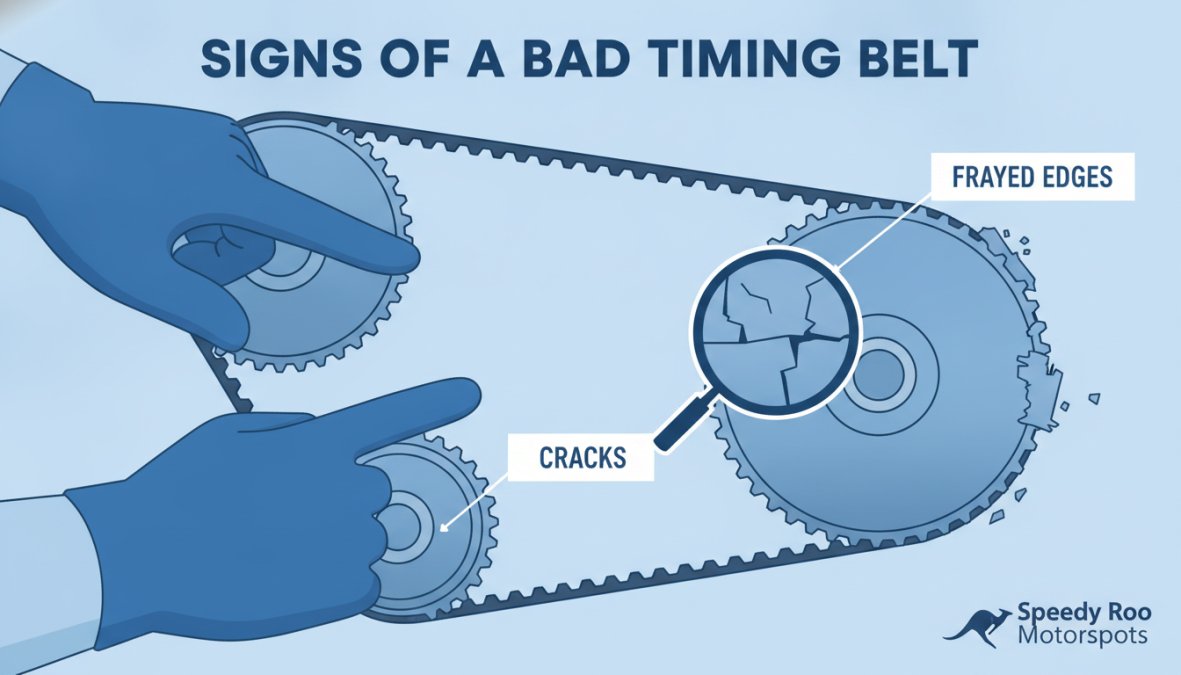
A visual inspection can catch belt problems before failure, though accessing the timing belt requires removing the timing belt cover and mechanical skill.
During inspection, look for:
Cracks or splits in the rubber indicate the belt is near the end of its life. Any visible crack means replacement is urgent.
Fraying or unraveling edges mean the belt's outer layers are separating. Fraying accelerates failure.
Glazing or shiny spots on the belt surface indicate the rubber has hardened and lost elasticity. A healthy belt has a matte finish.
Tooth wear or missing teeth are catastrophic signs. The belt's teeth grip the pulleys. Worn or missing teeth mean the belt cannot maintain synchronization.
Oil contamination on the belt surface means oil is leaking into the timing chamber. Oil breaks down rubber.
Tensioner or idler pulley wobbling indicates bearing failure.
Timing Belt vs. Timing Chain: Understanding the Difference
Not all engines use timing belts. Some use timing chains, which are fundamentally different and carry different maintenance implications.
A timing belt is made of reinforced rubber with molded teeth. It's lightweight and quiet but degrades over time, requiring replacement every 5-10 years or 60,000-110,000 miles.
A timing chain is a metal chain similar to a bicycle chain. It's more durable and can theoretically last the life of the engine. Many older vehicles used timing chains; modern engines increasingly use timing belts because they're quieter and allow for more compact designs.
The key difference: timing chains rarely need replacement if properly maintained. Timing belts always do. If your vehicle has a timing chain, you won't face the expense and complexity of timing belt replacement. However, chains still require proper lubrication and can fail if the oil is neglected or if the chain tensioner wears out.
How do you know which your vehicle has? Consult your owner's manual. If it specifies a timing belt replacement interval, you have a belt. If it says the timing chain is "maintenance-free," you likely have a chain.
Consequences of Ignoring Timing Belt Replacement
Ignoring your timing belt replacement interval doesn't mean your engine will gradually decline. It means your engine will suddenly and completely fail, likely without warning.
In an interference engine (the vast majority of modern vehicles), pistons and valves occupy the same space at different times during the combustion cycle. The timing belt keeps them synchronized. If the belt breaks or slips severely, the camshaft stops turning while the crankshaft continues. Pistons moving upward collide with open valves moving downward, resulting in bent valves, damaged valve seats, cracked pistons, bent connecting rods, and a destroyed cylinder head.
In a non-interference engine (rare in modern vehicles), pistons and valves never occupy the same space. If the timing belt fails, the engine simply stops running. You can restart it and drive to a repair shop.
The financial consequences are severe. A timing belt replacement costs between $300 and $800 for most Japanese vehicles. An engine destroyed by timing belt failure costs $3,000 to $8,000 to replace or rebuild, often exceeding the vehicle's value.
Timing Belt Replacement Cost and What to Budget
For most Japanese vehicles, you can expect:
- Labor: $200-$600 depending on engine accessibility and shop rates
- Timing belt part: $50-$150
- Additional parts: $100-$400 for tensioners, idler pulleys, and seals
- Total range: $350-$1,000+ for a complete timing belt service
Toyota and Lexus vehicles typically fall in the $400-$700 range. Honda and Acura vehicles range from $450-$800. Subaru models often run $500-$900. Nissan and Infiniti vehicles range from $400-$750. Mazda vehicles typically cost $350-$700.
Independent shops often charge 20-40% less than dealerships for the same work. Get a written, itemized quote before authorizing work.
Additional Components to Replace During Service
When your timing belt is replaced, several related components should be replaced simultaneously to avoid paying for labor twice.
The timing belt tensioner maintains proper belt tension as the belt wears. Replacing it adds $100-$200 but prevents future belt slippage. If you skip this, expect a second timing belt replacement in 30,000-50,000 miles.
Idler pulleys guide the timing belt along its path. Replacing all idler pulleys adds $50-$150 in parts.
The water pump should be replaced if it's driven by the timing belt. This adds $100-$250.
Timing belt seals and gaskets around the timing cover should be replaced to prevent oil leaks. This adds $50-$100.
Spark plugs should be changed during timing belt service. This adds $30-$80.
A complete timing belt service includes all these components. A partial service that replaces only the belt is penny-wise and pound-foolish.
Environmental Factors and Preventative Maintenance
Timing belt life is affected by environmental conditions and driving patterns.
Extreme heat accelerates rubber degradation. If you live in a hot climate, your timing belt will age faster than the manufacturer's time interval suggests. If you live in a consistently hot climate and your vehicle is 7-8 years old, consider replacing the belt even if you haven't hit the mileage interval.
Cold climates also stress timing belts. In freezing temperatures, rubber becomes stiff and less flexible, making it more prone to cracking.
Neglected oil changes accelerate timing belt failure. If oil leaks into the timing chamber, it contaminates the belt. Oil breaks down rubber. If your vehicle has a history of oil leaks, have the timing belt inspected more frequently after 60,000 miles.
Preventative maintenance beyond replacement:
- Keep oil clean with regular changes
- Inspect timing cover seals for oil weeping
- Listen for timing belt noise and have any ticking inspected
- Replace the serpentine belt to maintain proper charging
- Monitor engine temperature; an engine that runs hot stresses the timing belt
Interference vs. Non-Interference Engines: Critical Implications
An interference engine is designed so that the piston and valve paths overlap in the cylinder. The timing belt ensures they never collide. If the belt fails, the piston smashes into the open valve, causing catastrophic damage: bent valves, damaged valve seats, cracked pistons, bent connecting rods, and sometimes a cracked cylinder head. The engine must be replaced or completely rebuilt. Cost: $3,000-$8,000+.
Most modern engines are interference engines, including nearly all Japanese vehicles from the 1990s onward.
A non-interference engine is designed so that the piston and valve paths never overlap. If the timing belt fails, the engine simply stops running. You can restart it and drive to a repair shop. No internal damage occurs.
Non-interference engines are increasingly rare in modern vehicles. Some older Hondas and certain Subarus use non-interference designs.
Your owner's manual will state which type your vehicle is. If it says "interference engine," you have every reason to replace the belt on schedule.
Timing belt replacement is one of the most important maintenance tasks you'll face as a vehicle owner. The cost of prevention is trivial compared to the cost of engine failure. If your vehicle is approaching its timing belt interval, schedule replacement immediately. Don't gamble with your engine, get your timing belt replaced on schedule and drive with confidence.
External Sources Cited
Manufacturer Timing Belt Maintenance Guidelines
Engine Interference vs. Non-Interference Design Overview
Timing Belt Failure Prevention and Safety Standards
| Vehicle Make | Typical Interval (Miles) | Typical Interval (Years) | Replacement Cost Range |
|---|---|---|---|
| Toyota/Lexus | 60,000-100,000 | 5-10 | $400-$700 |
| Honda/Acura | 105,000-110,000 | 10 | $450-$800 |
| Subaru | 105,000 | 10 | $500-$900 |
| Nissan/Infiniti | 105,000 | 5 | $400-$750 |
| Mazda | 60,000-100,000 | 5-10 | $350-$700 |
Frequently Asked Questions
How often should a timing belt be replaced by mileage or years?
Most manufacturers recommend replacing your timing belt between 60,000 and 100,000 miles, or every 5 to 10 years, whichever comes first. Check your owner's manual for your specific vehicle's interval, as Japanese manufacturers like Toyota, Honda, Subaru, and Nissan often have different recommendations. Environmental factors and driving conditions can also affect this timeline.
What are the main warning signs of a failing timing belt?
Common warning signs include a ticking or rattling noise from the engine, squealing sounds, difficulty starting, rough idling, decreased engine power, and visible wear like cracks or fraying on the belt itself. Oil leaks near the timing cover and exhaust smoke can also indicate timing belt issues. If you notice any of these signs, have a mechanic inspect your belt promptly.
What happens if my timing belt breaks while driving?
The consequences depend on whether your engine is an interference or non-interference type. In interference engines, a broken timing belt causes catastrophic engine damage, pistons collide with valves, destroying the engine. Non-interference engines typically won't suffer internal damage, but your vehicle will stall and won't restart. Either way, you'll need immediate towing and expensive repairs.
Should I replace my water pump and tensioners when replacing the timing belt?
Yes, most mechanics recommend replacing the water pump, tensioner, and idler pulleys during timing belt service. These components are under similar stress and often fail around the same mileage. Replacing them together prevents future breakdowns and saves labor costs since your mechanic is already accessing that area of the engine.
How much does timing belt replacement typically cost?
Timing belt replacement costs vary widely depending on your vehicle make and model, local labor rates, and whether additional components need replacement. For a complete estimate tailored to your specific vehicle and needs, contact your trusted mechanic or repair shop. Factors like parts availability and engine accessibility significantly impact the final price.
Do all cars have a timing belt, or do some have a timing chain instead?
Not all vehicles have timing belts, many have timing chains instead. Timing chains are metal and typically last the life of the engine, while rubber timing belts require periodic replacement. Your owner's manual specifies which your vehicle has. Many newer vehicles and performance-oriented engines use chains, while older models and some Japanese vehicles use belts.
What's the difference between interference and non-interference engines?
In interference engines, pistons and valves occupy the same space at different times during the combustion cycle, a broken timing belt causes them to collide, resulting in catastrophic damage. Non-interference engines have enough clearance that a broken belt won't cause internal damage. Most modern vehicles are interference engines, making timely timing belt replacement critical for preventing engine failure.