 ultimate_guide
Honda Civic Maintenance Schedule 2026: Complete Guide
Table of Contents
- Understanding the Honda Maintenance Minder System
- Decoding Honda Civic Service Codes
- 2026 Honda Civic Maintenance Schedule by Mileage
- 2026 Honda Civic Hybrid Maintenance Requirements
- Honda Civic Fluid Capacities and Replacement Schedule
- DIY vs. Professional Service: Cost and Warranty Impact
- Severe Driving Conditions and Your 2026 Civic Maintenance
- Conclusion
- Frequently Asked Questions
Last Updated: July 18, 2026
Understanding the Honda Maintenance Minder System
The honda civic maintenance schedule 2026 relies on Honda's Maintenance Minder system, a digital tool that tracks your vehicle's service needs in real time. Unlike traditional fixed schedules that demand service at every 3,000 or 5,000 miles regardless of driving conditions, the Maintenance Minder adapts to your actual driving patterns. The system monitors engine oil life, transmission performance, and dozens of other variables continuously, displaying a dashboard message when attention is needed rather than forcing you to remember calendar dates.
How the Maintenance Minder Works
The Maintenance Minder calculates oil life based on engine temperature, driving patterns, and RPM data, not just mileage. Your 2026 Civic's onboard computer factors in whether you're doing highway driving or stop-and-go city traffic, short trips or long drives, and cold starts versus warm engine operation. When the system determines your oil has degraded to a certain threshold, it triggers a service indicator displaying a code like "A," "B," "1," or "2", each code tells your technician exactly what needs attention.
Why It Matters for Your 2026 Civic
The Maintenance Minder system directly impacts your warranty coverage. According to Honda's official maintenance guidelines, skipping scheduled services can void coverage on affected components. Following the Minder's recommendations keeps your engine running efficiently and extends the lifespan of critical components like your transmission and catalytic converter. The adaptive approach actually saves money over time by preventing premature wear that would cost thousands to repair.
Decoding Honda Civic Service Codes
Your Maintenance Minder displays codes that tell you exactly what service your vehicle needs. These are standardized codes that every Honda technician understands.
Common Service Codes Explained
Code A means an oil and filter change is due, typically every 10,000 miles under normal driving conditions. Code B indicates an oil change plus tire rotation, suspension inspection, brake fluid check, and transmission examination, usually every 20,000 miles. Code 1 means rotate tires and inspect suspension, steering linkage, and driveshaft boots. Code 2 requires engine air filter inspection and cabin air filter replacement. Code 3 indicates transmission fluid service is needed, typically every 30,000 to 60,000 miles. Code 4 signals spark plug replacement, usually between 100,000 and 150,000 miles.
| Service Code | Primary Service | Secondary Tasks | Typical Interval |
|---|---|---|---|
| A | Oil and filter change | None | 10,000 miles |
| B | Oil and filter change | Tire rotation, suspension inspection | 20,000 miles |
| 1 | Tire rotation | Suspension and steering inspection | 10,000-20,000 miles |
| 2 | Cabin air filter | Engine air filter inspection | 15,000-30,000 miles |
| 3 | Transmission fluid service | Differential fluid check | 30,000-60,000 miles |
| 4 | Spark plug replacement | Ignition system inspection | 100,000-150,000 miles |
2026 Honda Civic Maintenance Schedule by Mileage
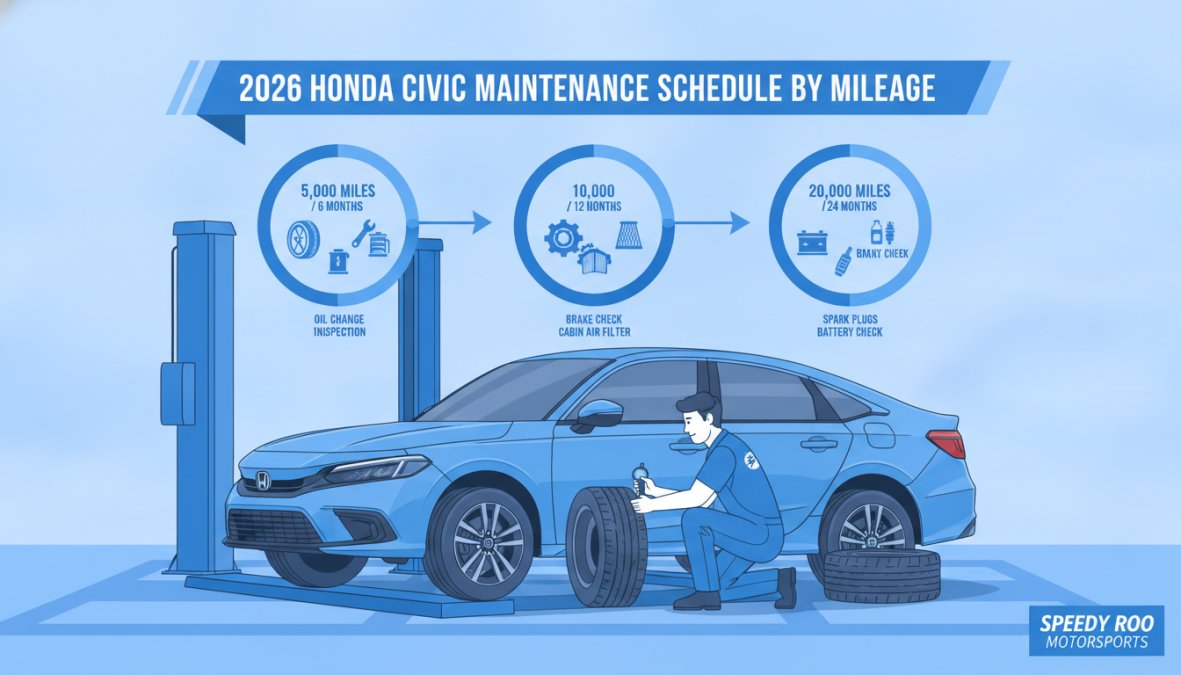
Understanding what happens at each mileage milestone helps you anticipate costs and plan service appointments ahead of time.
7,500 and 15,000 Mile Service Intervals
Your first service typically occurs around 7,500 miles, though the Maintenance Minder may trigger earlier or later depending on your driving conditions. Focus on an oil and filter change using the correct grade of full synthetic oil for your 2026 Civic, typically 0W-20. By 15,000 miles, you'll likely see a Code B, which means oil change plus tire rotation and a multi-point inspection including brake pad thickness, fluid levels, belt condition, and suspension components.
Oil and Filter Change Frequency
The 2026 Civic's Maintenance Minder typically calls for oil changes every 10,000 miles under normal driving conditions, though severe driving may require changes every 5,000 miles. Always use genuine Honda oil filters or equivalent OEM-quality filters. Cheap aftermarket filters can restrict oil flow or fail to catch contaminants, leading to premature engine wear.
Tire Rotation and Suspension Inspection
Tire rotation should happen every 10,000 to 15,000 miles to ensure even tread wear. During tire rotation, have your technician inspect suspension components for wear, including worn strut mounts, damaged control arm bushings, and steering play.
Air Filters and Brake System Checks
Your 2026 Civic has both an engine air filter and a cabin air filter. The engine air filter prevents dirt and debris from entering your engine, while the cabin air filter cleans the air entering your vehicle's interior. Brake system checks should happen during every service interval, measuring brake pad thickness, inspecting rotors, checking brake fluid condition, and ensuring all brake components function properly. Brake fluid should be replaced every two years or 24,000 miles, whichever comes first.
2026 Honda Civic Hybrid Maintenance Requirements
The 2026 Honda Civic Hybrid shares most maintenance requirements with the standard gasoline model, but hybrid-specific systems require attention. The hybrid battery pack stores energy and powers the electric motor during low-speed driving and acceleration, reducing engine wear and fuel consumption.
Hybrid-Specific Service Intervals
Hybrid battery cooling fluid should be inspected regularly. This fluid circulates through cooling passages around the battery pack, preventing overheating during hot weather or aggressive driving. A leak in the hybrid cooling system can damage the battery pack, which costs thousands to replace.
Regenerative Braking and Hybrid Battery Cooling
Regenerative braking captures energy that would normally be lost during deceleration and stores it in the hybrid battery, reducing brake pad wear compared to standard vehicles. Hybrid battery cooling is separate from your engine coolant system and uses a specific fluid type designed for the battery pack's requirements. Never mix this fluid with standard engine coolant.
Honda Civic Fluid Capacities and Replacement Schedule
Understanding your vehicle's fluid capacities and replacement intervals prevents overfilling, underfilling, and using the wrong fluid type.
Transmission Fluid, Coolant, and Brake Fluid
Your 2026 Civic's transmission fluid should be replaced every 30,000 to 60,000 miles, depending on driving conditions. Transmission fluid degrades over time, losing its ability to lubricate and cool the transmission. Engine coolant should be replaced every 10 years or 120,000 miles, whichever comes first, using Honda-specific coolant. Brake fluid should be flushed completely every two years or 24,000 miles to remove moisture and contaminants. Differential fluid (if your Civic has all-wheel drive or a limited-slip differential) should be replaced every 30,000 to 60,000 miles.
DIY vs. Professional Service: Cost and Warranty Impact
Many Civic owners wonder whether they can handle maintenance themselves to save money. The answer depends on your mechanical skill, available tools, and how much you value your warranty coverage.
When to DIY and When to See a Technician
Oil changes are the most DIY-friendly maintenance task. You'll save $30-50 per oil change compared to dealer pricing. Tire rotation and air filter replacement are also manageable for someone with basic mechanical knowledge. Brake pad replacement, transmission fluid service, coolant flushes, and spark plug replacement should be handled by professionals, as they require specialized equipment and technical knowledge.
Warranty Coverage and Missed Service Consequences
Your 2026 Civic's warranty covers defects in materials and workmanship for three years or 36,000 miles, with powertrain coverage extending to five years or 60,000 miles. However, warranty coverage is conditional on following the manufacturer's maintenance schedule. If you skip a scheduled service and a related component fails, Honda can deny warranty coverage. Using non-genuine parts or having service performed by non-certified technicians can also void warranty coverage.
Severe Driving Conditions and Your 2026 Civic Maintenance
Not all driving is equal. Towing, frequent short trips, dusty environments, and extreme temperatures all accelerate wear on your vehicle's components.
Adjusting Service Intervals for Your Driving Habits
Severe driving conditions include towing trailers, driving in dusty or sandy environments, making frequent short trips under 10 miles, driving in extreme heat or cold, or regularly driving in stop-and-go traffic. If you tow regularly, change your oil every 5,000 miles instead of 10,000 and service transmission fluid every 30,000 miles instead of 60,000. Dusty driving conditions require more frequent air filter changes. Frequent short trips prevent your engine from reaching optimal operating temperature, allowing moisture to accumulate in the oil. Extreme heat accelerates fluid degradation, requiring more frequent replacement of transmission fluid, brake fluid, and engine coolant.
Research shows that severe driving conditions can reduce component lifespan by 25-40% compared to normal driving. This means a transmission that typically lasts 150,000 miles under normal conditions might fail at 100,000 miles under severe conditions if maintenance is neglected.
Conclusion
Your 2026 Honda Civic's maintenance schedule is engineered to keep your vehicle running efficiently and reliably for 200,000 miles or more. The Maintenance Minder system adapts to your driving patterns and alerts you when service is needed, removing the guesswork from vehicle maintenance. Following the schedule protects your warranty, prevents costly repairs, and maintains your vehicle's resale value.
Staying on top of your 2026 Civic's maintenance keeps your vehicle safe and reliable. At Speedy Roo Motorsports, our factory-trained technicians understand the Maintenance Minder system completely and can decode service codes, perform multi-point inspections, and use genuine Honda parts to keep your vehicle in peak condition. We've been serving Japanese automobile owners across the Denver Metro area since 2002. Contact Speedy Roo Motorsports today for your next service appointment.
Frequently Asked Questions
What is the Honda Maintenance Minder system and how does it work for the 2026 Civic?
The Honda Maintenance Minder is an intelligent system that monitors your vehicle's operating conditions and displays service reminders on your dashboard. Rather than relying solely on mileage-based intervals, it calculates oil life based on driving patterns, engine temperature, and driving conditions. When maintenance is needed, it displays a code (like A1 or B3) indicating what service is required. This adaptive approach means your 2026 Civic alerts you when service is actually needed, not just at arbitrary mileage markers, making it more efficient for your specific driving habits.
How often should I change the oil in my 2026 Honda Civic?
Oil change frequency for your 2026 Civic depends on the Maintenance Minder system and the type of oil used. With full synthetic oil and normal driving conditions, you may go 10,000 miles or longer between oil and filter changes. However, under severe driving conditions, frequent short trips, towing, or extreme temperatures, more frequent changes may be needed. Always follow your Maintenance Minder alerts rather than a fixed schedule. Using genuine Honda parts and factory-trained technicians ensures your oil and filter changes meet manufacturer specifications and maintain warranty coverage.
What do Honda Civic maintenance codes like A1 and B1 mean?
Honda service codes use letters and numbers to indicate specific maintenance tasks. The letter indicates the service type: 'A' typically means an oil and filter change, while 'B' indicates a more comprehensive service including oil, filter, and additional inspections. The number specifies additional items, for example, A1 means oil and filter change, while A3 might include transmission fluid inspection. Understanding these codes helps you know exactly what work your vehicle needs. Dealerships and independent shops like Speedy Roo Motorsports can decode these for you and explain what each service includes.
What specific maintenance is required for the 2026 Honda Civic Hybrid?
The 2026 Honda Civic Hybrid requires all standard maintenance from the schedule but with special attention to hybrid-specific systems. Regenerative braking means brake pads may last longer, but brake fluid still needs regular inspection and replacement per the schedule. Hybrid battery cooling systems require monitoring to ensure optimal performance and longevity. Transmission fluid in the hybrid drivetrain may have different change intervals than conventional models. Additionally, the hybrid battery itself should be inspected during multi-point inspections. Always consult your owner's manual for hybrid-specific intervals and use a technician experienced with hybrid vehicles.
How can missed maintenance affect my 2026 Civic's warranty?
Failing to follow the scheduled maintenance plan can void or significantly limit your warranty coverage. Honda requires documented preventative maintenance at manufacturer-recommended intervals to maintain full warranty protection. If a component fails and Honda determines it resulted from neglected maintenance, they may deny the warranty claim. This applies to engine, transmission, and hybrid system coverage. Keeping detailed service records, whether from a dealership or independent shop, proves you've maintained the vehicle properly. Speedy Roo Motorsports provides comprehensive service documentation that protects your warranty coverage.
Should I perform any 2026 Civic maintenance myself, or is professional service necessary?
Some basic maintenance tasks like checking fluid levels, replacing cabin air filters, and inspecting tire pressure are safe DIY jobs if you're comfortable working on vehicles. However, tasks involving the engine, transmission, brake system, and hybrid components should be handled by factory-trained technicians with proper diagnostic equipment. Professional service ensures work meets Honda specifications, uses genuine parts, and maintains warranty coverage. Independent repair facilities like Speedy Roo Motorsports offer professional expertise at competitive pricing compared to dealerships, making quality maintenance more accessible while protecting your vehicle's long-term health.
What driving conditions affect my 2026 Civic's maintenance schedule?
Severe driving conditions, such as frequent short trips, towing, extreme temperatures, dusty environments, or aggressive driving, require more frequent maintenance intervals. The Maintenance Minder system accounts for some of these factors, but understanding your driving habits helps you anticipate service needs. Severe service typically means more frequent oil changes, cabin air filter replacements, and brake inspections. If you drive in Denver's variable climate or mountainous terrain regularly, your vehicle may need more frequent service. Discussing your driving conditions with your technician at Speedy Roo Motorsports helps create a customized maintenance plan for optimal vehicle health.