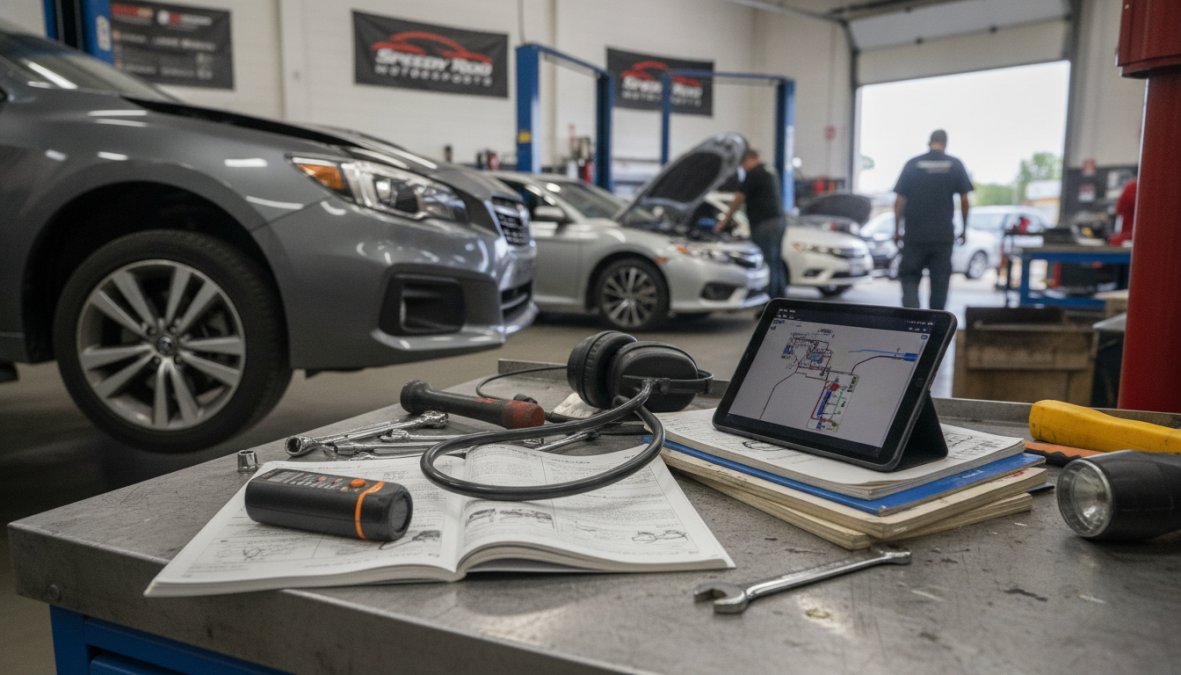
 how-to guide
Diagnose Car Noises: A Step-by-Step Guide
Table of Contents
- How to Diagnose Car Noises: The Basics
- Common Car Noises and Their Meaning
- Using a Car Noise Diagnostic Chart
- Frequency Identification and Vibration Analysis
- How to Describe Car Noise to Your Mechanic
- Common Mistakes to Avoid When Diagnosing Car Noises
- DIY vs. Professional Repair: Cost and Confidence
- Frequently Asked Questions
Diagnose Car Noises: A Step-by-Step Guide
Last Updated: July 20, 2026
Learning to diagnose car noises is one of the most practical skills a vehicle owner can develop. Strange sounds often signal mechanical issues that, when caught early, can save thousands in repair costs. This guide walks you through the diagnostic process so you can identify problems before they become emergencies.
How to Diagnose Car Noises: The Basics
Every noise tells a story about what's happening under the hood or underneath your vehicle. The key to effective diagnosis is isolating sounds, identifying their frequency, and connecting them to specific mechanical systems.
What You'll Need to Get Started
You don't need expensive equipment to begin diagnosing car noises. A quiet environment, basic knowledge of your vehicle's systems, and your own ears are your primary tools. A smartphone voice recorder helps capture sounds for later analysis or to play back to a mechanic. An automotive stethoscope ($15-40) amplifies engine sounds and pinpoints noise origins. Keep a notebook handy to record when the noise occurs: during acceleration, at idle, when turning, or while braking.
Setting Up Your Test Drive
Choose a quiet time of day and roads you know well so you can focus on sounds rather than navigation. Start with windows up to hear engine and interior noises, then roll them down to listen for undercarriage or exhaust issues. Accelerate gradually through different RPM ranges: idle, 2,000 RPM, 4,000 RPM, and highway speeds. Change gears smoothly and note whether the noise changes with gear selection. Make gentle turns both left and right to hear suspension and bearing sounds. Apply brakes softly and firmly to identify brake-related noises.
Common Car Noises and Their Meaning
Car noises fall into distinct categories based on their source and characteristics. Learning to recognize these patterns helps you move from confused driver to informed problem-solver.
Squealing and Screeching Noises
Squealing typically originates from a worn serpentine belt, the rubber belt that drives your alternator, power steering pump, and air conditioning compressor. When this belt wears, it slips on pulleys and creates a high-pitched squeal, especially during cold starts or sudden acceleration. Brake squealing indicates brake pads wearing thin, producing a deliberate squealing sound as a wear indicator. To diagnose squealing, listen carefully during cold starts when the sound is loudest and feel the serpentine belt (engine off) to check for cracks or glazing.
Grinding and Rasping Sounds
Grinding sounds indicate metal-to-metal contact and demand immediate attention. When brake pads wear completely through, metal backing plates contact metal rotors, creating grinding that worsens with each brake application. Wheel bearing failure produces grinding that changes with steering angle. Rasping sounds typically come from loose heat shields or debris caught between components.
Diagnosing grinding requires determining whether the sound comes from wheels, brakes, or the engine. Turn the steering wheel fully left and right while driving slowly; if grinding changes, suspect wheel bearings. Press the brake pedal; if grinding increases, suspect brake pads.
Clunking and Rattling from the Undercarriage
Clunking sounds come from loose components in suspension, steering, or drivetrain systems. A worn sway bar link, loose control arm, or failing shock absorber produces a clunk when you hit bumps or turn corners. Transmission mounts that have deteriorated allow the transmission to shift excessively, creating clunking during gear changes. Rattling differs from clunking in that it's usually faster and more continuous, often from loose heat shields or worn suspension bushings.
To diagnose undercarriage noise, drive slowly over a bumpy road and listen carefully. Clunking that worsens with bumps points to suspension components. Clunking during gear changes suggests transmission mounts. Jack up the vehicle (safely, with proper support) and grab suspension components to test for excessive play.
Engine Knocking and Rod Knock
Engine knock, a pinging or knocking sound from the engine, occurs when fuel burns too quickly or at the wrong time. This happens with low-octane fuel in high-compression engines, carbon buildup in cylinders, or a failing knock sensor. Rod knock represents the most serious engine noise. A failing connecting rod bearing produces a deep metallic knock that increases with engine RPM and gets worse as you accelerate, indicating imminent engine failure.
Distinguishing between regular knock and rod knock requires careful listening. Regular knock tends to be higher-pitched and might disappear when you switch to premium fuel. Rod knock is lower-pitched, rhythmic, and doesn't improve with fuel changes. If you suspect rod knock, avoid driving and have a mechanic listen immediately.
Roaring and Exhaust Leak Sounds
Roaring sounds often come from exhaust leaks. When the exhaust manifold or exhaust pipe develops a crack or hole, hot gases escape before reaching the muffler, creating a roaring sound that intensifies with acceleration. Look underneath your vehicle for rust stains or discoloration around the exhaust system to confirm. Some roaring comes from failing transmission bearings or differential bearings, which change with speed and load rather than RPM.
Whistling from the Air Intake Hose
Whistling sounds often come from air intake system leaks. A cracked hose or loose connection allows air to whistle as it's drawn into the engine. Diagnosing intake whistles involves visual inspection of all hoses connected to the air intake. Look for visible cracks, splits, or loose clamps. A loose clamp might be tightened with a screwdriver. A cracked hose requires replacement.
Using a Car Noise Diagnostic Chart
A systematic approach to car noise diagnosis saves time and prevents misdiagnosis. Start by categorizing the noise by sound type: squealing, grinding, clunking, roaring, or whistling. Move to the next question: when does it occur? At startup, at idle, during acceleration, during braking, or while turning? Each answer narrows the possibilities.
Next, determine the frequency. Does the noise happen constantly or intermittently? Does it correlate with engine RPM, vehicle speed, or specific actions like turning or braking? Constant noise at idle suggests something always in motion. Noise that appears only during acceleration suggests load-dependent issues. Noise that changes with steering angle strongly suggests wheel bearing problems.
| Noise Type | Common Causes | When It Occurs | Urgency |
|---|---|---|---|
| Squealing | Belt wear, brake pads | Cold start, braking | Medium |
| Grinding | Brake wear, bearings | Braking, turning | High |
| Clunking | Suspension, transmission | Bumps, gear changes | High |
| Roaring | Exhaust leak, bearings | Acceleration | Medium |
| Whistling | Air intake leak | Acceleration | Low |
Answer each question systematically, and you'll narrow possibilities from dozens to just a few.
Frequency Identification and Vibration Analysis
The frequency of a noise tells you a lot about its source. Low-frequency sounds (deep rumbling) typically come from large components like the transmission or differential. Mid-frequency sounds come from engine-related issues. High-frequency sounds (squealing, whistling) come from rotating components or air movement.
Vibration analysis works alongside frequency identification. Does the noise come with vibration you can feel through the steering wheel, seat, or floor? Vibration that increases with engine RPM suggests engine-related issues. Vibration that increases with vehicle speed suggests drivetrain or wheel issues. Vibration that appears only during turning suggests suspension or bearing problems.
When to Use an Automotive Stethoscope
An automotive stethoscope amplifies engine sounds, allowing you to pinpoint noise sources. You place the listening end on different engine components and listen through the earpieces. Using a stethoscope, you can determine whether a knock comes from the left side or right side of the engine and identify which cylinder is misfiring. To use one effectively, start with the engine off and familiarize yourself with where major components sit. Then start the engine and systematically listen to each component, noting which sounds normal and which sounds unusual.
How to Describe Car Noise to Your Mechanic
Clear communication with your mechanic dramatically improves diagnostic accuracy. Rather than saying "my car makes a noise," provide specific details that narrow the search.
Building a Clear Description
Start with sound comparison. Describe the noise relative to familiar sounds: "grinding like marbles in a can," "squealing like a pig," "clunking like something loose," "roaring like a motorcycle." Next, provide timing details. "The noise appears when I start the car cold and disappears after 30 seconds" is infinitely more useful than "it makes noise sometimes." Describe what you've already tried. "I switched to premium fuel and the knock disappeared" tells a mechanic the issue is likely fuel-related detonation. Bring a voice recording if you have one.
When to Seek Professional Automotive Diagnostics
Some noises demand immediate professional attention. Grinding from brakes, rod knock from the engine, or clunking from suspension all represent safety risks. If you're uncertain whether a noise is serious, err on the side of caution and have it checked. Professional mechanics have tools you don't: computer diagnostic scanners that read engine fault codes, specialized listening equipment, and experience with thousands of vehicles.
Common Mistakes to Avoid When Diagnosing Car Noises
Rushing diagnosis is perhaps the most common mistake. Taking time to listen carefully, test systematically, and gather information prevents misidentification. Another frequent error is focusing on the wrong component. A noise from the engine compartment might not come from the engine. Systematic listening helps you identify the actual source.
Many owners also mistake correlation for causation. Just because a noise appears when you accelerate doesn't necessarily mean it comes from the engine. Finally, avoid ignoring warning signs. A noise that worsens over weeks or months is getting worse for a reason. These changes warrant professional attention sooner rather than later.
DIY vs. Professional Repair: Cost and Confidence
Understanding your limitations helps you decide when to attempt repairs yourself and when to seek professional help. Simple fixes like tightening a loose heat shield, replacing an air intake hose, or adjusting serpentine belt tension are within reach for mechanically inclined owners. More complex issues like wheel bearing replacement, brake pad replacement, or transmission mount replacement require more skill and specialized tools.
Engine-related issues absolutely require professional diagnosis and repair. These problems involve internal engine components that demand specialized knowledge and equipment. Attempting these repairs without expertise risks catastrophic engine damage. The cost comparison often favors professional work for complex repairs, and confidence matters too. If you're uncertain about a repair, professional work is the right choice.
Diagnosing car noises takes patience, systematic listening, and honest assessment of your mechanical knowledge. The process transforms mysterious sounds into diagnostic information that points toward specific problems. Some noises you can address yourself. Others demand professional expertise. Knowing the difference keeps you safe and prevents expensive mistakes.
Frequently Asked Questions
What are the most common car noises and what do they mean?
Common car noises include squealing (often brake squealing or fan belt issues), grinding (worn-out bearings or brake problems), clunking (loose undercarriage components), engine knocking (potential rod knock), and roaring (exhaust leak). Each noise points to different mechanical failures. For example, a grinding noise when braking typically indicates brake pad wear, while engine knocking may signal serious internal damage. Identifying the noise's timing, whether it occurs during acceleration, changing gear, or at rest, helps narrow down the source.
How do I describe a car noise to a mechanic effectively?
Describe the noise using clear, relatable terms: Is it squealing, grinding, clunking, or whistling? Note when it happens, during acceleration, at idle, or when changing gear. Mention the location if possible (engine bay, undercarriage, wheels). Describe the frequency (continuous or intermittent) and whether vibration accompanies it. Use comparisons: 'sounds like metal grinding' or 'high-pitched squeal.' Record a short audio clip on your phone if possible. This detailed information helps your mechanic perform faster automotive diagnostics and avoid unnecessary troubleshooting.
Can I use an automotive stethoscope to diagnose car noises myself?
Yes, an automotive stethoscope is a valuable DIY tool for pinpointing noise sources. It amplifies sounds so you can identify whether noise comes from the engine, wheel bearings, or other undercarriage components. Place the probe near suspected problem areas while the engine runs or the car is moving. However, stethoscopes work best for experienced listeners. If you're unfamiliar with normal engine sounds, professional diagnostics using frequency identification equipment may be more reliable for accurate fault detection.
When should I see a professional mechanic instead of diagnosing the noise myself?
Seek professional automotive diagnostics immediately if you hear engine knocking (potential rod knock, a serious mechanical failure), loud grinding during braking, or any noise accompanied by warning lights. If the noise is severe, safety-critical, or you're unsure of its cause after a test drive, professional help prevents further damage. A qualified mechanic has AI-powered diagnosis tools and deep experience with your vehicle type. For Japanese automobiles like Subaru, Toyota, Lexus, Honda, and others, specialists familiar with your specific model can diagnose issues faster and more accurately.