 how-to
How Humidity Affects Honda Brake Fluid Life
Quick Summary
Humidity speeds up how fast brake fluid absorbs water, which lowers its boiling point and raises the risk of brake fade. Fresh fluid holds under 0.1% water, but after two years in humid climates that can reach 3% or higher. Shorten your brake fluid life by testing moisture at each service.
- Fresh brake fluid contains less than 0.1% water.
- After two years in humid climates, water can reach 3% or higher.
- Wet fluid boils at a much lower temperature than dry fluid.
- Parked time still lets moisture build up in the system.
- Test moisture at every oil change and log the readings.
Table of Contents
- Why Brake Fluid Absorbs Moisture in the First Place
- How Humidity and Heat Change the Boiling Point
- Honda Brake Fluid Change Interval in Humid Climates
- Moisture in Brake Fluid Symptoms to Watch For
- How to Test Brake Fluid Moisture at Home or in the Shop
- Storage Versus Driving: Does Parked Time Still Count?
- Brake Fluid Replacement in Humid Climates: Scheduling Your Next Service at Speedy Roo Motorsports
- Frequently Asked Questions
How Humidity Affects Honda Brake Fluid Life
Last Updated: November 3, 2026
Why Brake Fluid Absorbs Moisture in the First Place
Brake fluid is the hydraulic fluid that turns your pedal press into stopping force at each wheel. It also quietly pulls water out of the air, and that matters more than most owners expect.
Brake fluid is hygroscopic, meaning it naturally absorbs moisture from the air over time. Fresh brake fluid contains less than 0.1% water. After two years in humid climates, that concentration can climb to 3% or higher (Hallmark Nissan Birmingham brake fluid guide).
What makes brake fluid hygroscopic
Brake fluid is built to pull in water. That is by design. Water mixed into the fluid keeps it from pooling and corroding parts from the inside.
The downside is that the water never really leaves. Every bit of moisture that gets in stays there, and it builds up slowly. Humidity speeds this up, but time does most of the damage.
How moisture enters the hydraulic system
Moisture does not usually pour in through a big leak. It sneaks in through tiny gaps. Rubber brake hoses are slightly porous, and seals around the master cylinder and calipers let vapor through over months and years.
Honda owners in dry climates still see moisture build up. Humid regions simply give water more chances to get in. A car that sits parked still absorbs moisture, so driving habits are only part of the story.
How Humidity and Heat Change the Boiling Point
Moisture matters most when your brakes get hot. Water lowers the temperature at which brake fluid boils, and that can cause real trouble on a long downhill or in stop-and-go traffic.
Brake fluid gets hot fast during hard braking. When the fluid boils, it forms vapor bubbles. Vapor compresses, so your pedal can go soft or sink toward the floor. That is called brake fade, and it is one of the most dangerous brake problems a driver can face.
Dry boiling point versus wet boiling point
The dry boiling point is the temperature of brand-new fluid with no water in it. The wet boiling point is the temperature of fluid that has absorbed moisture, which is what most older systems contain.
Wet fluid can boil at a much lower temperature than dry fluid. That gap is why a fluid change matters even if the fluid still looks clean.
The article compares how moisture changes the temperature at which brake fluid boils.
| Fluid condition | Boiling point behaviour | Why it matters |
|---|---|---|
| Dry (brand-new) | Higher boiling point | Resists vapor bubbles under heat |
| Wet (absorbed moisture) | Much lower boiling point | Can cause brake fade on hard braking |
| Fresh fluid | Under 0.1% water | Baseline for comparison |
| Two years in humid climate | Up to 3% water or higher | Lowers wet boiling point significantly |
Honda Brake Fluid Change Interval in Humid Climates
Honda's maintenance schedule treats brake fluid as a time-based item, not a mileage item. Honda's maintenance schedule treats brake fluid as a time-based item, and owners in humid regions often choose to replace it more frequently than the baseline interval. Consult your owner's manual for the interval specific to your model. The reason is simple: moisture accumulates while the car sits, so a low-mileage Honda in a damp climate can have worse fluid than a high-mileage highway car in a dry one.
What the numbers actually look like
Moisture content rises over time, and higher water levels reduce the fluid's wet boiling point, which matters under hard braking.
Why the interval matters more on a Honda
Honda ABS modulators and calipers use small internal passages and aluminum or alloy bodies that are sensitive to acidic, water-laden fluid. Neglected fluid can contribute to internal corrosion in brake components, which is why an early flush is a cost-effective precaution compared with waiting for a warning light.
A practical schedule for humid climates
- Shorten to yearly: if you tow, do repeated hard stops, drive mountain grades, or track the car.
- Test before you decide: a moisture reading at each oil change lets you stretch a dry-climate interval or justify an early flush in a wet one.
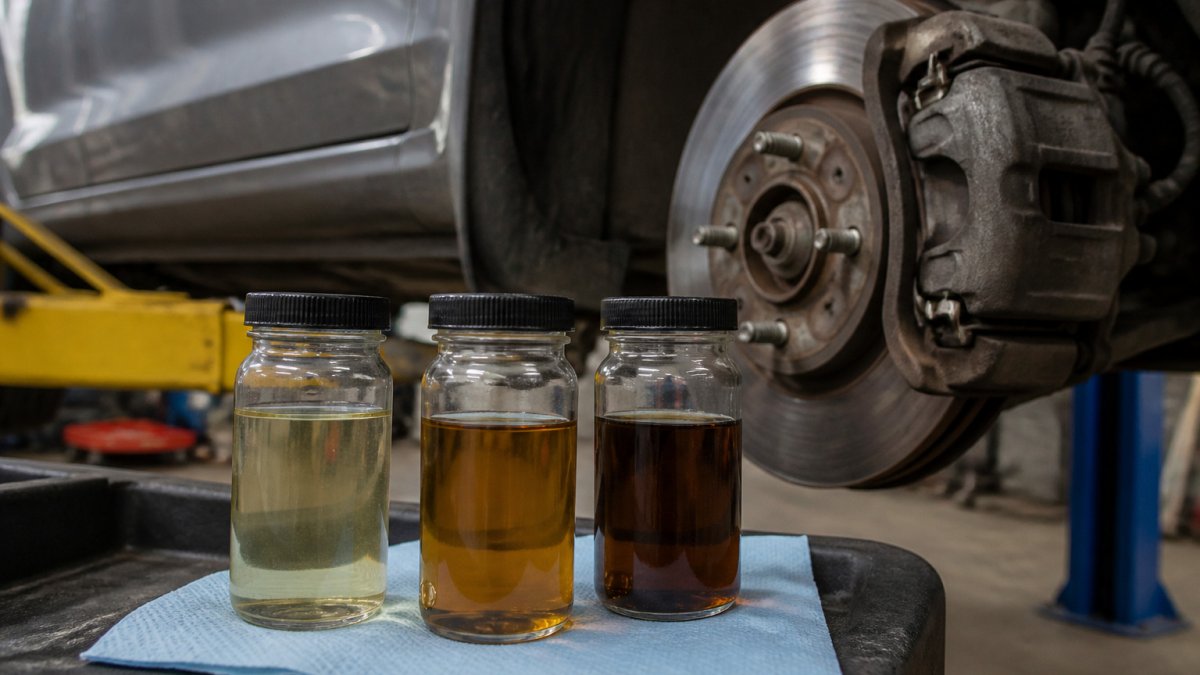
- Never rely on color alone: dark fluid is a late sign, and fluid can be near 3% water while still looking amber.
Moisture in Brake Fluid Symptoms to Watch For
Moisture damage often shows up slowly, so it is easy to miss. Watch for these signs:
- A brake pedal that feels softer or sinks more than before
- Brakes that fade after repeated hard stops
- Dark or cloudy fluid in the reservoir
- A spongy feel when you press the pedal
- An ABS warning light that comes on during braking
Watch out: a soft pedal on a steep grade is a safety issue, not a minor annoyance. Have the system inspected before the next long drive.
How to Test Brake Fluid Moisture at Home or in the Shop
Most guides tell you to change brake fluid on a calendar. A moisture test tells you what your fluid is actually doing, which matters in a humid climate where two identical Hondas can diverge by a full percentage point of water in the same year.
DIY testers: what they measure and how to read them
Electronic testers and test strips are common options for checking fluid condition at home. They are useful for spotting a trend over time.
Watch out: pen testers can read high on fresh fluid that has additive residue on the probe, and strips can be misread under poor light. Clean the probe, follow the tester's calibration steps, and treat a single borderline reading as a prompt to retest rather than a verdict.
Shop testing: boiling point and documented results
A shop can measure the fluid's actual boiling point with a dedicated tester, which is more meaningful than a conductivity estimate because it reflects the property that prevents brake fade. Ask for the wet boiling point number and compare it with the DOT rating on the reservoir cap. A fluid rated at a wet boiling point of 311°F (DOT 4) that now tests near 250°F is due for replacement even if the calendar says otherwise.
Why this matters more on a Honda
Honda ABS modulators and calipers are the parts most exposed to corrosion from water-laden fluid, and they are among the most expensive brake components to replace. Test at every oil change, log the reading, and let the trend rather than the calendar drive the decision.
Storage Versus Driving: Does Parked Time Still Count?
Yes, parked time counts. Moisture moves into brake fluid whether the car is driven or sitting in a garage. A Honda that rarely leaves the driveway in a humid area can still need a fluid change on schedule.
Storage conditions matter too. A car parked in a damp garage or outdoors in summer humidity takes on moisture just as a daily driver does. The difference is that daily driving also heats the brakes, which makes any moisture problem more dangerous sooner.
Brake Fluid Replacement in Humid Climates: Scheduling Your Next Service at Speedy Roo Motorsports
Fluid replacement is a straightforward service, and it is one of the most cost-effective things you can do for brake safety. Speedy Roo Motorsports works on Honda vehicles and can help you decide when your brake fluid should be replaced. Contact us to learn more about the maintenance and repair services available for your Honda.
Ready to schedule? Contact Speedy Roo Motorsports to discuss your Honda's brake fluid needs.
Frequently Asked Questions
Is a brake fluid flush really necessary on a Honda?
Yes, in most cases. Brake fluid is hygroscopic, meaning it absorbs water from the air over time regardless of how many miles the car is driven. Fresh fluid contains very little water, but that amount can rise over time in humid conditions. Water lowers the fluid's boiling point, which can reduce braking performance under hard use. Honda's maintenance schedule is based on time, so a flush is a sound preventive step even when the fluid still looks clear.
How long does Honda brake fluid last?
Brake fluid replacement intervals vary by vehicle and driving conditions, so consult your owner's manual. Drivers in humid areas or those who drive hard or tow may choose to replace it more often. A moisture test can help confirm whether your fluid is still in good condition.
Can I check Honda brake fluid condition at home?
You can perform a basic check by looking at the color of the fluid in the reservoir. Fresh fluid is clear to light amber, while darker fluid suggests age or contamination. For a more accurate reading, electronic brake fluid testers can measure moisture content. Keep in mind that color alone does not reveal how much water is present, so a moisture reading is the more reliable indicator.