 how-to
Find Fair Pricing for Nissan Maintenance: A Step-by-Step Guide
Table of Contents
- Understanding Nissan Maintenance Costs
- Independent vs Dealership Auto Repair Pricing
- How to Read an Auto Repair Estimate
- Average Cost of Nissan Oil Change and Common Services
- Step-by-Step Process to Find Fair Pricing
- Red Flags That Indicate Overcharging
- Negotiation Scripts for Service Advisors
- Conclusion
- Frequently Asked Questions
Last Updated: August 30, 2026
Understanding Nissan Maintenance Costs
Every repair estimate breaks down into two core components: parts and labor. Parts are straightforward; labor rates vary wildly depending on where you go. At Speedy Roo Motorsports, we've worked with thousands of Nissan owners in the Denver Metro area and found that most drivers don't know what fair pricing actually looks like.
The average cost of ownership includes scheduled maintenance like oil changes, fluid exchanges, and multi-point inspections, plus unexpected repairs, brake work, and diagnostics. A factory-recommended service at a dealership costs more than the same service at an independent shop, but the markup isn't always unjustified. Dealerships employ certified technicians trained on your vehicle model, use OEM parts, and back their work with manufacturer warranties. Independent shops charge less due to lower overhead and may use aftermarket parts, though you lose manufacturer backing.
Independent vs Dealership Auto Repair Pricing
Dealerships charge premium labor rates because they have higher overhead, employ factory-certified technicians, and maintain manufacturer-approved facilities. When your Nissan is under warranty, dealership service protects that coverage. Many extended warranties also require dealership maintenance records.
Independent repair shops operate with lower overhead. A shop specializing in Japanese automobiles, like Speedy Roo Motorsports, develops institutional knowledge about common issues and efficient repair procedures for Nissan models, which can reduce labor time and offset the lower hourly rate. Independent shops also have flexibility in parts sourcing and rely on customer retention, making them less likely to push unnecessary work.
How to Read an Auto Repair Estimate
A proper estimate breaks down into distinct sections: parts with part numbers and unit costs, labor specified in hours and hourly rate, diagnostic fees, shop supplies, disposal fees, and taxes. A transparent shop lists everything separately so you can see exactly where your money goes.
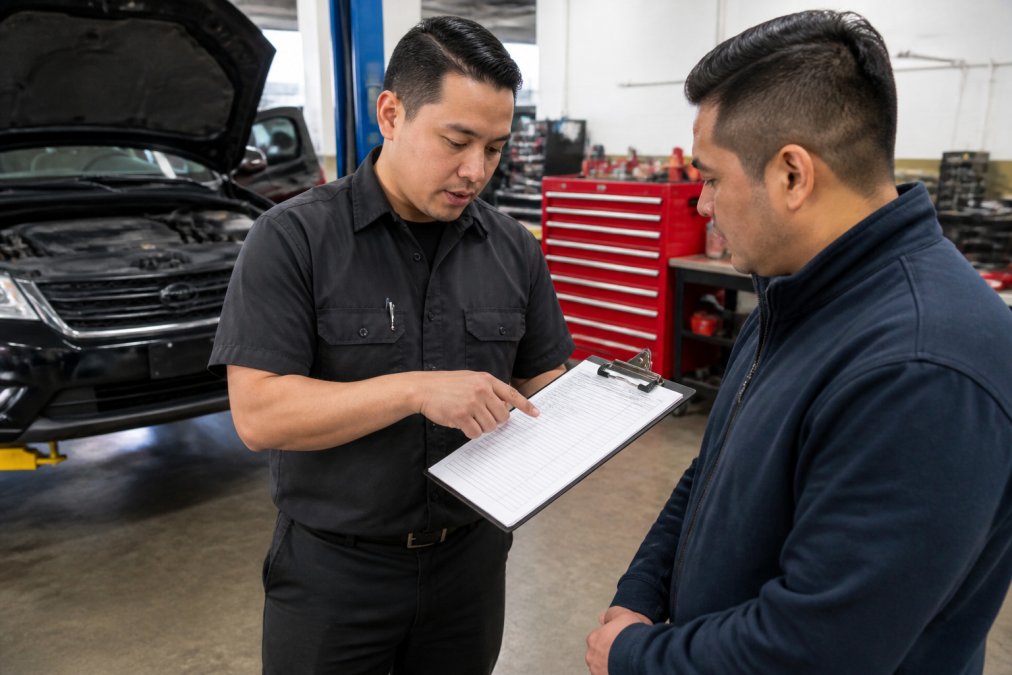
When you see "oil change: $89," ask for the breakdown. Is that $40 for oil and filter, $35 for labor at 0.5 hours, and $14 for shop supplies and disposal? Legitimate shops provide this without hesitation.
Parts costs are easier to verify than labor. You can look up OEM part numbers online and see what they cost at parts suppliers. If a dealership quotes $180 for a part that retails for $120, they're marking it up 50%, standard practice, but worth knowing. An independent shop might charge $135 for the same part, marking it up 12.5%.
Labor rates are regional and shop-dependent. A certified technician at a high-end dealership commands a higher rate than a generalist at a quick-lube shop. What matters is whether the quoted hours are reasonable for the job. A brake pad replacement should take 1-1.5 hours per axle (ase.com). If someone quotes 3 hours, they're either padding the estimate or your vehicle has complications worth understanding.
Average Cost of Nissan Oil Change and Common Services
Oil change frequency depends on your Nissan model year and engine type. Most modern Nissans run 5,000 to 7,500 miles between oil changes with conventional oil, or up to 10,000 miles with synthetic. Your owner's manual specifies the exact interval and oil grade; follow that, not generic advice.
At a dealership, an oil change typically costs more than at an independent shop, largely because dealerships use OEM filters and often include a multi-point inspection. At an independent shop, you're paying for the technician's time and materials with less overhead built in.
Common maintenance services include fluid exchanges (coolant, transmission fluid, brake fluid), which are preventative items designed to extend component life. Brake pad replacement is another frequent service; pads wear at different rates depending on driving style, climate, and brake quality. Air filter replacement is simple and often overpriced, a cabin air filter costs $15-30 in parts and takes 15 minutes to replace. If someone charges you $80, they're including a large service markup.
Diagnostic fees recoup the cost of specialized equipment. A proper diagnostic involves connecting your vehicle to a code reader, running tests, and interpreting results. This takes 30 minutes to an hour. Some shops waive the diagnostic fee if you authorize the repair; others charge it regardless.
Step-by-Step Process to Find Fair Pricing
Finding fair pricing for Nissan maintenance follows a repeatable process. You're shopping for the best value, not the cheapest option.
Step 1: Gather Multiple Quotes
Start by getting estimates from at least three shops. This gives you a pricing range and reveals outliers. Request estimates in writing with itemization. Phone quotes are easy to forget and hard to compare.
When requesting quotes, provide the same information to each shop: your vehicle's year, make, model, mileage, and the specific problem. Include at least one dealership quote and at least two independent shops. This shows you the full spectrum of pricing. save on maintenance.
Step 2: Verify Labor Rates and Parts Costs
Once you have estimates, verify the components. Look up the parts using part numbers on sites like RockAuto or Advance Auto Parts. If a shop is quoting OEM parts, compare against OEM pricing. If they're quoting aftermarket, compare against aftermarket pricing.
Labor rates vary by region and shop type. A certified Nissan specialist commands more per hour than a general mechanic. What you're checking is whether the quoted hours are realistic for the job. Red flags appear when parts pricing is significantly higher than market rates, or when labor hours seem padded.
Step 3: Check for Unnecessary Upsells
Service menus at dealerships and some independent shops list "recommended" services that aren't on your vehicle's factory maintenance schedule. Your owner's manual is the authority on what your vehicle actually needs. If a service isn't listed there, question whether it's necessary.
Ask the shop directly: "Is this service on the factory-recommended schedule for my vehicle?" If they hedge, push back. Longevity is achieved by following the manufacturer's schedule, not by adding extra services.
Step 4: Validate Warranty and Guarantees
Before committing to a shop, understand what happens if something goes wrong. A dealership backs its work with the manufacturer's warranty. Independent shops offer their own warranties, typically 12 months or 12,000 miles on parts and labor.
Get the warranty terms in writing. Some shops warranty only the part they replaced, not the labor. Others warranty the entire repair. Ask about the shop's process if a repair doesn't hold. A shop confident in its work offers strong warranties.
Red Flags That Indicate Overcharging
The most obvious red flag is a service not on your maintenance schedule. If a shop recommends a service you've never heard of, look it up in your manual. If it's not there, it's likely an upsell.
Padded labor hours are harder to spot but common. A brake pad replacement should take 1-1.5 hours per axle. If a shop quotes 3 hours, ask why. Maybe your vehicle has complications, or maybe they're padding.
Parts markup varies by shop, but extreme markups signal overcharging. A 25-30% markup on parts is standard (repairpal.com). A 60-80% markup is aggressive. Compare the shop's pricing to retail pricing before committing.
Vague estimates hide overcharging. "Transmission service: $500" tells you nothing. A transparent shop breaks it down. Pressure tactics indicate overcharging. A shop that says "I need to order this part, so you have to decide today" is using urgency to prevent comparison shopping.
Upsells presented as emergencies are a classic overcharging tactic. A service advisor says your brake fluid is "dark" and needs immediate flushing, or your spark plugs are "worn" and need replacement. These may be true, but they're not emergencies.
Negotiation Scripts for Service Advisors
You don't have to accept the first estimate. Negotiation is standard in the repair industry.
When you've gathered three estimates, call the shop you prefer and say: "I've received quotes from three shops. Your estimate is higher than the lowest quote. Can you match that price or explain what you're doing differently?" This opens a conversation.
If you want to challenge a specific line item, use this approach: "I looked up this part online and found it for $120. Your estimate shows $180. Can you explain the difference?"
For labor rate negotiations, try: "I understand your hourly rate is $140. I've received quotes at $110 per hour from other shops. Given the work involved, can you offer a package rate?"
When a shop recommends a service you're unsure about, respond with: "I don't see this on my vehicle's maintenance schedule. Can you show me where the manufacturer recommends this service?"
If a shop presents an upsell as urgent, ask for time: "I appreciate the recommendation. I'd like to get a second opinion before committing. Can you put this in writing?"
For warranty discussions, ask directly: "What's your warranty on this repair? If the problem returns within 30 days, what's your process?" Get the answer in writing.
The key to all these scripts is staying calm and professional. Shops that respond honestly and transparently are worth your business. Shops that get defensive or evasive are showing you who they are.
| Negotiation Tactic | What to Say | Expected Outcome |
|---|---|---|
| Price matching | "I have a lower quote from another shop. Can you match it?" | Shop either matches, explains the difference, or declines |
| Parts markup challenge | "I found this part for $X online. Why is your price higher?" | Shop explains markup or adjusts quote |
| Labor rate negotiation | "Can you offer a package rate for this multi-hour job?" | Shop may negotiate for larger jobs; often won't for small ones |
| Upsell verification | "I don't see this on my maintenance schedule. Where does the manufacturer recommend it?" | Shop either cites manufacturer guidance or admits it's optional |
| Warranty commitment | "What's your warranty on this repair in writing?" | Shop provides written warranty terms or declines |
Conclusion
Finding fair pricing for Nissan maintenance comes down to three practices: gathering multiple quotes, verifying the components of each quote, and understanding what you're paying for. The cheapest option isn't always the best value. The fair option is the one where you understand exactly what you're getting and why it costs what it does.
At Speedy Roo Motorsports, we've spent over two decades earning the trust of Nissan owners throughout the Denver Metro area by maintaining transparency in every estimate, explaining our labor rates and parts sourcing, and standing behind our work with solid warranties. We specialize in Japanese automobiles, which means we've developed the institutional knowledge to diagnose issues efficiently and recommend only the services your vehicle actually needs. When you're ready to get a fair estimate from a shop that treats you with respect, we're here to help.
Frequently Asked Questions
Q: What should be included in a fair Nissan maintenance quote?
A: A fair quote includes an itemized breakdown of parts, labor hours, and total cost. It should specify which original equipment manufacturer parts or aftermarket parts you're getting, the service interval being performed, and any diagnostic fees if applicable. The estimate should list each service separately, oil change, filter replacement, fluid exchange, rather than lumping everything together. A certified technician should explain what's factory-recommended service versus optional maintenance, and the quote should note warranty coverage on parts and labor.
Q: Are independent repair shops cheaper than dealerships for Nissan maintenance?
A: Independent shops often have lower labor rates than dealerships because they have fewer overhead costs. However, price alone doesn't guarantee quality. Independent shops may offer competitive pricing while maintaining high standards, especially those specializing in Japanese vehicles. The key is comparing service advisor expertise, technician certification, and warranty terms alongside cost. Many independent facilities provide transparent pricing and personalized service that larger dealerships cannot match, making them a good value for routine maintenance and preventative upkeep.
Q: How can I tell if a repair estimate for my Nissan is inflated?
A: Compare the estimate against the service bulletin and factory-recommended service schedule for your model year. Check if the shop is recommending services that aren't due yet based on mileage or time. Watch for vague line items like 'miscellaneous repairs' without detail. Get a second opinion from another certified technician before approving expensive work. Be wary if the estimate includes multiple fluid exchanges or component replacements that weren't mentioned as failing during the multi-point inspection. Request itemized labor rates and parts costs separately to spot inflated markups.
Q: What is the average cost of a Nissan oil change?
A: Oil change costs vary based on whether you use synthetic or conventional oil, your model year, and whether you go to a dealership or independent shop. Dealerships typically charge more due to higher labor rates and use of original equipment manufacturer fluids. Independent repair shops generally offer lower pricing for the same service. Costs also depend on whether additional services like filter replacement or fluid top-offs are included. For accurate pricing for your specific Nissan model, request an itemized estimate from your preferred service provider rather than relying on national averages.
Finding fair pricing for Nissan maintenance protects both your vehicle and your wallet. The process takes time, but it's time well spent. You'll avoid unnecessary repairs, catch real problems early, and build a relationship with a shop you trust. That's the foundation of long-term vehicle ownership.