 how-to
Engine Diagnostic Services Aurora CO: Complete Guide
Table of Contents
- What Is an Engine Diagnostic Service?
- Understanding Check Engine Light Issues in Aurora CO
- The Engine Diagnostic Process: Step by Step
- Cost of Engine Diagnostic Aurora CO: What to Expect
- Choosing Reliable Auto Repair Shops Aurora CO for Diagnostics
- OBD-II Scanner Technology Aurora CO: Professional vs. Consumer Tools
- DIY vs. Professional Diagnostic Comparison
- Post-Diagnostic Action Plan: What Happens Next
- Frequently Asked Questions
Last Updated: July 29, 2026
What Is an Engine Diagnostic Service?
Engine diagnostic services are professional assessments that identify the root cause of vehicle problems by reading your car's onboard computer system. When your check engine light comes on, the underlying issue could be anything from a loose gas cap to a failing catalytic converter. Shops like Speedy Roo Motorsports use specialized equipment to retrieve trouble codes and pinpoint exactly what's wrong before recommending repairs. A proper engine diagnostic includes visual inspection, electrical system testing, and real-time data analysis to ensure the repair addresses the actual problem, not just the symptom.
How Computerized Engine Analysis Works
Modern vehicles communicate through their onboard diagnostic system, which monitors hundreds of parameters every second. When something falls outside acceptable ranges, the system stores a diagnostic trouble code and triggers your warning light. A computerized engine analysis retrieves these codes and interprets what they mean for your specific vehicle.
The OBD-II scanner connects to your vehicle's diagnostic port and reads live data streaming from engine sensors, revealing fuel pressure, ignition timing, emissions levels, and sensor voltages. Unlike a simple code reader that just tells you there's a problem, professional diagnostic equipment reveals the complete picture.
Why Professional Diagnostics Beat DIY Scanning
A handheld OBD-II scanner costs between $25 and $100 and reads basic trouble codes. A P0300 code means "random misfire detected," but it could be caused by bad spark plugs, a fuel injector problem, a vacuum leak, or ignition coil failure. Without professional diagnostic equipment and trained technicians, you're essentially guessing.
Professional diagnostic services use manufacturer-grade scanners that access advanced parameters, view freeze frame data from the moment the fault occurred, and perform targeted electrical testing. Technicians can isolate whether a problem is mechanical, electrical, or sensor-related. Replacing parts based on a DIY code read often costs more than a single professional diagnostic, you might install a new oxygen sensor for $200, only to discover the real problem was a vacuum leak worth $50 to fix.
Understanding Check Engine Light Issues in Aurora CO
Your check engine light is a communication tool from your vehicle's engine control module. It doesn't mean your engine is about to explode; it means something has triggered a fault code that affects emissions, performance, or drivability.
Common Causes for Engine Warning Lights
Engine warning lights appear for dozens of reasons. A loose or missing gas cap disrupts the fuel system's vapor recovery, triggering an emissions code. Faulty oxygen sensors are another frequent cause, costing $150-400 to replace. Catalytic converter problems can run $400-2,500 for replacement. Spark plug or ignition coil failures cause misfire codes. Vacuum leaks create lean-running conditions. Professional engine diagnostic services in Aurora CO distinguish between a minor sensor drift and a serious mechanical failure.
When a Flashing Light Means Stop Driving
A steady check engine light indicates a fault that needs attention but isn't immediately dangerous. A flashing check engine light means your engine is misfiring and unburned fuel is entering the exhaust system, potentially damaging your catalytic converter right now. Pull over safely and have the vehicle towed for diagnostics. Continuing to drive on a flashing light can cost thousands in additional repairs.
The Engine Diagnostic Process: Step by Step
Professional engine diagnostic services follow a structured approach that identifies problems efficiently and accurately.
Reading Diagnostic Trouble Codes with OBD-II Scanners
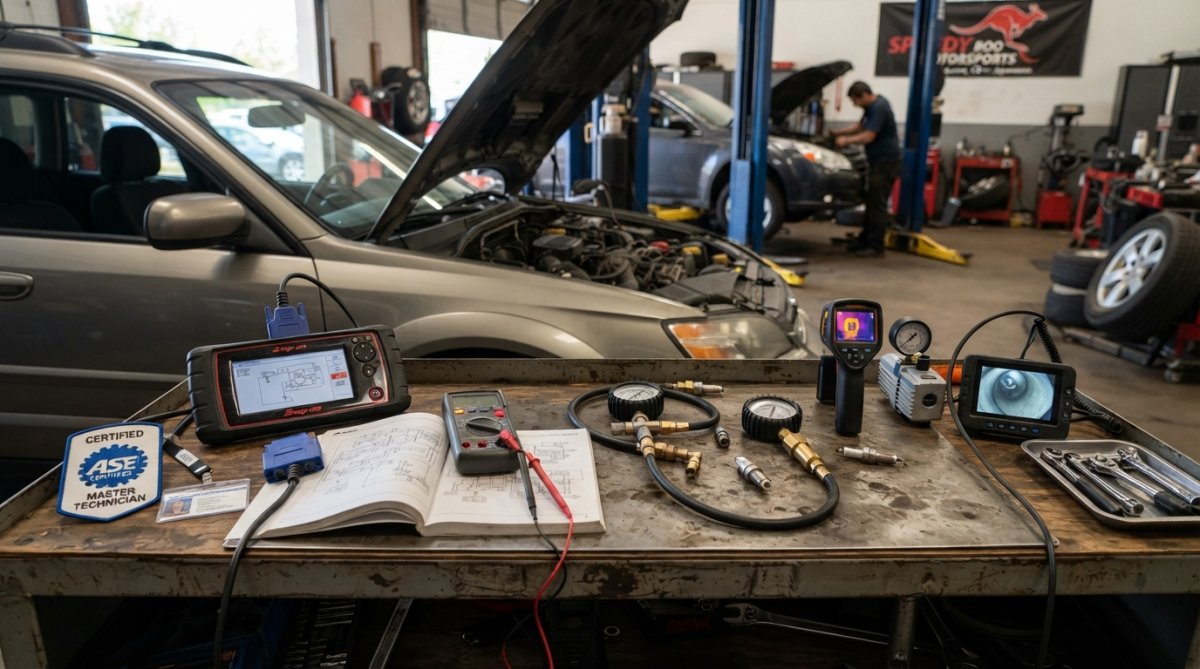
The first step is connecting a professional OBD-II scanner to your vehicle's diagnostic port, usually located under the steering column or dashboard. The scanner retrieves all stored codes and pending codes. Each code is a five-character alphanumeric identifier, a P0420 code means "catalyst system efficiency below threshold," while a P0171 code indicates a fuel system running too lean. Technicians interpret these codes within the context of your vehicle's make, model, and year. Modern diagnostic equipment also retrieves freeze frame data, a snapshot of all sensor readings at the exact moment the fault was detected.
Electrical System Testing and Sensor Diagnostics
After reading codes, technicians perform electrical system testing to verify sensor operation. Sensor diagnostics involve measuring voltage output, resistance, and response time. A technician might test an oxygen sensor by revving the engine and watching how quickly the sensor responds to changing exhaust composition. Electrical system testing also checks battery voltage, alternator output, and ground connections, as a weak battery or corroded ground wire can cause multiple fault codes.
Visual Inspection and Real-Time Data Analysis
Professional diagnostics always include a physical inspection for obvious problems: disconnected hoses, corroded connectors, damaged wiring, or loose components. Real-time data analysis means watching sensor readings while the engine runs to spot patterns that codes alone wouldn't reveal.
| Diagnostic Step | Purpose | Time Required |
|---|---|---|
| Code retrieval | Identify stored and pending faults | 5-10 minutes |
| Freeze frame review | Understand conditions when fault occurred | 5 minutes |
| Electrical testing | Verify sensor voltage and resistance | 15-20 minutes |
| Visual inspection | Check for obvious physical problems | 10-15 minutes |
| Real-time data analysis | Monitor live sensor readings under load | 15-30 minutes |
Cost of Engine Diagnostic Aurora CO: What to Expect
Most independent shops charge a flat diagnostic fee ranging from $75 to $150. Dealerships typically charge $100-200. This fee covers the technician's time to connect equipment, retrieve codes, perform electrical testing, and provide a written report. The diagnostic fee is separate from repair costs. Many facilities credit the diagnostic fee toward your repair bill if you approve repairs there. A $100 diagnostic that reveals your problem is a simple $50 fix is money well spent.
Independent shops often cost less than dealerships because they have lower overhead. Independent shops specializing in specific vehicle brands develop deep expertise. At Speedy Roo Motorsports, our technicians have spent over two decades working on Japanese automobiles, meaning faster diagnostics and fewer misdiagnoses compared to generalist shops.
Choosing Reliable Auto Repair Shops Aurora CO for Diagnostics
Not all diagnostic services are equal. The quality of your diagnostic depends on the technician's training, equipment quality, and diagnostic methodology.
What to Look for in Certified Technicians
ASE certification indicates a technician has passed rigorous testing on automotive systems. An ASE-certified technician has demonstrated knowledge of engine systems, electrical systems, and diagnostic procedures. Experience matters enormously, a technician who has diagnosed thousands of vehicles develops pattern recognition that newer technicians lack. Ask whether technicians have manufacturer-specific training. At Speedy Roo Motorsports, our team specializes in Japanese automobiles including Subaru, Toyota, Lexus, Honda, Acura, Nissan, Infiniti, Mitsubishi, and Mazda.
Red Flags: Signs of an Unreliable Shop
Avoid shops that diagnose problems without connecting diagnostic equipment. Be wary of shops that immediately recommend expensive repairs without explaining the diagnostic findings. A reputable shop provides a written report showing the trouble codes, test results, and why they're recommending specific repairs. Shops that pressure you to approve repairs immediately are concerning. Poor communication is another warning sign, you should understand what was found, why it matters, and what your options are.
OBD-II Scanner Technology Aurora CO: Professional vs. Consumer Tools
Consumer OBD-II scanners read basic trouble codes and live data from a limited number of sensors, costing $25-150. They tell you that something is wrong but often lack the depth to tell you why. Professional diagnostic scanners access manufacturer-level data, perform bi-directional testing, and cost $3,000-15,000. The difference is like comparing a basic thermometer to medical diagnostic imaging.
DIY vs. Professional Diagnostic Comparison
When a DIY OBD-II Scanner Is Enough
If you're mechanically inclined and the trouble code clearly points to a simple fix, a consumer scanner might suffice. DIY scanning makes sense when you want a preliminary understanding before taking the vehicle to a shop or to clear codes after making a repair.
When You Need a Professional Diagnostic
Complex problems with multiple codes almost always require professional diagnostics. Intermittent problems that come and go are nearly impossible to diagnose without professional equipment. Electrical problems almost always require professional diagnostics. If the trouble code is vague or you're unsure what it means, professional diagnostics save money by preventing parts replacement guessing games.
| Scenario | DIY Approach | Professional Diagnostic |
|---|---|---|
| Single clear code, simple fix | Reasonable | Optional |
| Multiple codes or intermittent issues | Not recommended | Necessary |
| Electrical or sensor problems | Not recommended | Necessary |
| Unknown or vague code | Risky | Recommended |
| Preventative check before major trip | Reasonable | Optional |
Post-Diagnostic Action Plan: What Happens Next
Once diagnostics are complete, you have decisions to make about repairs and next steps.
Understanding Your Repair Estimate
A good repair estimate includes the diagnosed problem, the recommended repair, parts cost, labor cost, and timeline. It should reference the trouble codes and test results that support the recommendation. Ask your technician to explain why this specific repair addresses the problem. Request an estimate in writing to protect both you and the shop. Before authorizing repairs, ask about warranty, most reputable shops warranty their work for 30 days or 1,000 miles.
Preventative Maintenance After Diagnostics
After repairs are completed, preventative maintenance keeps problems from recurring. If your diagnostic revealed a sensor failure, ask what typically causes that sensor to fail. Sometimes the underlying system issue needs attention or the new sensor will fail again. Regular maintenance intervals, oil changes, air filter replacements, and spark plug service prevent many diagnostic problems from occurring.
When your check engine light comes on, the uncertainty about what's wrong and how much repairs will cost creates stress. Professional engine diagnostic services in Aurora CO provide the clarity you need to make informed decisions. At Speedy Roo Motorsports, we've spent over 20 years diagnosing and repairing Japanese automobiles with transparent communication and honest recommendations. Our certified technicians use manufacturer-grade diagnostic equipment to identify problems accurately the first time, saving you money on unnecessary repairs. Contact Speedy Roo Motorsports today to schedule your diagnostic and drive with confidence knowing exactly what your vehicle needs.
Frequently Asked Questions
How much does an engine diagnostic cost in Aurora, CO?
Engine diagnostic pricing varies by shop and complexity. Independent repair shops typically offer competitive rates compared to dealerships. Costs depend on whether the diagnostic fee is applied toward repairs and the vehicle's make and model. Contact local auto repair shops Aurora CO for current pricing. Many shops provide written estimates before beginning work, so you know costs upfront.
What does an engine diagnostic service include?
A comprehensive engine diagnostic includes reading diagnostic trouble codes with an OBD-II scanner, visual inspection of engine systems, electrical system testing, sensor diagnostics, and real-time data analysis. Technicians examine the fuel system, ignition system, and emissions components. The process identifies the root cause of warning lights and drivability issues, resulting in a detailed written report and repair estimate before any work begins.
Can I use a handheld OBD-II scanner instead of professional engine diagnostic services?
A handheld OBD-II scanner reads basic diagnostic trouble codes, which can help identify simple issues. However, professional engine diagnostic services go deeper, technicians interpret codes in context, perform electrical system testing, check sensor function, and use advanced computerized analysis to find root causes. DIY scanning often misses intermittent faults and complex problems. For persistent check engine light issues, professional diagnostics save time and money by avoiding unnecessary parts replacement.
What are the most common reasons for a check engine light in Aurora CO?
Common causes include a loose or faulty gas cap, oxygen sensor failure, catalytic converter issues, engine misfire, and fuel system problems. Electrical system faults and transmission concerns can also trigger warning lights. Some issues are minor; others affect vehicle safety and emissions testing compliance. Professional diagnostic trouble code reading identifies the specific cause. Don't ignore a flashing check engine light, stop driving and seek immediate diagnostics, as this indicates severe engine damage risk.
How do I choose a reliable auto repair shop in Aurora CO for engine diagnostics?
Look for certified technicians with ASE credentials and experience with your vehicle's make and model. Check reviews and ask about their diagnostic equipment and warranty on repairs. Trustworthy shops provide written estimates before work, explain findings clearly, and offer transparent communication. Avoid shops that pressure you into repairs or won't explain diagnostic trouble codes. Independent shops specializing in Japanese automobiles often provide personalized service and competitive pricing compared to dealerships.