 how-to
AWD Suspension Repair Aurora: Complete Diagnostic Guide
Table of Contents
- How AWD Suspension Systems Work
- Signs Your AWD Vehicle Needs Suspension Repair
- AWD Repair Aurora CO: What a Professional Inspection Includes
- Shock and Strut Replacement Aurora: When and Why
- Suspension Diagnostics Aurora: DIY Checklist vs. Professional Service
- Wheel Alignment Aurora CO: Critical for Suspension Health
- Common AWD Suspension Problems and Solutions
- Why Vehicle Safety and Handling Depend on Suspension Maintenance
- Frequently Asked Questions
AWD Suspension Repair Aurora: Complete Diagnostic Guide
Last Updated: August 2, 2026
When your all-wheel drive vehicle starts clunking over bumps or pulls to one side, the problem usually traces back to suspension wear. At Speedy Roo Motorsports, we've diagnosed thousands of AWD vehicle suspension repair cases across the Denver Metro area. AWD suspension systems carry unique demands compared to conventional two-wheel drive setups, requiring specialized knowledge of how torque distribution affects component stress.
This guide walks you through what happens when an AWD suspension fails, how to recognize warning signs, and what professional diagnostics involve.
How AWD Suspension Systems Work
All-wheel drive vehicles distribute engine torque to all four wheels simultaneously, creating suspension forces that rear-wheel or front-wheel drive cars never experience. The suspension must manage this constant four-directional pull while maintaining ride comfort and handling precision.
The role of shock absorbers and struts
Shock absorbers and struts dampen oscillation created when coil springs compress and extend. A shock absorber is a separate component; a strut integrates the damping function directly into the suspension assembly. On an AWD vehicle, these components work harder because the drivetrain sends power to all four wheels simultaneously, creating additional vertical and lateral forces. When dampening fails, the suspension can't control spring rebound, causing excessive bouncing and loose handling.
Why AWD adds complexity to suspension design
The suspension geometry on an AWD vehicle must account for torque steer, the tendency of a vehicle to pull left or right under hard acceleration when power flows to wheels with different grip levels. When one component fails on an AWD system, it often triggers a cascade of problems. A worn ball joint doesn't just affect steering response; it can alter suspension geometry enough to cause uneven tire wear, which then changes how the drivetrain distributes torque.
Signs Your AWD Vehicle Needs Suspension Repair
The earliest warning signs appear as subtle changes in how your vehicle responds to the road.
Clunking noises and vibration patterns
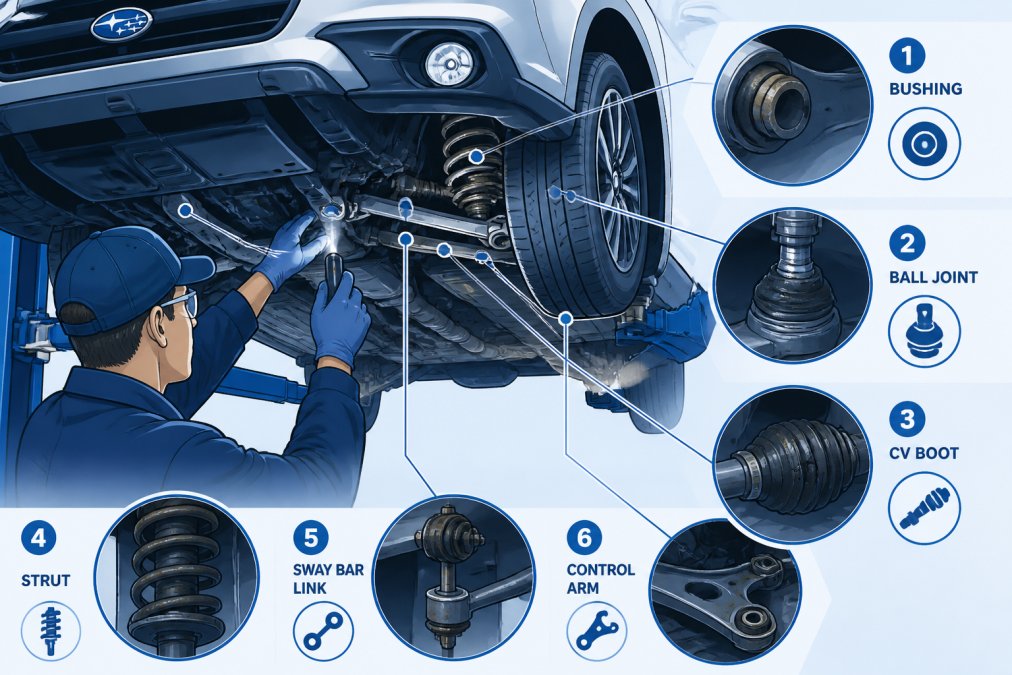
A clunking sound from the undercarriage when driving over rough roads or speed bumps indicates loose or worn suspension components. Vibration during turns or acceleration suggests suspension geometry problems, as worn control arms or ball joints allow movement in directions they shouldn't.
Handling changes and tire wear indicators
Your vehicle should maintain consistent handling through repeated turns. If the car feels loose or unstable during cornering, suspension wear is likely the cause. Tire wear patterns reveal suspension problems before they become obvious. If the inner and outer edges of your tires wear faster than the center tread, alignment is off due to worn suspension components. Feathered wear (tread ribs worn at an angle) indicates toe-in problems. Cupping (scalloped dips around the tire circumference) points directly to shock or strut failure.
AWD Repair Aurora CO: What a Professional Inspection Includes
Professional suspension diagnostics on an AWD vehicle involves far more than a visual walk-around.
Undercarriage and chassis assessment
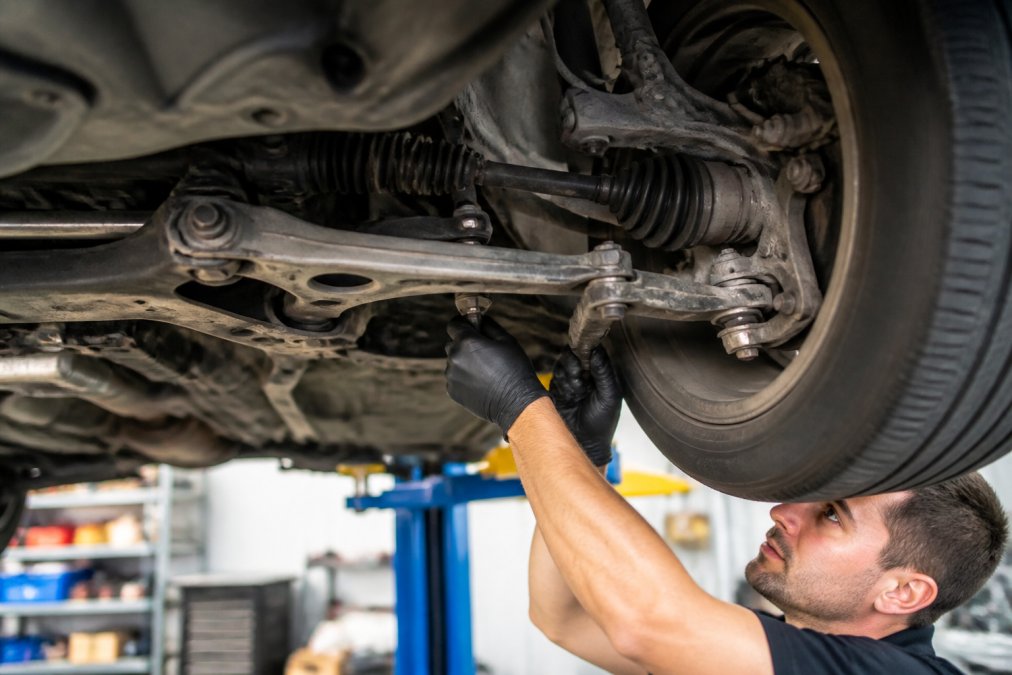
The technician lifts the vehicle and physically manipulates each suspension component to feel for play (movement where there shouldn't be any). A complete undercarriage inspection includes checking all rubber bushings for cracking or deterioration. The technician also checks the condition of the chassis itself for cracks or bending, particularly around where suspension components attach.
Driveline and torque distribution checks
This is where AWD vehicle suspension repair differs from standard suspension work. The technician must verify that the all-wheel drive system isn't compensating for suspension problems by unevenly distributing torque. A proper diagnostic includes checking suspension ride height on all four corners. On an AWD vehicle, even a quarter-inch difference between left and right sides can trigger electronic stability control interventions.
Shock and Strut Replacement Aurora: When and Why
Shock absorbers and struts fail in stages. Understanding which stage your vehicle is in determines whether you need replacement now or can wait.
Identifying dampening failure
Push down hard on each corner of your vehicle, release, and count how many times it bounces before settling. It should settle after one bounce. If it bounces three or more times, the dampening is failing. On an AWD vehicle, uneven shock failure creates asymmetrical handling that triggers the AWD system to compensate, accelerating tire wear and increasing driveline stress.
OEM vs. aftermarket parts: cost-benefit analysis
Original equipment manufacturer (OEM) shocks and struts are engineered specifically for your vehicle's suspension geometry and weight distribution. An OEM strut assembly is calibrated for that vehicle's specific AWD system and suspension geometry. For daily-use vehicles, quality aftermarket parts from established brands often represent better value. For performance-focused vehicles or those with high mileage, OEM parts justify their higher cost because they preserve the precise engineering your vehicle needs.
Suspension Diagnostics Aurora: DIY Checklist vs. Professional Service
You can safely perform several suspension checks yourself, but others require specialized equipment and training.
What you can safely check yourself
Park on a level surface and look underneath with a flashlight for obvious damage: bent components, separated rubber bushings, or fluid leaking from shocks. Perform the bounce test: push down firmly on each corner and count bounces. Inspect your tires for wear patterns and measure tread depth with a penny. Check steering play by turning the steering wheel slightly left and right while parked, the wheel should move only a small amount before the front wheels start to turn.
When professional equipment is essential
Wheel alignment requires a four-wheel alignment rack that measures suspension geometry against the vehicle's specification. Suspension height measurement requires specialized sensors or a laser measurement system. Ball joint wear assessment and strut assembly replacement require professional training and specialized tools.
| Diagnostic Task | DIY Feasible | Equipment Needed | Risk Level |
|---|---|---|---|
| Visual undercarriage inspection | Yes | Flashlight | Low |
| Bounce test (dampening check) | Yes | None | Low |
| Tire wear pattern assessment | Yes | Penny, tape measure | Low |
| Steering play check | Yes | None | Low |
| Wheel alignment measurement | No | Four-wheel alignment rack | N/A |
| Suspension height measurement | No | Laser system or specialized sensor | N/A |
| Ball joint play assessment | No | Professional training | N/A |
| Strut assembly replacement | No | Spring compressor, torque wrench | High |
Wheel Alignment Aurora CO: Critical for Suspension Health
Wheel alignment is the adjustment of suspension angles to manufacturer specification. These angles affect how tires contact the road and how the drivetrain distributes power on an AWD vehicle.
How misalignment affects AWD handling
On an AWD vehicle, misalignment affects torque distribution. If the front wheels are toed-in (pointing slightly inward), the AWD system perceives less grip than actually exists, sending more torque to the rear. If the front wheels are toed-out (pointing slightly outward), the AWD system sends too much torque forward. Both conditions compromise safety and accelerate tire wear.
Ball joints, control arms, and steering linkage
These components form the connection between the wheel and the chassis. When ball joints wear, they develop play that allows the wheel to move in directions it shouldn't, changing suspension geometry and throwing off alignment. Control arms can bend from impact or gradually wear at the bushings. Steering linkage components (tie rods, center link) can wear or bend, affecting how precisely the steering system controls wheel direction.
Common AWD Suspension Problems and Solutions
Certain suspension problems appear consistently on AWD vehicles, particularly those in Colorado's climate with its freeze-thaw cycles and rough road conditions.
AWD-specific failure modes in cold Colorado climates
Salt and sand used on Colorado roads in winter accelerate corrosion of suspension components. Ball joints and tie rod ends corrode internally, weakening them without showing obvious external rust. Freeze-thaw cycles create unique stress on suspension components as water that enters rubber bushings expands when it freezes, cracking the rubber from inside.
Bushings, torsion bars, and coil spring wear
Bushings are rubber or polyurethane components that isolate metal parts and absorb vibration. They deteriorate from UV exposure, ozone, and constant flexing. Cracked or separated bushings allow metal components to contact each other, creating noise and changing suspension geometry. Torsion bars can crack from impact or metal fatigue, creating a sudden drop in ride height. Coil springs rarely break suddenly, but they can sag as the metal gradually loses its spring properties, changing suspension geometry and affecting alignment.
Why Vehicle Safety and Handling Depend on Suspension Maintenance
The suspension system is the most critical safety system on your vehicle. It's the only component keeping your tires in contact with the road, which determines whether your brakes can stop the vehicle and whether your steering can change direction. A suspension problem that feels minor can become a critical safety issue in an emergency maneuver. Regular suspension inspection and maintenance is preventative safety work.
Professional diagnostics from Speedy Roo Motorsports include a comprehensive assessment of how your suspension components interact with your AWD drivetrain. Our technicians understand the specific demands that all-wheel drive places on suspension systems, particularly on Japanese vehicles like Subaru, Lexus, and Infiniti. We've been diagnosing and repairing AWD suspension issues across the Denver Metro area since 2002.
Your AWD vehicle's suspension keeps you connected to the road in every condition Colorado throws at it. When clunking sounds or handling changes appear, professional inspection from Speedy Roo Motorsports identifies exactly what's failing and what needs repair. We specialize in AWD vehicle suspension repair Aurora with transparent communication about what needs fixing now and what can wait. Contact us for a suspension diagnostic today, we'll show you exactly what's happening under your vehicle and recommend the most cost-effective repair path.
Frequently Asked Questions
How do I know if my AWD suspension needs repair?
Watch for clunking noises when turning or hitting bumps, excessive vibration in the steering wheel, uneven tire wear patterns, or a bouncy ride that doesn't settle. Your vehicle may also pull to one side even after wheel alignment. If you notice any of these signs, schedule a suspension inspection with a qualified technician who has experience with AWD systems. Early detection prevents more costly repairs and keeps you safe on Colorado roads.
What makes AWD suspension repair different from standard 2WD suspension work?
AWD vehicles distribute power to all four wheels, which puts different stress on the suspension system compared to 2WD cars. The driveline, torque distribution, and how the suspension handles weight transfer during acceleration and cornering are more complex. Technicians need specialized training and diagnostic equipment to properly assess AWD-specific failure modes. This is why choosing a shop experienced with your vehicle's make and model matters for accurate diagnosis and repair.
Should I use OEM or aftermarket parts for shock and strut replacement?
OEM parts match your vehicle's original specifications and suspension geometry exactly, which is especially important for AWD systems where precision affects handling and driveline performance. Aftermarket parts vary widely in quality and cost. Consider OEM if your vehicle is newer or if you prioritize long-term reliability. Aftermarket options work for older vehicles or if budget is the primary concern, but verify they meet your vehicle's performance requirements. Ask your technician for a cost-benefit comparison for your specific situation.
How often should I have my AWD suspension checked in Aurora?
Colorado's rough roads, salt, and temperature swings accelerate suspension wear. Most manufacturers recommend inspection every 12 months or 12,000 miles, whichever comes first. If you drive frequently on rough terrain, tow, or have noticed any handling changes, check sooner. Preventative maintenance catches small issues before they become expensive repairs and keeps your vehicle handling safely. Regular inspections also document the condition of bushings, ball joints, and steering linkage, which helps plan future maintenance.